Orchestrating agents and subagents
How a multi-agent system is wired: fan-out, isolated workers, fan-in and partial failure.
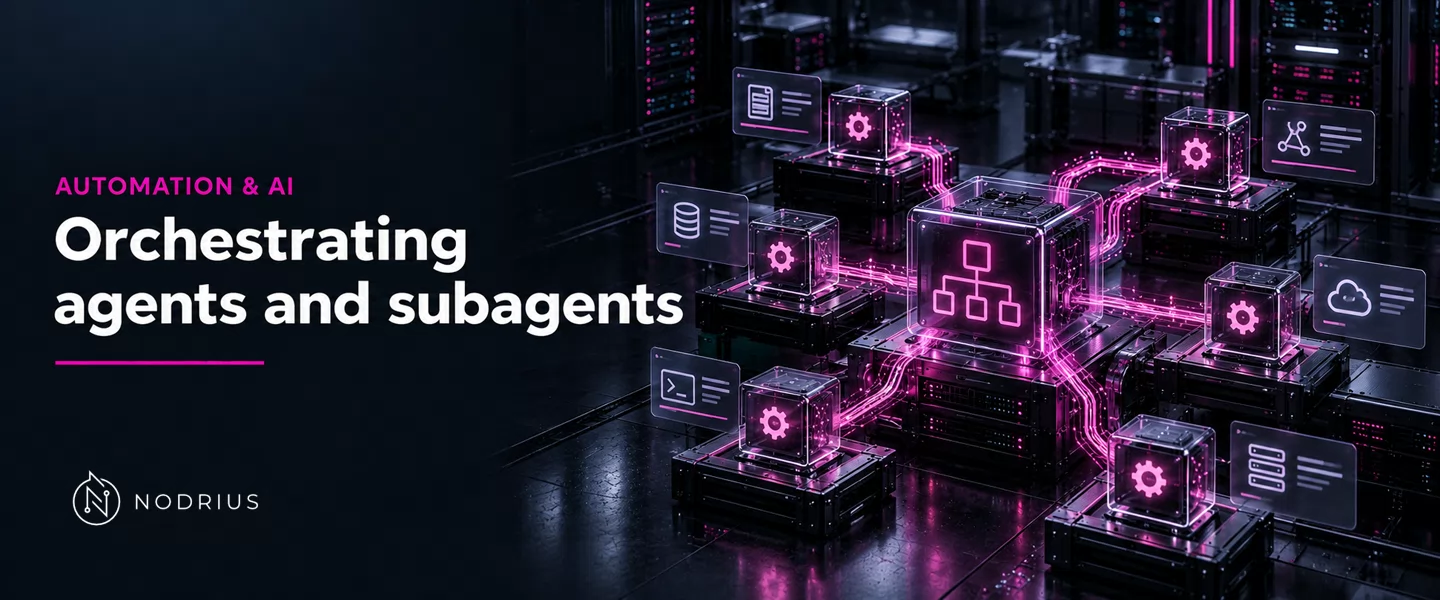
Orchestration is the system-level view of several agents: how the work fans out, what each worker runs with, how the results become one answer, and what happens when a branch fails. The OpenTelemetry GenAI conventions name the unit directly — a workflow span “Represents an operation that executes a coordinated process composed of multiple agents or other operations involving generative AI.”
The single-agent loop and delegation belong to the earlier sheets of this area; this sheet owns the graph drawn around them — the fan-out shape, each worker’s isolation, the fan-in where results merge, and how a branch fails.
Orchestration is a topology, not a bigger loop
The specification keeps the two layers apart. A workflow span “SHOULD be reported for operations that trigger the execution of composable processes (e.g., graphs, orchestrators) coordinating multiple agents or GenAI calls”, and it “SHOULD NOT be reported for standalone agent invocations”. Orchestration is a distinct layer above individual agent runs, and it can nest: a workflow that is “an internal implementation detail of another operation (e.g., an agent or tool that spins up a runner/workflow under the hood to delegate to a sub-agent)” still changes who produces the result and where.
Fan-out: dividing the work or repeating it
Anthropic names two fan-out shapes: “LLMs can sometimes work simultaneously on a task and have their outputs aggregated programmatically”, and parallelization “manifests in two key variations: Sectioning: Breaking a task into independent subtasks run in parallel. Voting: Running the same task multiple times to get diverse outputs.” Sectioning buys throughput; voting buys confidence; and “Parallelization is effective when the divided subtasks can be parallelized for speed, or when multiple perspectives or attempts are needed for higher confidence results.”
Anthropic draws both from practice: sectioning appears in a guardrail where “one model instance processes user queries while another screens them for inappropriate content or requests”, and voting in code review “where several different prompts review and flag the code if they find a problem”. Its own system fans out wider than either — “the lead agent spins up 3-5 subagents in parallel rather than serially”, the subagents running “3+ tools in parallel” — a change it reports cut research time “by up to 90% for complex queries”, that vendor’s own figure, not an independent benchmark.
Isolation: every worker is a boundary that loses information
Fan-out rests on separate state: Anthropic’s architecture “distributes work across agents with separate context windows to add more capacity for parallel reasoning”, which is why a worker can be retried or replaced without disturbing the others. The boundary is lossy: the coordinator receives a condensed result, not the material behind it. Anthropic’s remedy is to keep large outputs out of the conversation: “Direct subagent outputs can bypass the main coordinator for certain types of results, improving both fidelity and performance”, with subagents that “store their work in external systems, then pass lightweight references back to the coordinator”, because “This prevents information loss during multi-stage processing”. The coordinator’s context is the narrow waist: whatever it cannot hold, the system forgets.
Fan-in: aggregation is a design decision
Merging is a decision with failure modes of its own: results are appended, merged, counted as votes, or judged, and each option fixes what a disagreement means. The coordinator is also the single place the whole run is visible — in the OpenAI Agents SDK, “Runner emits the same event names as a single stream across the whole run. This is useful for multi-agent workflows where you want one place to observe handoffs and tool calls” — and the single place a bad division of labour surfaces: Anthropic records “one subagent explored the 2021 automotive chip crisis while 2 others duplicated work investigating current 2025 supply chains, without an effective division of labor”, a fan-in that received two overlapping results and one gap. Fan-in is also synchronous in most systems, which Anthropic says “simplifies coordination, but creates bottlenecks in the information flow between agents”.
Partial failure: when one branch dies
Failures are not independent. Anthropic is blunt — “Agents are stateful and errors compound” — and its response is to make a branch recoverable rather than restartable: “we built systems that can resume from where the agent was when the errors occurred”, pairing “the adaptability of AI agents” with “deterministic safeguards like retry logic and regular checkpoints”. Orchestration must decide what a missing branch means — retry it, degrade the answer, or fail the run — and that belongs to the topology, not the worker. Evaluation follows suit: “Even with identical starting points, agents might take completely different valid paths to reach their goal”, so the system is judged on outcomes and interaction (“Success requires understanding interaction patterns, not just individual agent behavior”), with the checkpoint as the practical unit — “For complex workflows, break evaluation into discrete checkpoints where specific state changes should have occurred”.
Level and prerequisites. L5 — systems-engineering level: the reader knows the single-agent loop and delegation and must now reason about a graph of agents as one system — its topology, isolation boundaries, aggregation and partial failure. Prerequisites: the L4 sheets of this area, the action loop and stopping conditions and subagents and delegation, plus the L3 sheets on context construction and tool calling.
Where to go next
- Automation & AI — the macro-area this sheet belongs to.
- Applications — the node this sheet sits in.
References
- OpenTelemetry — Semantic Conventions for GenAI agent and framework spans (specification draft) — the definition of a workflow span and its separation from a standalone agent invocation.
- Anthropic — How we built our multi-agent research system — separate context windows, the artifact handoff that bypasses the coordinator, the duplicated-work fan-in failure, the synchronous bottleneck, the parallel fan-out, and compounding errors with resume.
- Anthropic — Building effective agents — the parallelization workflow, sectioning versus voting, and the case for each.
- OpenAI — Agents SDK (JavaScript) — the run-level event stream as the single observation point across a multi-agent run.