Complex multi-component AI architectures
What a component boundary buys, where state lives, and why such systems fail as one.
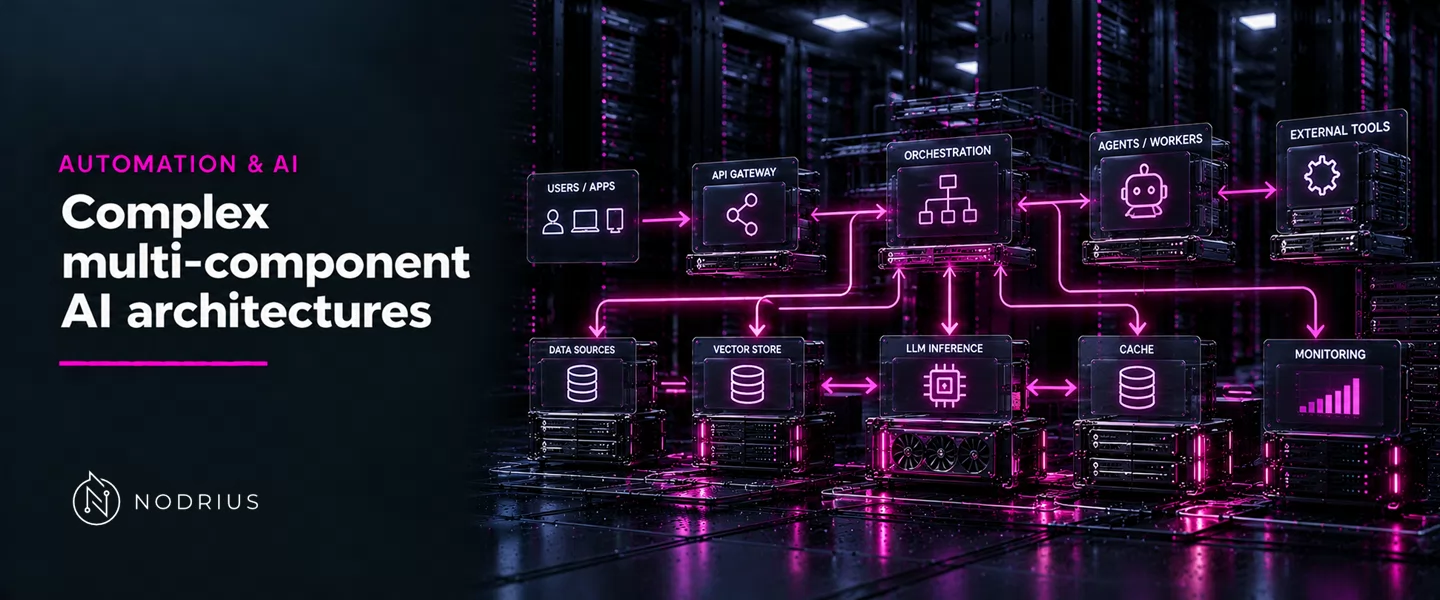
A multi-component AI system is not one model with more tools bolted on; it is several parts with boundaries between them. Anthropic’s definition is blunt: “A multi-agent system consists of multiple agents (LLMs autonomously using tools in a loop) working together.” The Model Context Protocol (MCP) draws the line as a boundary: it “follows a client-host-server architecture where each host can run multiple client instances.”
This closing sheet asks the system-level question the component sheets do not: what a boundary buys, where state lives, what must be versioned together, and why parts fail differently from a monolith.
What a component boundary buys
A boundary is not decoration. Anthropic notes that each subagent “provides separation of concerns—distinct tools, prompts, and exploration trajectories—which reduces path dependency.” The protocol agrees in its own terms: “Each server connection maintains isolation,” and “Servers should not be able to read the whole conversation, nor “see into” other servers.”
Interpretation: a boundary earns its place only if it isolates something you can name — a context window, a set of tools, a permission scope, a failure domain. The cost is real, and the same report measures it: “multi-agent systems use about 15× more tokens than chats,” and “some domains that require all agents to share the same context or involve many dependencies between agents are not a good fit for multi-agent systems today.” The price buys independent contexts and a contained blast radius.
Where the state lives
In a monolith, state sits wherever the process keeps it; here, where state lives is a decision. The protocol fixes it deliberately: “Full conversation history stays with the host” and “Cross-server interactions are controlled by the host.” Anthropic adds the operational half — agents “are stateful and errors compound,” and because “restarts are expensive and frustrating for users” the system must “resume from where the agent was when the errors occurred.” Its answer to state that would otherwise be copied through the conversation is for subagents to store their work externally and “pass lightweight references back to the coordinator.” The question is always which component owns this state and what crosses the boundary when it changes; assembling that context is the context-management sheet, and what may be cached across a turn is the caching sheet.
What must be versioned together
A prompt, its tool definitions, and the code that routes between them are one deployable object even when they live in separate files. Anthropic describes “Agent systems [that] are highly stateful webs of prompts, tools, and execution logic that run almost continuously,” so “whenever we deploy updates, agents might be anywhere in their process.” The mitigation is to “use rainbow deployments to avoid disrupting running agents, by gradually shifting traffic from old to new versions while keeping both running simultaneously” — possible only if the new version is identifiable as a unit. The GenAI semantic conventions treat a workflow name as “a static, application-unique identifier” (for example multi_agent_rag). If a prompt, a tool schema and a routing rule can drift apart without anything crashing, they were never versioned as one component; catching that drift by replaying a recorded run is the trajectory-replay sheet’s subject.
Why it fails differently from a monolith
Microsoft’s AI Red Team reports it “identified several new safety and security failure modes unique to agentic AI systems, especially multi-agent systems,” including “failures that occur in the communication flow between agents within a multi-agent system.” Familiar failures gain weight too: bias and hallucination “gain in importance in agentic AI systems due to their increased risk.”
Two properties make propagation the defining risk. Provenance survives only if someone carries it — data “is passed between multiple agents or components before being output, potentially leading to the loss of provenance for that data.” And errors compound rather than localise: “One step failing can cause agents to explore entirely different trajectories, leading to unpredictable outcomes,” in a system that is “non-deterministic between runs, even with identical prompts.” A monolith that hits an error stops; a multi-component one can keep running down a path nobody intended.
How the pieces are held together
Everything above points to one discipline: boundaries that isolate something nameable, a stated home for each piece of state, a version unit that moves as one, and a trace that spans components. The GenAI semantic conventions name that last piece: an operation that “executes a coordinated process composed of multiple agents” is reported as a distinct workflow span. The controls inside these boundaries — routing, cache lifetimes, context assembly, concurrency, policy enforcement, credential scope, tracing, replay, degradation — are each a sheet of this level, because a multi-component system is where none of them is optional.
Level and prerequisites. L5 — advanced systems engineering: the sheet where the level’s controls are read as one system, and the decisions are architectural (where a boundary sits, what it owns, what ships together) rather than procedural. Prerequisites: the L1–L2 sheets of this area (how a model generates text; serving, context and structured output), the L3 sheets on retrieval and tool calling, and the L4 sheets on the agent loop with its permissions and injection risks.
Where to go next
- Automation & AI — the macro-area this sheet belongs to.
- Applications — the node this sheet sits in.
References
- Anthropic — How we built our multi-agent research system — the definition of a multi-agent system, what a subagent boundary isolates, the token cost, compounding state, and coordinated deployment.
- Model Context Protocol (Anthropic) — Architecture — the client-host-server boundary, where conversation state lives, and server isolation.
- OpenTelemetry — Semantic Conventions for GenAI agent and framework spans — the workflow span for a coordinated multi-component process; a specification draft under Development.
- Microsoft AI Red Team — Taxonomy of Failure Mode in Agentic AI Systems — failure modes unique to multi-agent systems and provenance lost across components.