Subagents and delegation: splitting work across agents
Delegation buys parallel context windows, and bills you in tokens and coordination.
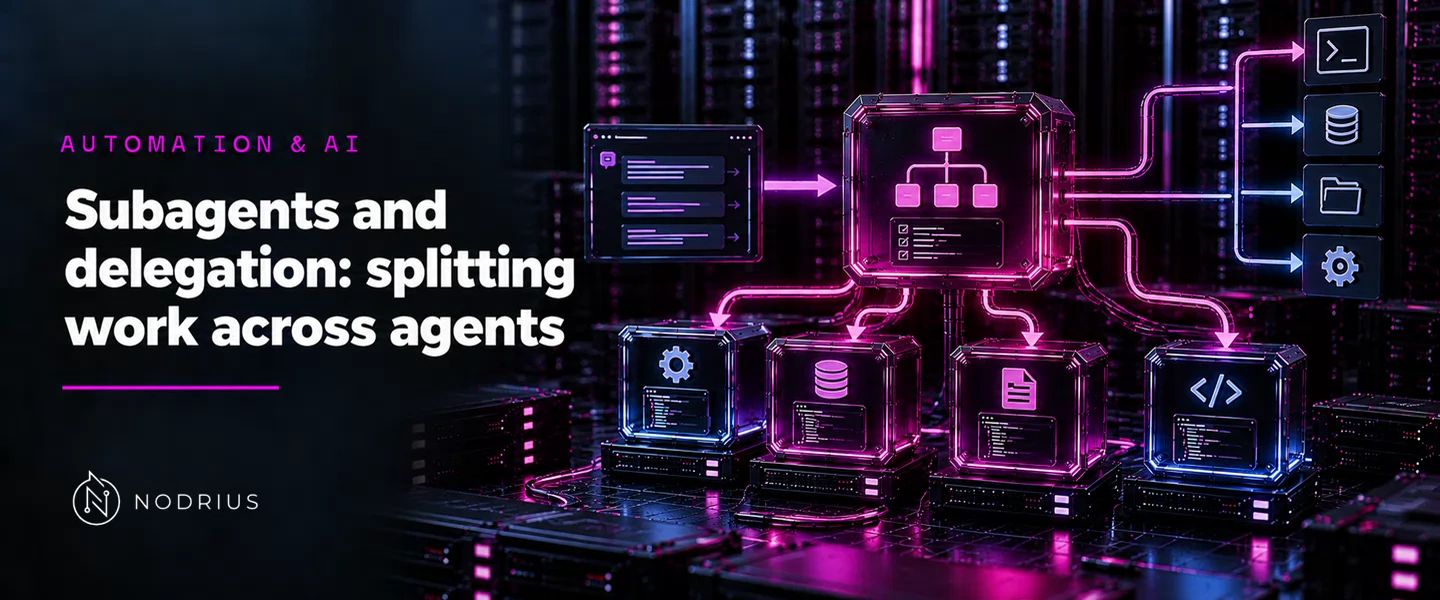
A single agent has one context window, and every turn spends it. When a task is broad — several independent questions, many sources, a search space nobody can map in advance — the ceiling is the room the model has to reason in. Delegation raises it by adding agents: “A multi-agent system consists of multiple agents (LLMs autonomously using tools in a loop) working together”, in Anthropic’s account of its Research feature, and the usual shape is the orchestrator-worker pattern, “where a lead agent coordinates the process while delegating to specialized subagents that operate in parallel”.
Everything the design buys, and everything it costs, follows from one mechanism: a subagent brings its own context window and returns a result it has already condensed.
What the orchestrator actually does
Anthropic’s building-blocks post names the pattern directly: “In the orchestrator-workers workflow, a central LLM dynamically breaks down tasks, delegates them to worker LLMs, and synthesizes their results.” The load-bearing word is dynamically: parallelization runs subtasks that were fixed in advance, whereas the orchestrator-workers pattern differs because “the key difference from parallelization is its flexibility—subtasks aren’t pre-defined, but determined by the orchestrator based on the specific input.” A lead agent is therefore given a goal and the authority to decide, at run time, how many helpers it needs and what each should do.
A second context window is the point
The benefit is not that more agents think harder; it is that they think somewhere else. Subagents “facilitate compression by operating in parallel with their own context windows, exploring different aspects of the question simultaneously before condensing the most important tokens for the lead research agent.” Each one also contributes “separation of concerns—distinct tools, prompts, and exploration trajectories—which reduces path dependency and enables thorough, independent investigations.” The lead never holds the raw material; it holds a condensed answer from each worker. It is why the pattern suits breadth-first questions, and why Anthropic reports that on its internal research evaluation a lead-and-subagents configuration “outperformed single-agent Claude Opus 4 by 90.2%” — that vendor’s own figure, not an independent benchmark.
Two ways to hand work over
The two composition patterns are easy to confuse. In a manager design the specialists are tools and the coordinator keeps the conversation: “the manager never hands over control—the LLM uses the tools and the manager summarizes the final answer.” In a handoff, by contrast, “the initial agent delegates the entire conversation to a specialist”, and control genuinely passes: once the handoff fires, “the specialist agent owns the conversation until it produces a final output.” The trade-off is stated plainly — “Managers give you a single place to enforce guardrails or rate limits, while handoffs let each agent focus on a single task without retaining control of the conversation.” Mechanically they are close: a handoff is a specialist offered to the model as a tool, described by the text used “when this agent is offered as a handoff tool.”
Delegation is a prompt, not a setting
A lead agent delegates only as well as it is taught to. Anthropic’s rule is that “Each subagent needs an objective, an output format, guidance on the tools and sources to use, and clear task boundaries”; below that level of detail, “agents duplicate work, leave gaps, or fail to find necessary information.” Effort has to be budgeted too, because agents misjudge scale — “Simple fact-finding requires just 1 agent with 3-10 tool calls, direct comparisons might need 2-4 subagents with 10-15 calls each, and complex research might use more than 10 subagents with clearly divided responsibilities.” The framing that lasts is that a delegating prompt is one of the “frameworks for collaboration that define the division of labor, problem-solving approaches, and effort budgets.”
What it costs, and where it breaks
Delegation multiplies tokens: “agents typically use about 4× more tokens than chat interactions, and multi-agent systems use about 15× more tokens than chats.” Some shapes are wrong for it: domains “that require all agents to share the same context or involve many dependencies between agents are not a good fit”, which is why most coding work parallelises less cleanly than research. Three failure modes are structural. Execution is often synchronous, and then “the lead agent can’t steer subagents, subagents can’t coordinate, and the entire system can be blocked while waiting for a single subagent to finish searching.” Routing every result back through the coordinator loses fidelity — the “game of telephone” — so large outputs are better written to storage and handed back as references. And the system is emergent: “small changes to the lead agent can unpredictably change how subagents behave”, so it must be evaluated on outcomes and interaction patterns, not on a fixed script.
Level and prerequisites. L4 — the design level of this area: the reader must decide whether a task should be split across agents at all, and be able to name what a subagent buys, how control passes, and what the split costs. Prerequisites: the L3 sheets on context construction and citations, and on tool and function calling — a subagent is reached by the same mechanism as any other action.
Where to go next
- Automation & AI — the macro-area this sheet belongs to.
- Applications — the node this sheet sits in.
References
- Anthropic — How we built our multi-agent research system — the definition of a multi-agent system, the orchestrator-worker pattern, subagent context windows and separation of concerns, the internal research evaluation, the token multiplier, the delegation rules and effort budgets, and the synchronous and filesystem caveats.
- Anthropic — Building effective agents — the orchestrator-workers workflow and how it differs from parallelization.
- OpenAI — Agents SDK (JavaScript), Agents guide — the manager and handoff composition patterns, when each is chosen, and the handoff-as-tool mechanism.