Unicast, broadcast and multicast: one host, one group, or a whole segment
How unicast, broadcast and multicast address traffic, why IPv6 dropped broadcast, and why the size of a broadcast domain is an operational problem.
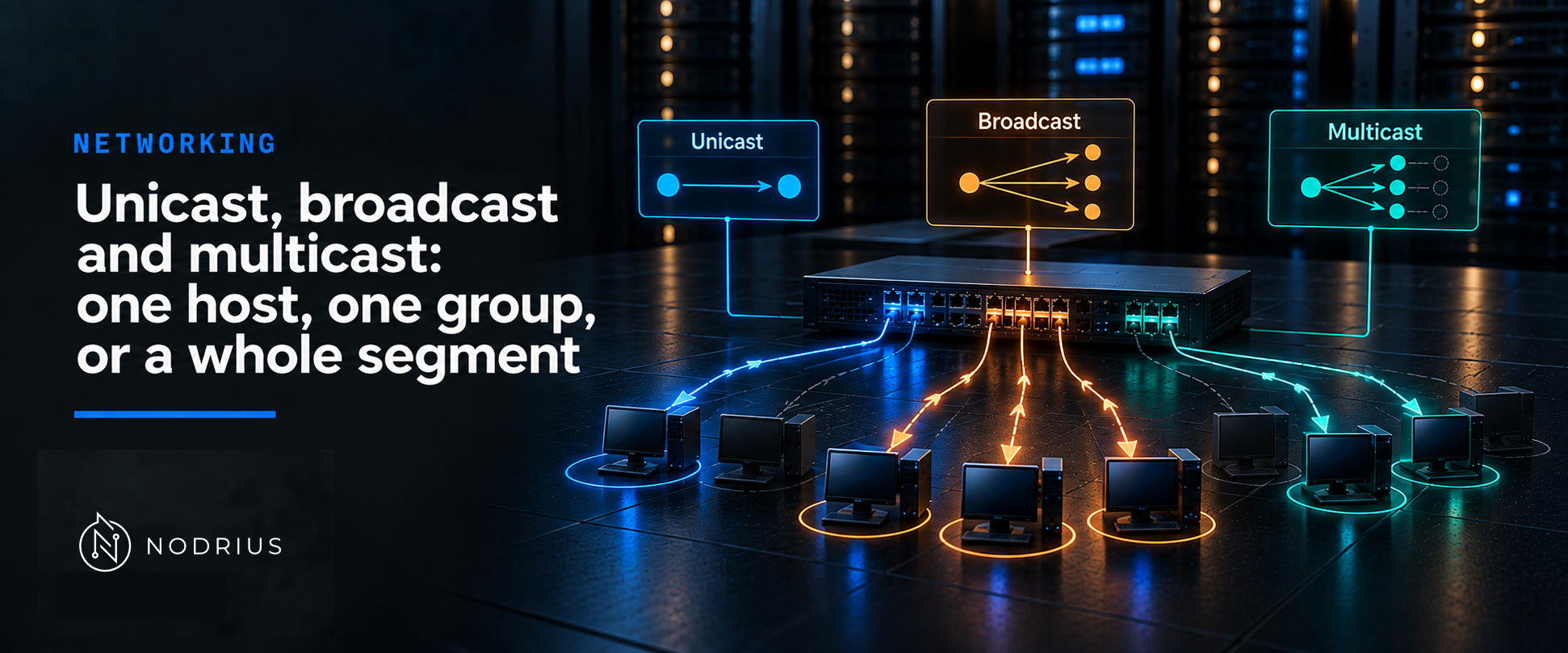
IPv4 has three ways to address a packet, and they differ in a single question: how many interfaces must receive it. Unicast names one interface, broadcast names every interface on the local segment, and multicast names a group whose membership is managed. IPv6 keeps unicast and multicast and removes broadcast. The set of interfaces a broadcast can reach — the broadcast domain — is what turns these definitions into an operational limit.
The model: how many interfaces must receive this packet?
one packet — how many interfaces must receive it?

   exactly one ....................... unicast    one named interface
   every interface on the segment .... broadcast  IPv4 only; no opt-out
        └─ that segment is the broadcast domain — a router ends it
   the interfaces that joined a group  multicast  opt-in; membership managed
Read the rest of the sheet through this one question: the three models are three answers to one problem, not three unrelated mechanisms. IPv6 answers all three with unicast or multicast — where IPv4 broadcasts, IPv6 names a known multicast group instead.
Terms. Unicast: an address for one interface. Broadcast: an address for every interface on the local segment. Multicast: an address for a group of interfaces. Broadcast domain: the set of interfaces a broadcast reaches — a Layer 2 segment bounded by a router. Membership: the signalling with which a host joins or leaves a multicast group.
The three delivery models
| Model | IPv4 destination | Reaches | Membership |
|---|---|---|---|
| Unicast | one host address | exactly one interface | fixed by the address |
| Broadcast | 255.255.255.255, or the all-ones host part | every interface on the segment | none; a host cannot opt out |
| Multicast | 224.0.0.0/4 (IPv4), ff00::/8 (IPv6) |
only the interfaces that joined the group | dynamic (IGMP or MLD) |
RFC 4291 defines unicast as an identifier for a single interface and multicast as an identifier for a set of interfaces. Anycast is a third, unicast-derived form: one address on several interfaces, delivered to the nearest by the routing protocol’s metric.
Unicast
Unicast is the default: a source and a destination address, each naming one interface. A router forwards on the destination prefix and nothing else. The other models only change which interfaces may accept that one destination.
Broadcast exists only in IPv4
An IPv4 broadcast destination has an all-ones host part, and RFC 922 sets out two cases. 255.255.255.255 is a limited broadcast: confined to the local hardware network, it “must not be forwarded”. A directed broadcast uses the all-ones host part of one specific network — RFC 922’s own example is 36.255.255.255 for net 36 — and reaches every host on that network even when the sender does not know how the address splits into subnet and host fields. RFC 919 and RFC 922 make the design caution explicit: a broadcast “imposes a cost on every host that hears it”, so it “should not be used indiscriminately”.
IPv6 has no broadcast
RFC 4291 is unambiguous: “There are no broadcast addresses in IPv6, their function being superseded by multicast addresses.” Where IPv4 would broadcast, IPv6 names a group instead. The two groups every node must recognise are the all-nodes address ff02::1 and, for routers, the all-routers address ff02::2 (RFC 4291 §2.7.1). A link-local solicited-node address is joined automatically for each configured unicast or anycast address, which is how IPv6 answers address resolution without a broadcast. Because an IPv6 multicast address carries a scope field, a packet sent to a link-local group never leaves the link.
Multicast is a managed group
A multicast address is not a broadcast with a smaller audience. It is a group, and a host becomes a member by signalling interest: IPv4 uses IGMP, IPv6 uses Multicast Listener Discovery (MLD). A router builds membership state from those messages and uses it to decide whether any listener exists on a segment before forwarding a stream (RFC 3376 for IPv4 group membership, RFC 3810 for IPv6).
The broadcast domain
A broadcast domain is the set of interfaces that receive a broadcast sent by one host — a Layer 2 segment bounded by a router. A bridged network forms a single IP subnet (RFC 1812 §2.2.3), so every host on it shares the domain. Size matters for the reason the RFCs already give: a broadcast costs every host that hears it. A large flat domain means every address-resolution request, every DHCP discovery and every stray broadcast interrupts every host, and a broadcast storm has nowhere to stop. Three levers limit it.
- VLANs. A VLAN is a switched network segmented logically; unicast, broadcast and multicast traffic is “forwarded and flooded only to end stations in the VLAN”, and traffic between VLANs must be routed (Cisco, Configuring VLAN).
- A router or Layer 3 boundary. A limited broadcast is not forwarded, so a router ends the domain by definition.
- Smaller IPv6 subnets. IPv6 keeps the same /64 subnet boundary and, having no broadcast, confines the equivalent traffic to a multicast group rather than to every host on the link.
The common mistake
The frequent error is to treat broadcast and multicast as the same thing because both reach more than one host. They do not behave alike: broadcast has no membership and no opt-out — every host must process it — while multicast reaches only joined members, and only while the membership signalling works along the path.
Level and prerequisites. L1 — fundamentals. Prerequisites: what an IP address and a subnet are, and a rough sense of what a router does. No configuration experience is required.
Where to go next
- Networking — the area this sheet belongs to.
References
- RFC 4291 — IP Version 6 Addressing Architecture (unicast, multicast and anycast definitions; no broadcast in IPv6;
ff02::1andff02::2). - RFC 919 and RFC 922 — broadcasting Internet datagrams; limited and directed broadcast.
- RFC 1812 — Requirements for IP Version 4 Routers (bridged segments and a single subnet).
- RFC 3376 — IGMPv3 (IPv4 group membership); RFC 3810 — MLDv2 (IPv6 group membership). The older RFC 2236 and RFC 2710 were replaced by these during the batch technical review: the body cited versions that had been obsoleted.
- Cisco — Configuring VLAN (VLANs as logical networks and broadcast scope).