
Capacity, cost and lifecycle management
Sizing with money attached: allocation, lifecycle, and the cost of the reserve.
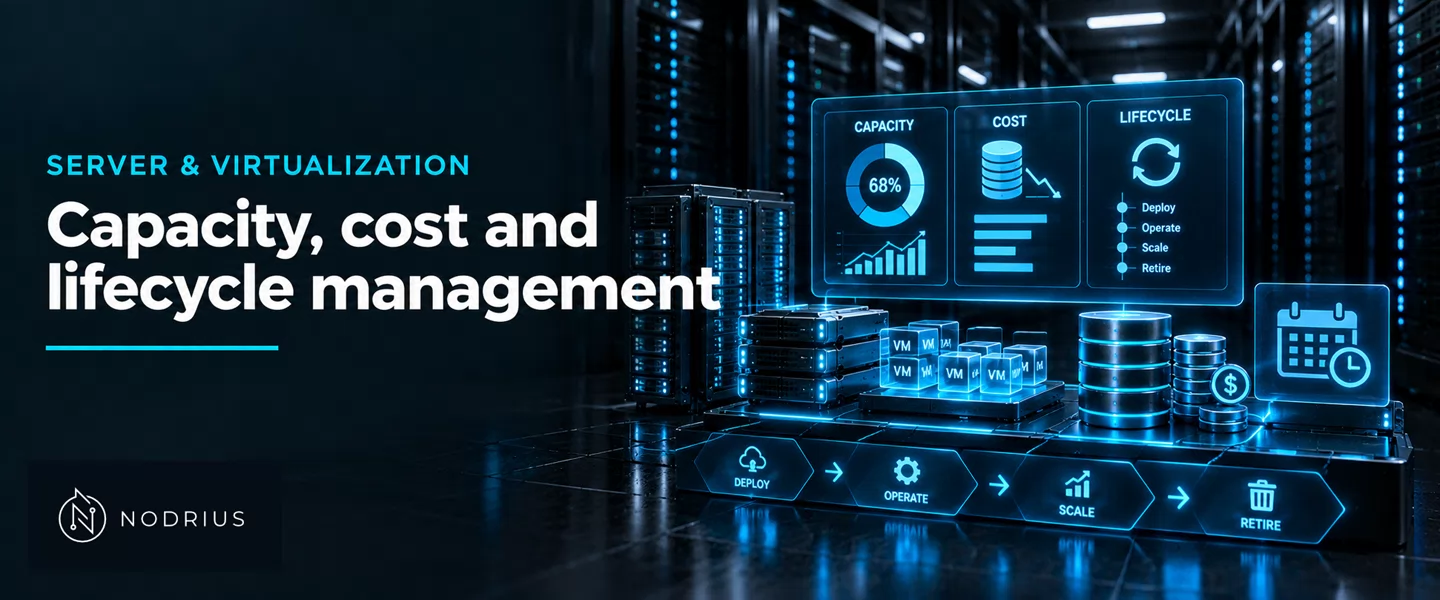
A cluster’s bill is not one number but a set of lines, and the lines that cannot be attributed to a consumer are the ones nobody can cut. Capacity management reads the figures the L4 sheet measures; this sheet reads them with money attached, and with a clock attached: who owns each line, and for how long?
        the same capacity, read three ways

   what it is        what it costs            who can cut it
   ------------      -----------------        ----------------------
   consumed          attributed per scope     the consuming owner
   idle              billed, unattributed     rightsizing / scheduling
   reserve (n+1)     billed, unattributed     policy only, never usage
   shared platform   one undivided line       nobody, until it is split

   the loop    inform (attribute) --> optimize (attribute) --> operate (keep)
   the clock   commit term ---- renew? ---- upgrade ---- end of support
The cycle under the bill: inform, optimize, operate
FinOps treats technology spend as a practice, not an invoice: it “is an operational framework and cultural practice which maximizes the business value of technology”. Its journey has three phases — “The FinOps journey consists of Inform, Optimize and Operate.” — and they are one loop. Inform is attribution: who consumed what. Optimize changes the size, the rate or the placement of that consumption. Operate holds the result and restarts the loop. Two principles carry the sheet: “Everyone takes ownership for their technology usage”, and its data “should be accessible, timely, and accurate”. A report to someone who cannot change the spend is inform without optimize; measuring and draining stay with the L4 sheet.
Allocation is a metadata problem before it is a discount
No rate can be improved before the line it changes belongs to someone. The framework is explicit that a scope is a defined segment “aligned to business constructs” — a product, a cost center, an environment. That mapping is metadata: a tag, an account, a folder, a budget code decided when the resource is created, and only a scope that already existed on the resource lets the consumption figure flow to a consumer. What no scope claims does not vanish from the bill; it pools into one line the platform can no longer split. Allocation is a metadata problem before it is a price problem: a discount on an undivided line lowers a number no one owns.
The three classic levers: rightsize, commit, scale
The cloud cost pillar names the levers. The first is size: “Rightsize to find the optimal instance family and size for your compute workloads.” The second is commitment, for predictable usage: “Enjoy up to 72% discounts when committing to Savings Plans or Reserved Instances for predictable usage.” That rate is bought with a term and a risk, and work that tolerates interruption pays less still: “Run fault-tolerant workloads with Amazon EC2 Spot Instances and gain up to 90% discounts.” The third is elasticity: “Elastic resource provisioning for variable demand” pays only while the resource runs. Only an attributed line can be matched to the lever that fits it.
The reserve is a cost line, not a virtue
The L4 sheet sized the reserve as a technical requirement: enough spare capacity that losing any one host still fits its guests. Read with money attached, the same reserve is an expense: capacity paid for, deliberately unused, earning nothing until the day a host leaves. It is a recurring line, not free insurance. To whoever reads the bill it reads as waste; to whoever operates the cluster, as the price of surviving a failure on a Tuesday. So the reserve needs a named owner, because an unowned line is the first an annual cut targets, and its size is a decision renewed each cycle rather than a constant.
Memory: a resource that contracts and expands
The clearest lever that is also a lifecycle figure is memory. A guest is promised a startup size, but the steady state is usually smaller, and the platform can reclaim the difference: Dynamic Memory “introduces a minimum memory setting (minimum RAM), which is the minimum amount allocated after startup and allows Hyper-V to reclaim the unused memory from the virtual machines.” The gap must be bridged when a guest restarts, and the platform does so with disk — “Smart Paging bridges the memory gap between minimum memory and startup memory” — which “can degrade virtual machine performance because disk access speeds are much slower than memory access speeds.” The reclaim is best-effort: “The buffer isn’t maintained when there’s not enough physical memory available”. A memory line can shrink and grow while the machine runs, so sizing on the peak buys idle capacity.
The lifecycle clock and the homogeneous cluster
Support and upgrades carry their own clock, and it runs on the fleet at once. A host must be current to be safe: known vulnerabilities “can only show up if the” host is not past “end of life , and has at least been rebooted since the” last kernel update. A major upgrade is a fleet event: “Major system upgrades are announced in the Proxmox VE” forum, and in a hyper-converged cluster the layers move together, since “each Proxmox VE major release requires a corresponding minimum Ceph major” release. The Windows answer is Cluster-Aware Updating, “an automated feature that enables you to update servers in a failover cluster with little or no loss in availability during the update process”, schedulable — “CAU can schedule Updating Runs on regular daily, weekly, or monthly intervals”. Packages are a cost line too: “All users with a subscription get access to the Proxmox VE” enterprise repository, while a host without one must “Upload your subscription key to gain access to the Enterprise repository.” Hardware ages on the same clock; the renewal window and the update window are the same conversation.
Isolation is bought, and what stays undivided
A boundary is a purchase. Splitting a workload across “Availability Zones (AZ), Regions, control planes, and data” planes buys “the predictable scope of impact containment they provide” — a failure stops at a line you drew — but each boundary is duplicated capacity and coordination that must be paid for. Not every boundary earns its price; the guidance is to use them so as to “take dependencies on global services while minimizing single points of failure”, because a global dependency re-couples what the boundary separated. Cost work begins where attribution begins: spend measured per consumer can be owned, matched to a lever, and defended, while spend not measured per consumer becomes one undivided line — the shared floor, the reserve no one booked, the idle capacity no one reports. And an undivided line is one nobody knows how to cut, because there is no consumer to ask. You optimize what you can attribute; what you cannot attribute you can only regret.
Level and prerequisites
L5 — reading an existing environment as a budget: attributing spend to a consumer through metadata, choosing among rightsizing, commitment and elasticity, treating the n+1 reserve as a recurring line, and tracking a support and upgrade clock across the fleet. It sits above the L4 capacity sheet, whose headroom it assumes, and below platform design. Nothing here is financial advice.
Where to go next
- Server & Virtualization — the area this sheet belongs to.
- The L4 sheet it assumes: capacity planning and host maintenance, where the reserve is a fact before it is a cost.
- The neighbouring sheets: multi-host infrastructure and performance analysis and bottlenecks.
References
- FinOps Foundation — FinOps Framework Overview.
- Amazon Web Services — Cost Optimization with AWS (Cloud Financial Management).
- Amazon Web Services — AWS Fault Isolation Boundaries.
- Proxmox — Proxmox VE Administration Guide.
- Microsoft Learn — Cluster-Aware Updating overview.
- Microsoft Learn — Dynamic Memory for Hyper-V Virtual Machines.