
Management plane isolation
Why the management plane is the highest-value target, and how to keep it apart.
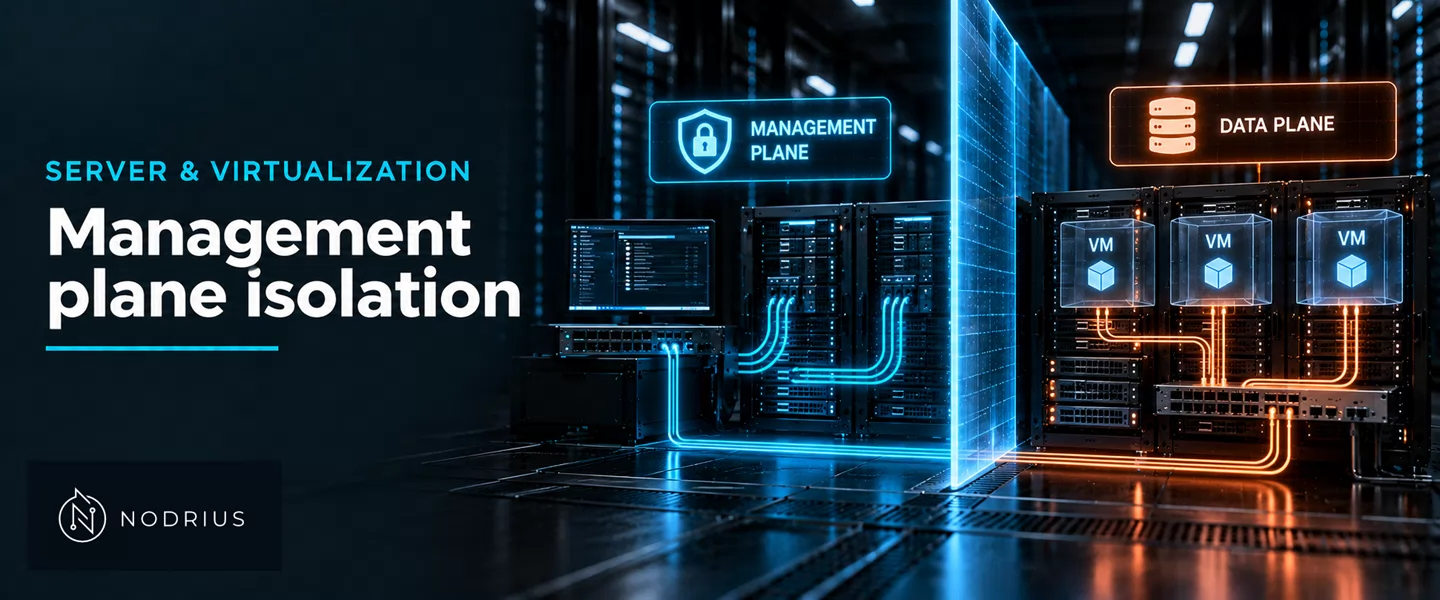
A virtualized platform is two machines in one: the workloads it runs, and the machinery that decides what runs where. Fuse them and a single compromise reaches the console that can create or destroy every other machine on the host. That machinery — the administrative interfaces, the hypervisor’s management endpoint, the orchestration layer and the configuration store — is the management plane. Its isolation from the service plane, where workloads and their traffic live, is this sheet’s subject.
        MANAGEMENT PLANE  (the path of control)

    operator --(indirect access)--> jump host --> firewall
                                                     |
        -------------------------------------------------
        |     dedicated management network / VLAN        |
        -------------------------------------------------
              |                 |                 |
        [ hypervisor       [ orchestration     [ cluster
          mgmt iface ]        / API ]            config store ]
   =============== boundary: no service traffic ===============
              |                 |                 |
        [ guest VM ]       [ guest VM ]      [ storage / migration ]

      SERVICE PLANE  (the path of service: workloads, data, tenants)

    compromise above the line = control of everything below it
What the management plane is, and why it is the target
The plane is a path, not one box. It runs from an operator’s session to the endpoints with the strongest privileges: the hypervisor’s management interface, the web or API front end of the virtualization manager, and the replicated store holding the cluster’s configuration. Its value is its reach. NIST states the reason plainly: “The security of the entire virtual infrastructure relies on the security of the virtualization management system that controls the hypervisor”, and concludes that “access to the virtualization management system should be restricted to authorized administrators only”. The hypervisor carries the same weight, because “Because of the hypervisor’s level of access to and control over the guest OSs, limiting access to the hypervisor is critical to the security of the entire system”. Compromise the service plane and you own one workload; compromise the management plane and you own the tenancy model.
The governance: NIST on virtualization and on the virtual network
Two NIST publications govern the plane. SP 800-125 opens with a warning — “It is important to secure each hypervisor management interface, both locally and remotely accessible” — and answers with an architectural rule: “One option is to have a dedicated management network that is separate from all other networks and that can only be accessed by authorized administrators”. Its recommendation list is blunt: “Restrict administrative access to the management interfaces of the hypervisor” and “Protect all management communication channels using a dedicated management network”. SP 800-125b sorts the traffic inside a virtualized host into three classes — “Management traffic (commands for hypervisor administration)”, infrastructure traffic such as migration, and inter-VM traffic — and keeps the first apart, with a “Management VLAN for carrying only management traffic”. The separation is physical, not only logical: “Isolation of the hypervisor’s management network using virtual switches needs special configuration”, because “the management traffic pathway should have separate pNICs and separate physical network connections”.
The controls, by ID
SP 800-53 revision 5 gives the separation its control identifiers. SC-2 requires the operator to “Separate user functionality, including user interface services, from system management functionality”; its discussion names the means, “isolating administrative interfaces on different domains and with additional access controls”. SC-3 states the rule in one line: “Isolate security functions from nonsecurity functions”. SC-7, boundary protection, turns the idea inward — “Monitor and control communications at the external managed interfaces to the system and at key internal managed interfaces within the system” — so the plane boundary may be an internal one. At the access layer, AC-3 enforces authorizations, AC-4 controls the flow of information, AC-6 applies least privilege, and AC-17 authorizes each remote path. Together: the console is a system function, the workload users are not, and the two meet only at a controlled interface.
The mechanisms: a network, an indirection, distinct credentials, an unexposed interface
The rules become concrete in a product. On Proxmox VE, “We recommend a dedicated physical NIC for the cluster traffic”, and the default is the very mistake this sheet warns about: “the corosync cluster network is generally shared with the web interface and the VMs’ network”. Migration gets its own network too, so that “sensitive cluster traffic can be disrupted” is avoided by construction. The management interface stays off the service plane: the web interface answers on HTTPS port 8006, and the daemon behind it “runs as user www-data and has very limited permissions”. Access is indirect — a session “connects to a terminal proxy on node A, which is in turn connected to the login shell on node B via a non-interactive SSH tunnel” — the jump-host pattern, where the operator never reaches the plane directly. The firewall closes the remainder: “If you want to administrate your Proxmox VE hosts from remote, you need to create rules to allow traffic from those remote IPs to the web GUI (port 8006)”, and “The Proxmox VE firewall groups the network into multiple logical zones”. Credentials stay distinct from workload identity: logins use an authentication realm, automation uses tokens, and “API tokens allow stateless access to most parts of the REST API from another system, software, or API client” under their own scope and expiry.
The failure that explains why it matters
A partition shows why the separation is not cosmetic. Microsoft’s guidance on quorum witnesses requires that a witness be placed away from the thing it arbitrates — “The file share should be physically separate from the cluster nodes or cluster sites” — because “This separation increases the chances of cluster nodes or sites remain operational if network communication between them is disrupted”. The same guidance warns that a replicated file system “can cause a partition-in-space or partition-in-time”. When communication between hosts is severed, the cluster still decides who may keep acting, over its own control path. If that path shares the network that has just failed, the outage and the loss of the ability to manage it arrive together.
The two ways the management plane fails
The first failure is fusion. The common default — “the corosync cluster network is generally shared with the web interface and the VMs’ network” — puts the control path on the same wire as the workloads, so a traffic spike or a compromise in the service plane reaches the plane that governs everything; on a busy host “sensitive cluster traffic can be disrupted”, never confined to one tenant. The second failure is the opposite mistake: a plane isolated beyond reach. Guarding it with a default-deny firewall is correct, but the product has to warn, “Please open a SSH connection to one of your Proxmox VE hosts before enabling the firewall”, because the rule that protects the plane can also lock the operator out of it. Isolation with no documented path back in turns the strongest control into a self-inflicted outage: the plane must be reachable exactly when the rest of the platform is not.
Level and prerequisites
L5 — the separation of the control path from the service path, and the mechanisms that implement it. It assumes the L3 and L4 sheets on hosts, virtual machines and clusters. Hardening a single host belongs to the L2 baseline sheet; the risk-management and governance framing belongs to the Cybersecurity Governance area.
Where to go next
- Knowledge — the index.
- Server and virtualization — the area.
- Virtualization and networking — this sheet’s node.
- Companion sheets, still in draft: the L2 baseline sheet on hardening a single host, and the L4 sheets on clusters and quorum.
References
- NIST — SP 800-125, Guide to Security for Full Virtualization Technologies — https://csrc.nist.gov/pubs/sp/800/125/final — the security of the virtualization management system, the restriction of administrative access, and the dedicated management network.
- NIST — SP 800-125B, Secure Virtual Network Configuration for Virtual Machine (VM) Protection — https://csrc.nist.gov/pubs/sp/800/125/b/final — the three classes of virtual-network traffic, the management VLAN, and the isolation of the hypervisor’s management network.
- NIST — SP 800-53 Rev. 5, Security and Privacy Controls for Information Systems and Organizations — https://doi.org/10.6028/NIST.SP.800-53r5 — controls SC-2, SC-3, SC-7, AC-3, AC-4, AC-6 and AC-17.
- Proxmox Server Solutions — Proxmox VE Administration Guide — https://pve.proxmox.com/pve-docs/pve-admin-guide.html — the dedicated cluster NIC, the shared-network default, the web interface and its daemon, the SSH-tunnel indirection, the firewall zones and the API tokens.
- Microsoft — Deploy a quorum witness (Windows Server failover clustering) — https://learn.microsoft.com/en-us/windows-server/failover-clustering/manage-cluster-quorum — the physical separation of a witness and the partition-in-space warning.