
Multi-host infrastructure: one platform, many hosts
What a set of hosts shares, what it must agree on, and what each host still owns alone.
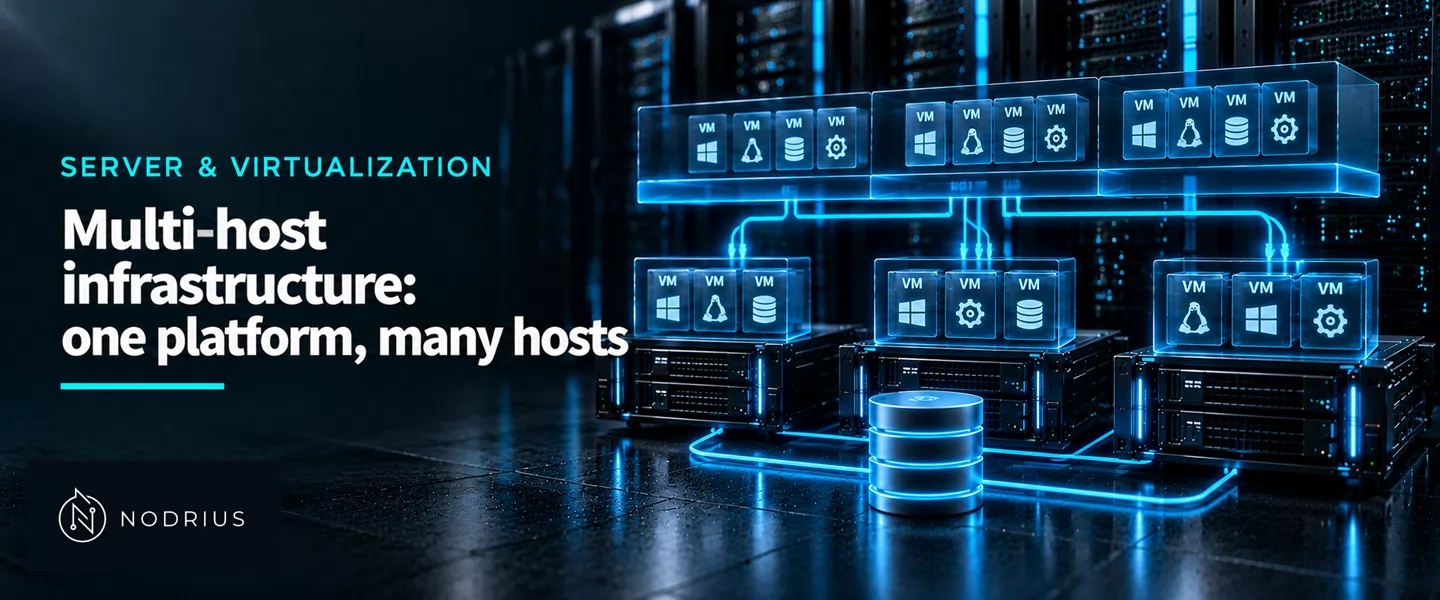
A virtualization cluster is one platform built from many servers: each host keeps its own CPUs, memory and disks, but the hosts agree on a shared configuration, see the same storage, and act as one body. That separates a fleet from a larger computer. This sheet covers the fleet’s arithmetic: what the hosts share and what each still owns alone, the roles a node can play, why losing any host is not the same as losing a particular one, the domains in which maintenance is counted, and why a fleet is sized on its failure domain rather than its node count.
  ONE PLATFORM, MANY HOSTS              THE BOUNDARY OF ONE FAULT
      hostA  hostB  hostC                     +--- room / rack ---+
        |      |      |                       | hostA   hostB     |
   +----+------+------+----+                  | hostC             |
   | shared configuration  |                  | shared switch     |
   | shared storage        |  <-- shared -->  | shared power feed |
   | one vote each         |                  +-------------------+
   | one master at a time  |                   one fault empties it:
   +----+------+------+----+                   the node count does not
        |      |      |                        decide the domain
   own CPU  own RAM  own local disks
   (a guest that needs one of these can only
    run on the host that has it)
One platform, not one large server
Proxmox VE creates a group of physical servers, ties it together with the Corosync Cluster Engine, and there is “no explicit limit for the number of nodes in a cluster”. What binds the group is not a control host but a copy of the same configuration on every node: the Proxmox Cluster File System is used to “transparently distribute the cluster configuration to all cluster nodes”. Hence the platform scales down as easily as up — “Managing a cluster of 16 nodes is as simple as managing a single node” — and it is multi-master: “Multi-master clusters: each node can do all management tasks”. A service, too, is a property of the platform: “Cluster-wide services like firewall and HA” belong to the fleet.
What the fleet shares and what a host owns
Shared or owned is a question of what can move and what cannot. An HA resource may use only what is present on every node: “use only shared storage that is accessible from all cluster nodes”, “use only network interfaces that exist on all cluster nodes”, “use only device passthroughs that are present on all cluster nodes”. Placement follows the same test: “By default, the HA Manager treats every cluster node as eligible”. A Windows converged fleet builds its shared plane the other way: Storage Spaces Direct “enables you to combine internal storage drives on a cluster of physical servers (2 and up to 16) into a software-defined pool of storage”. A host still owns its silicon and disks: live migration is “only supported when nodes have CPUs from the same vendor”, and “Guests with local disks (or other local resources which are only available on the offline node) are not recoverable like this”.
Nodes do not all play the same role
A fleet is not a set of identical members. Two daemons run on every Proxmox node with different scopes: “The local resource manager (LRM), which controls the services running on the local node”, and “The cluster resource manager (CRM), which makes the cluster-wide decisions” — and the manager lock is held by one node at a time, so one host decides for all. Storage roles are equally uneven: “In the two-zone configuration, Ceph arranges for each zone to hold a copy of the data” and “A third zone houses a tiebreaker (arbiter, witness) Monitor” that “picks a winner when a network connection between zones fails”. The tiebreaker holds no data; it exists to decide. Storing, deciding and merely arbitrating are three jobs.
Fleet capacity: any host, not a specific one
Fleet availability is a statement about a random host, not a named one. Proxmox states the promise for a workload that fits: “if one host fails, you can simply start those services on another host within your cluster”. For that to hold, every host must be interchangeable for the workload — same CPU family, same shared storage, same networks and passthroughs. It is false for the guest with a local disk, not recoverable elsewhere at all. The fleet therefore has two capacities: to lose an arbitrary member, which the shared plane buys, and to lose a particular member, which every exception reduces.
Draining a node: update and maintenance domains
You rarely take a host down because it died; you take it down because you must. Maintenance mode is the deliberate version: it is used to “mark the node as unavailable for HA operation, prompting all services managed by HA to migrate to other nodes”. A fleet-wide upgrade repeats the move, and the tooling says so when “an upgrade situation requires you to migrate all of your guests from one node to another”. The domain is the set of nodes you may remove together: one at a time is safe while the rest still hold the replicated configuration and a copy of every volume.
Isolation boundaries, from a rack to a region
Every boundary has a scope, and the scope decides what one fault removes. AWS names the layers it builds with — “such as Availability Zones (AZ), Regions, control planes, and data planes” — and describes their point as “the predictable scope of impact containment they provide”. A fleet may cross those boundaries, at a price stated one layer down: “A stretch cluster spreads hosts across geographically separated data centers”, and the failure it then expects is a “temporary or complete loss of an entire data center (which can represent one-third to one-half of the total cluster)”. The multi-site sheet owns whether a second site is a live member or only a recovery target.
Redundant components are not redundant domains
Component-level redundancy is a checklist, and the Proxmox availability chapter keeps it: “Eliminate single point of failure (redundant components)” — a UPS, redundant power supplies, ECC-RAM, redundant network hardware, RAID, distributed storage — and, separately, “availability of spare parts (other nodes in a Proxmox VE cluster)”. A second power supply removes a component fault inside one host; the spare nodes remove a host fault inside one room. If the room has one feed or one switch, its hosts are one domain whatever their number. Sizing on domains asks what one event removes, and buys a host of headroom per domain, not per node. Two hosts in the same rack are one domain; a fleet is counted in domains.
Level and prerequisites
L5 — fleet-level design: what a set of hosts shares and owns, the roles a node plays, and the domains in which maintenance and faults are counted. It is above L4 because it does not operate one cluster’s membership, storage or maintenance but reasons about the platform they compose, and it leaves the theory of failure domains to the first sheet of the batch. Prerequisites are the L4 sheets on clusters and quorum, on capacity planning and host maintenance and on shared and distributed storage, and the L3 sheets on hosts and on shared storage.
Where to go next
- Knowledge — the index.
- Server and virtualization — the area.
- Virtualization and networking — this sheet’s node.
- Companion sheets, still in draft: distributed systems and failure domains; distributed storage: consistency and availability trade-offs; multi-site disaster recovery; management plane isolation.
References
- Proxmox Server Solutions — Proxmox VE Administration Guide (Cluster Manager, Maintenance, Bulk Guest Migration, Storage) — https://pve.proxmox.com/pve-docs/pve-admin-guide.html — the cluster, the pmxcfs configuration replication, the multi-master claim, the same-vendor CPU requirement, the local-disk recovery limit, bulk migration and maintenance mode.
- Proxmox Server Solutions — High Availability (Proxmox VE wiki) — https://pve.proxmox.com/wiki/High_Availability — the resource eligibility rules, the LRM and CRM split, the redundant-components list, the spare-nodes entry and the failover promise.
- Microsoft — Storage Spaces Direct overview — https://learn.microsoft.com/en-us/windows-server/storage/storage-spaces/storage-spaces-direct-overview — the shared software-defined pool built from the servers’ internal drives.
- Ceph — Stretch Clusters — https://docs.ceph.com/en/latest/rados/operations/stretch-mode/ — the geographically separated fleet, the two-zone configuration and the tiebreaker Monitor.
- Amazon Web Services — AWS Fault Isolation Boundaries — https://docs.aws.amazon.com/whitepapers/latest/aws-fault-isolation-boundaries/abstract-and-introduction.html — the isolation boundaries and their predictable scope of impact containment.