
The lifecycle of credentials and permissions
A credential is delegated authority with an expiry: issue, scope, rotate, revoke, audit.
An AI system acts because something issued it a credential and a server accepted it. The OAuth 2.0 authorization framework exists for that: to let a client “obtain limited access to an HTTP service” on behalf of a resource owner (RFC 6749). What limits access is the credential’s scope and lifetime.
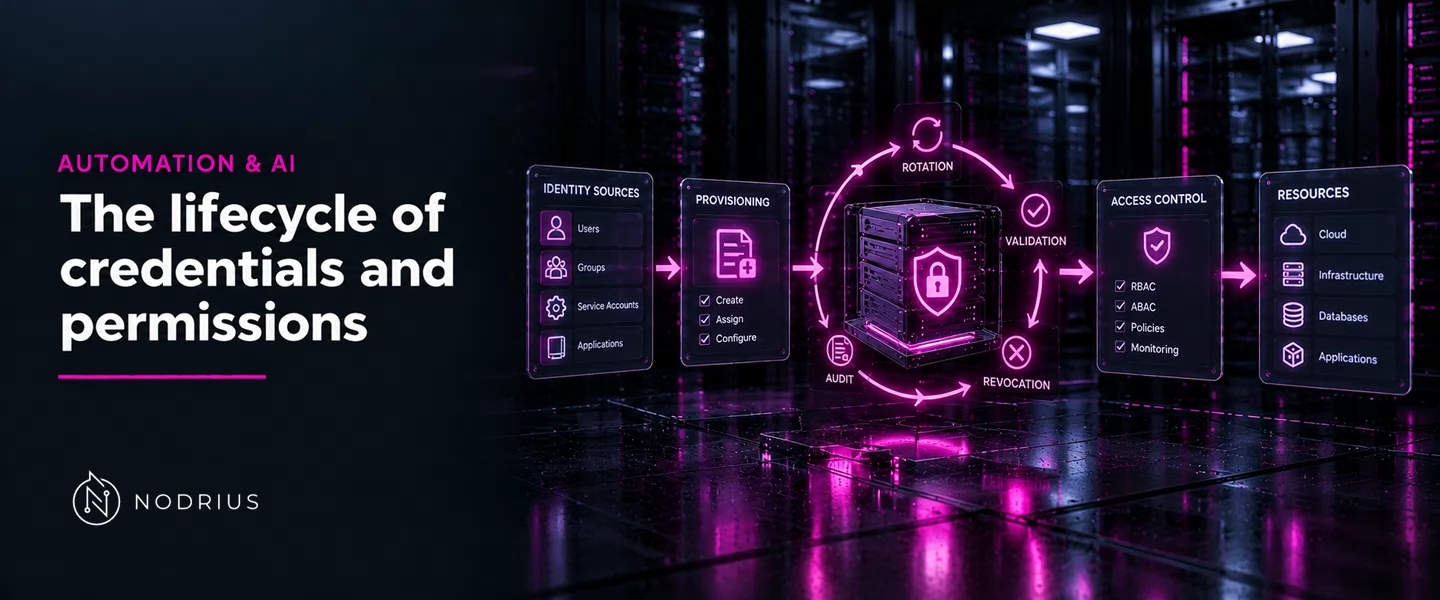
That is the model: a credential is a delegation of authority with an expiry; every stage of its life is where the delegation can become too broad, too long-lived, or invisible. Issuing, scoping, rotating, revoking and auditing are five points on one loop.
issue ──▶ scope ──▶ use ──▶ rotate ──▶ revoke
                              │
                              └──▶ every stage leaves a trace (audit)
A permission has a lifetime
RFC 6749 calls an access token a string “denoting a specific scope, lifetime, and other access attributes”; tokens “represent specific scopes and durations of access, granted by the resource owner, and enforced by the resource server and authorization server” (§1.4). A credential neither role can date is a permanent grant, not a delegation.
Key management reaches the same idea under another name. NIST SP 800-57 Part 1 Revision 5 (May 2020) calls a cryptoperiod “The time span during which a specific key is authorized for use” (glossary); authority is time-bounded, which is why a key moves through active, deactivated, compromised and destroyed states.
Issuing and scoping: make the grant narrower than the request
Scope — what may be done. The client asks for a scope, but the server “MAY fully or partially ignore the scope” requested and must tell the client the actual scope granted (RFC 6749 §3.3). RFC 9700 (January 2025) states the rule: “The privileges associated with an access token SHOULD be restricted to the minimum required for the particular application or use case” (§2.3).
Audience — where it may be used. RFC 9700 asks that access tokens be “audience-restricted to a” single resource server, which must check “for every request, whether the access token sent with that request was meant to be used” for it. The MCP authorization specification (version 2025-06-18) says the same for tool servers: “MCP servers MUST validate that access tokens were issued specifically for them as the intended audience”. That closes token passthrough — a server using or forwarding a token minted elsewhere. The rights an agent accumulates belong to the excessive-agency sheet; the credential’s identity and lifetime belong here.
Rotation: replace a live credential before it is worth stealing
Refresh tokens are the counterweight to long access-token lifetimes: they let the issuer mint short-lived, reduced-scope tokens, which is what makes leakage survivable (RFC 9700 §4.14). That makes the refresh token the prize, so RFC 9700 requires one of two defences for public clients — sender-constrained tokens, or rotation, where the server “issues a new” refresh token “with every access token refresh response” and invalidates the previous one; a replayed stolen token then reveals the breach.
Session lifetime follows the same logic. NIST SP 800-63B-4 (July 2025) requires periodic reauthentication on two clocks: “An overall timeout limits the duration” of a session, while an inactivity timeout ends one after quiet (§5.2). At AAL2 the overall timeout “SHOULD be no more than 24 hours at AAL2”; at AAL3 it “SHALL be no more than 12” hours.
Revocation: the limit is the verifier, not the issuer
Revocation sounds like a delete, but a bearer credential cannot be un-issued by the issuer alone. RFC 6750 defines a bearer token as one where “any party in possession of the token (a ‘bearer’) can use the token in any way that any other party in possession of it can” — possession is authority. Revocation is real only where the deciding server checks on every request — the duty RFC 9700 places on the resource server.
The controls are therefore blunt. Authorization codes are single-use, and on reuse the server “SHOULD attempt to revoke all access tokens already granted based on” the compromised code (RFC 6749 §10.5); refresh tokens are revoked on logout or a password change (RFC 9700 §4.14.2). RFC 6749 is candid that it “does not provide any methods for the resource” server to prove a token was issued to the presenting client — which is why the lifetime, not the revocation call, is the fallback.
Auditing: you can only revoke what you can see
Each stage leaves a decision someone must reconstruct: which credential, issued to whom, scoped to what, expiring when, revoked and why. NIST SP 800-63B-4 frames this as continuous session monitoring — evaluating session characteristics to “detect possible fraud” and, on suspicion, to reauthenticate, terminate the session or notify support (§5.3). Key management keeps the thread: a destroyed key “no longer exists”, yet “its previous existence may be recorded (e.g., in” metadata “or audit logs)” (SP 800-57 Part 1 Rev. 5, glossary).
The trade-off runs through all five stages: shorter lifetimes and narrower scopes cut exposure but multiply rotations and failure modes; richer auditing makes revocation possible but records the material an attacker wants. The answer is not a maximum but a risk assessment that sets each number.
Level and prerequisites. L5 — the sheet is for an operator who chooses a lifetime, a scope and a rotation policy. Prerequisites: the L4 sheets on excessive agency and permissions, and on secrets and data exposure.
Where to go next
- Automation & AI — the macro-area this sheet belongs to.
- Operations & risk — the node this sheet sits in.
- Not yet published: policy engines and enforcement outside the model, and the L4 sheets on excessive agency and secrets and data exposure.
References
- IETF — RFC 6749, The OAuth 2.0 Authorization Framework — access-token definition, scope negotiation, single-use authorization codes and the limits of resource-server validation.
- IETF — RFC 6750, The OAuth 2.0 Authorization Framework: Bearer Token Usage — what makes a token a bearer token.
- IETF — RFC 9700, Best Current Practice for OAuth 2.0 Security — least privilege, audience restriction, refresh-token rotation and reauthentication.
- NIST — SP 800-57 Part 1 Revision 5 — the cryptoperiod and the key lifecycle states.
- NIST — SP 800-63B-4 — session timeouts, reauthentication and session monitoring.
- Model Context Protocol — Authorization — audience validation for tool servers.