
Execution policy: deny by default and allowlists
Deny by default, then allow only what is named: the policy governing an agent’s calls.
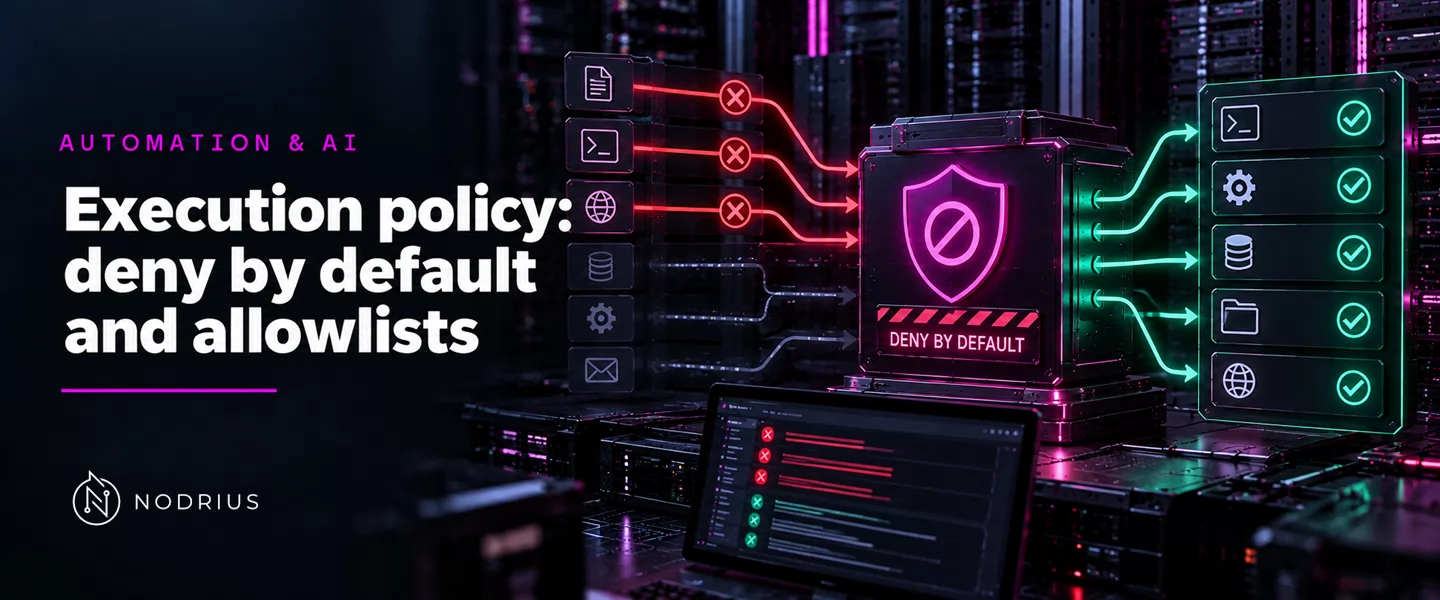
An agent’s authority is the set of calls its runtime will actually allow, and that set is a policy before it is ever a behaviour. Deny by default makes the policy start from no: nothing executes unless something has been named, and the allowlist is that naming. NIST’s guide to application whitelisting states the inversion plainly: “Unlike security technologies such as antivirus software, which use blacklists to block known bad activity and permit all other, application whitelisting technologies are designed to permit known good activity and block all other.” (lines 282–283)
A blocklist enumerates what is known bad and lets everything else through: it stops only what someone has already seen. An allowlist enumerates what is trusted and stops everything else, so it survives threats nobody has catalogued — at the cost of naming in advance everything legitimate work needs. An execution policy for an agent applies that posture not to files on a host but to the tool calls a model proposes.
Deny by default is a position, not a setting
What makes a policy deny-by-default is not the tooling but which side of the list is finite. NIST defines a whitelist as “a list of discrete entities, such as hosts, email addresses, network port numbers, runtime processes, or applications that are authorized to be present or active on a system according to a well-defined baseline”, and a blacklist as “a list of discrete entities that have been previously determined to be associated with malicious activity” (lines 265–268). The baseline is what does the work: the list comes from a known-good state, not from a guess about attackers. The strictest wording is a control text NIST reproduces in its standards-mapping appendix: an organization “Employs a deny-all, permit-by-exception policy to allow the execution of authorized software programs on the information system” (lines 929–930).
What an allowlist can name
The list’s power and its weakness are the same property: specificity; NIST’s entities each name exactly what is allowed. For an agent the entity is the tool call, and a policy that names only a tool while leaving its arguments open has named almost nothing. OWASP’s Excessive Agency entry rejects that breadth: “Avoid the use of open-ended extensions where possible (e.g., run a shell command, fetch a URL, etc.) and use extensions with more granular functionality” (owasp-llm-top10-2025.txt, lines 1073–1074). Scope follows the same logic: MCP’s guidance recommends a “progressive, least-privilege scope model” whose “minimal initial scope set” holds “only low-risk discovery/read operations” (mcp-security-best-practices.txt, lines 641–643).
Enforcement, audit and the in-between
A whitelisting technology runs in one of two modes. “Audit mode allows items, including those not on the whitelist to be executed and logs their execution” (nist-sp800-167.txt, lines 465–466); enforcement actually stops things, and its strictest form “permits only whitelist items to be executed and blocks execution of all others” (lines 472–473). Audit mode is “strictly informative; it can log the execution of malware and other unauthorized executables, but it cannot do anything to stop them” (lines 491–492) — useful only before enforcement. Between block and allow sits the graylist, items “that have not yet been established as benign or malicious” (lines 268–269), resolved by prompting a human: where an execution policy hands off to approval.
From host processes to tool calls
The policy is the same idea with a new subject: a host allowlist governed which programs may execute; an agent’s policy governs which tool calls the model may make, enforced somewhere the model cannot edit. CaMeL treats “Security Policies” as governing “allowed operations in the information flow” and stops violations: “If a policy violation is detected (e.g., private data passed to a tool with side effects), the tool’s execution is blocked” (camel-2503.18813.txt, lines 493–494 and 642–643). OWASP states the placement as complete mediation: “Implement authorization in downstream systems rather than relying on an LLM to decide if an action is allowed or not” (lines 1098–1100). MCP keeps the list form — clients “SHOULD use allowlist-based validation rather than blocklist-based approaches” (mcp-security-best-practices.txt, line 563). Across all three, code outside the model decides, against an enumerated list.
What an allowlist does not buy
Two limits follow. First, the list constrains what may run, not what a permitted tool may then do: an allowlisted tool with broad downstream rights is still broad, which is why OWASP’s root causes of Excessive Agency are “excessive functionality; excessive permissions; excessive autonomy” (owasp-llm-top10-2025.txt, lines 1011–1014), and why permissions must be minimised alongside the list. Second, the policy leans on a human at its edges — the graylist prompt and any refused call — and a policy that fires often enough to demand frequent confirmation risks “user fatigue, where users become desensitized to security prompts and may inadvertently approve malicious actions” (camel-2503.18813.txt, lines 1470–1471).
Level and prerequisites. L4 — one layer past the mechanics of tools and agents: the reader knows what a tool call is, and the sheet asks what ought to be allowed to happen. Prerequisites: the sheets on the action loop and its stopping conditions, on tool schemas and argument validation, and on prompt injection, since an allowlist decides how far a successful injection can reach.
Where to go next
- Automation & AI — the macro-area this sheet belongs to.
- Operations and risk — the node this sheet sits in.
References
- NIST — Guide to Application Whitelisting (SP 800-167) — the whitelist, blacklist and graylist definitions; the permit-known-good inversion; audit versus enforcement modes; the deny-all, permit-by-exception control text.
- OWASP — Top 10 for LLM Applications 2025, LLM06 Excessive Agency — the open-ended-extension warning, the root causes, and complete mediation.
- MCP — Security Best Practices — allowlist-based validation over blocklists, and the progressive least-privilege scope model.
- Debenedetti et al. — Defeating Prompt Injections by Design (CaMeL) — security policies checked before tool calls, and the user-fatigue limit.