Human approval for high-impact actions
Insert a human decision before an agent takes an irreversible, high-stakes action.
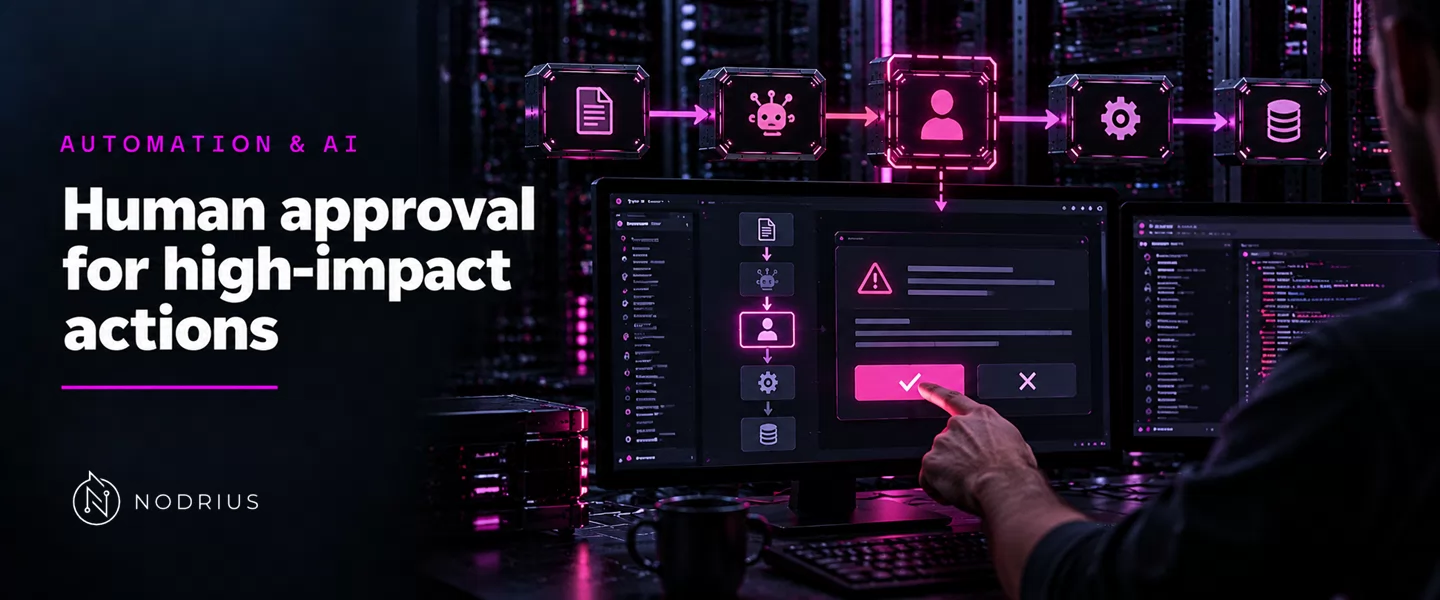
An agent can carry a task from start to finish, and most of its steps are safe to run without a person watching. A few are not: a payment released, an order cancelled, a record deleted. Human approval places one person’s decision between the agent’s intent and the effect of that intent — and a gate built carelessly fails at the very thing it was built to prevent.
What makes an action high-impact
The test is not how complex an action is; it is what happens when it is wrong and whether the wrong can be undone. OpenAI’s agent guide names the triggers: “High-risk actions: Actions that are sensitive, irreversible, or have high stakes should trigger human oversight until confidence in the agent’s reliability grows. Examples include canceling user orders, authorizing large refunds, or making payments.” (lines 1177–1179)
Three factors do the work, each checkable before a run: sensitivity (the action touches money, personal data or another party), irreversibility (there is no undo) and stakes (the magnitude of the harm). Reading is almost always safe to run autonomously; writing is the candidate for a gate. That is how the guide rates a tool’s risk: “Assess the risk of each tool available to your agent by assigning a rating–low, medium, or high–based on factors like read-only vs. write access, reversibility, required account permissions, and financial impact.” (lines 884–887)
The pause is a checkpoint, not a prompt
The mechanism has four parts: the run reaches the boundary, stops, a person supplies a decision, and the run continues with it. LangGraph’s interrupt primitive states the idea plainly: “Interrupts allow you to pause graph execution at specific points and wait for external input before continuing. This enables human-in-the-loop patterns where you need external input to proceed.” (line 86)
The property that matters is durability. A gate that lives only inside the model’s turn — the agent says it will wait — loses its place the moment the process restarts: the action is either lost or, worse, taken without the decision ever arriving. A real gate serialises the run’s state and waits indefinitely for a value keyed to that paused step.
Where the gate must sit
The decision is only as good as what the human is shown. The gate belongs immediately in front of the executor, holding the exact call and its arguments, not the model’s prose summary of intent. LangGraph lists both patterns: “Approval workflows : Pause before executing critical actions (API calls, database changes, financial transactions)” (line 179) and “Interrupting tool calls : Pause before executing tool calls to review and edit the tool call before execution” (line 182).
Two consequences follow. Approval must bind to the concrete action, because the harm lives in the arguments — a refund of ten units and a refund of ten thousand are the same tool. And one approval must cover one action: a grant that silently authorises every later call of the same tool is not a gate but a switch that opens once and stays open.
The gate has its own failure mode
A human gate is only as strong as the attention behind it. NIST names the mechanism: “This phenomenon is an example of automation bias, or excessive deference to automated systems. Automation bias can exacerbate other risks of GAI, such as risks of confabulation or risks of bias or homogenization.” (lines 464–466)
The practical failure is a gate that approves everything. When every action is paused, the person learns that the expected answer is yes and supplies it without reading — the decision is technically present and substantively absent. (Interpretation: the sources name the bias, not the pile-up.) The control can be watched: NIST calls for systems to “continually monitor and track the outcomes of human-GAI” configurations over time, for future refinement (line 1207).
Calibrating the gate
Gate too little and the agent acts where it should not; gate too much and the gate becomes noise. OpenAI frames intervention as an investment that pays off most early: “Human intervention is a critical safeguard enabling you to improve an agent’s real-world performance without compromising user experience. It’s especially important early in deployment, helping identify failures, uncover edge cases, and establish a robust evaluation cycle.” (lines 1158–1161) It names two triggers, not one — a high-risk action, and “Exceeding failure thresholds”, where repeated retries should escalate rather than loop.
Oversight is not one setting for the whole system: “GAI may call for different levels of oversight from AI Actors or different human-AI configurations in order to manage their risks effectively.” (lines 2140–2141) The strongest approvals are the ones whose effects can still be undone, so the gate is paired with a backstop — mechanisms “to supersede, disengage, or deactivate AI systems that demonstrate performance or outcomes inconsistent with intended use.” (lines 1899–1900)
Level and prerequisites. L4 — the operations layer, where the controls are assembled into a runtime an operator can trust with real actions. This sheet moves from choosing an agent pattern to containing one. Prerequisites: the L3 sheet on tool calling and the L2 sheet on structured output, and the L4 companions on state, checkpoint and resume, and on execution policy.
Where to go next
- Automation & AI — the macro-area this sheet belongs to.
- Operations and risk — the node this sheet sits in.
References
- NIST — Artificial Intelligence Risk Management Framework: Generative Artificial Intelligence Profile (NIST AI 600-1) — the automation-bias mechanism, the call to monitor human–AI outcomes and the deactivation backstop.
- OpenAI — A practical guide to building agents — the high-risk-action trigger, the tool risk rating and the human-intervention rationale.
- LangGraph — Interrupts — the pause-and-resume primitive and the approval and tool-call interrupt patterns.