
Authentication and authorisation for tool calls
Authentication says who is calling; authorisation says what the call is allowed to do.
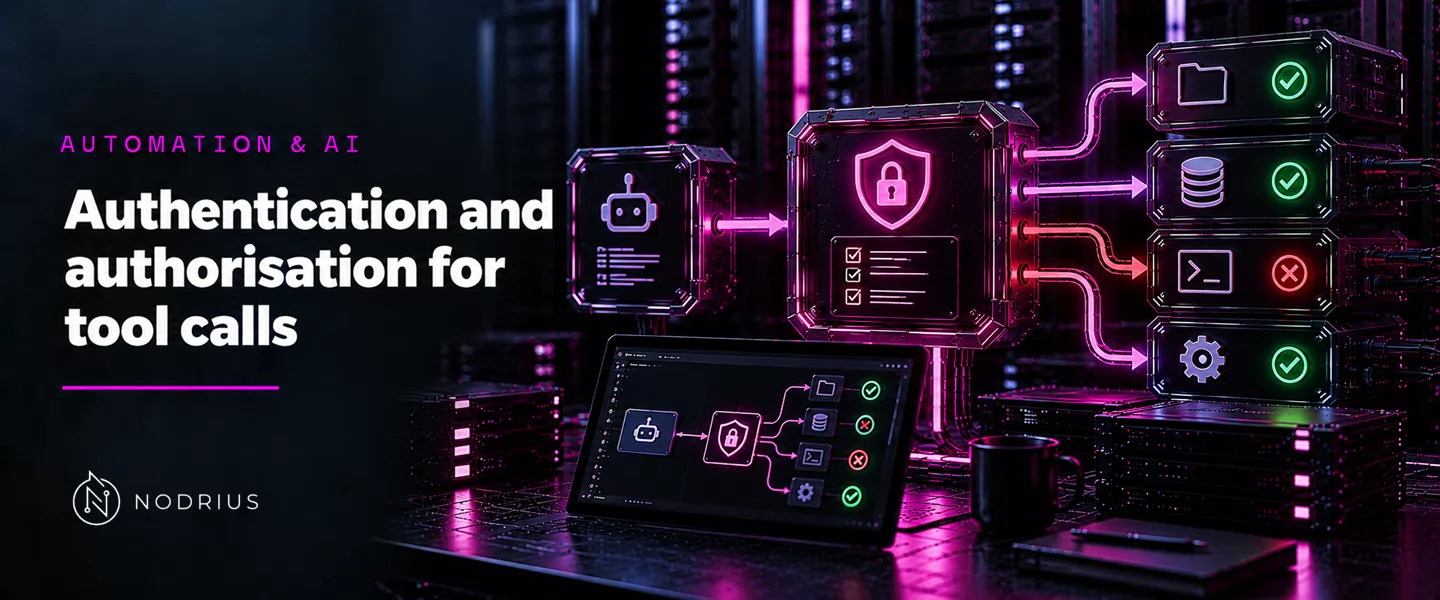
A tool call crosses a trust boundary and must answer two different questions on the way. Authentication establishes who or what is making the call; authorisation decides what that caller may do once the call arrives. A valid credential proves an identity was established, not that it may run this tool.
The Model Context Protocol makes the roles explicit. A protected server “acts as an OAuth 2.1 resource server”, and the client “acts as an OAuth 2.1 client”, “making protected resource requests on behalf of a resource owner”. The difficulty sits in that last phrase: the model is not the owner, so the credential must carry the owner’s authority, and the server must verify it rather than accept the caller’s identity claim at face value.
What each question actually answers
NIST keeps the two in separate control families. Access enforcement asks a system to “Enforce approved authorizations for logical access to information and system resources in accordance with applicable access control policies.” Its glossary sibling in SP 800-57 defines access control as what “Restricts resource access to only authorized entities”, and identity authentication as “The process of providing assurance about the identity of an entity interacting with a system”. Authentication produces an identity; authorisation compares that identity against a policy. Either one without the other is a half-check.
A credential must be bound to the server it is used on
The failure the specification targets is not a missing check but a token believed to be as good as any other. The specification closes this: “MCP servers MUST validate that tokens presented to them were specifically issued for their use”, and “MCP servers MUST NOT accept or transit any other tokens.” The client half is that it “MUST implement Resource Indicators for OAuth 2.0 … to explicitly specify the target resource for which the token is being requested”. A token minted for one service is not a credential for another.
Two failure modes this prevents
When a token is accepted on the wrong audience, the server becomes a courier for someone else’s credential. “Token passthrough” is “an anti-pattern where an MCP server accepts tokens from an MCP client without validating that the tokens were properly issued to the MCP server and passes them through to the downstream API”, and it is explicitly forbidden. The confused deputy is the proxy variant: “Attackers can exploit MCP proxy servers that connect to third-party APIs”, where a proxy with a static client ID can have a downstream API act as though the user had consented. The fix is per client, not per server: a proxy “MUST” “Maintain a registry of approved client_id values per user” before the third-party flow.
Authorisation is per operation, not per session
Least privilege on a tool server narrows the scope to the operation. NIST states the principle generally: “Employ the principle of least privilege, allowing only authorized accesses for users (or processes acting on behalf of users) that are necessary to accomplish assigned organizational tasks.” The MCP guidance applies it to scopes: “Poor scope design increases token compromise impact, elevates user friction, and obscures audit trails.” A broad scope granted up front is one stolen token away from lateral access.
Flow control is the second half. AC-4 governs “where information can travel within a system and between systems (in contrast to who is allowed to access the information)” — an authorisation over “the flow of information within the system and between connected systems”. For tools this separates a credential that may read a record from one that may send it somewhere: the access can be authorised and the movement still be wrong.
A session is not a credential
A tool server also errs by treating the state it keeps as authentication. The guidance is blunt: “MCP servers that implement authorization MUST verify all inbound requests. MCP Servers MUST NOT use sessions for authentication.” Session identifiers must be unpredictable — “MCP servers MUST use secure, non-deterministic session IDs” — and binding a session to its user stops a guessed identifier from standing in for another person. Token lifetime gets the same treatment: “Authorization servers SHOULD issue short-lived access tokens to reduce the impact of leaked tokens”, and public clients must rotate refresh tokens.
The transport decides where the credential comes from
MCP authorisation is defined for HTTP. There, “Authorization is OPTIONAL for MCP implementations”; HTTP-based transports “SHOULD conform”, while STDIO transports “SHOULD NOT follow this specification, and instead retrieve credentials from the environment”. That is a boundary statement, not an exemption: a local process is already separated from its neighbours by the operating system, so its credential is the environment it inherited, not an OAuth flow. The moment the server is reached over a network, the OAuth machinery applies again.
Level and prerequisites. L4 — the operations-and-risk level, where the reader must reason about a system already connected to others and must be able to say which layer enforces which check. Prerequisites: the L3 sheets on tools and structured output, and the earlier sheets of this layer that introduce the client/server split and the protocol model.
Where to go next
- Automation & AI — the macro-area this sheet belongs to.
- Operations and risk — the node this sheet sits in.
References
- Model Context Protocol — Authorization specification (page stamped 2025-06-18) — the resource-server and client roles, the RFC 8707 resource parameter, token validation and the transport rules.
- Model Context Protocol — Security Best Practices (page stamped 2025-11-25) — token passthrough and the confused deputy, per-client consent, session handling and scope minimisation.
- NIST SP 800-53 Rev. 5 — access enforcement (AC-3), information flow enforcement (AC-4) and least privilege (AC-6).
- NIST SP 800-57 Part 1 Rev. 5 — the glossary distinction between access control and identity authentication.
The two MCP pages carry different version stamps (2025-06-18 and 2025-11-25); each is quoted as printed and the two are not reconciled to one version.