
Configuration management as a control process: the baseline and its changes
A baseline is a governance object: approved, changed under control, watched for drift.
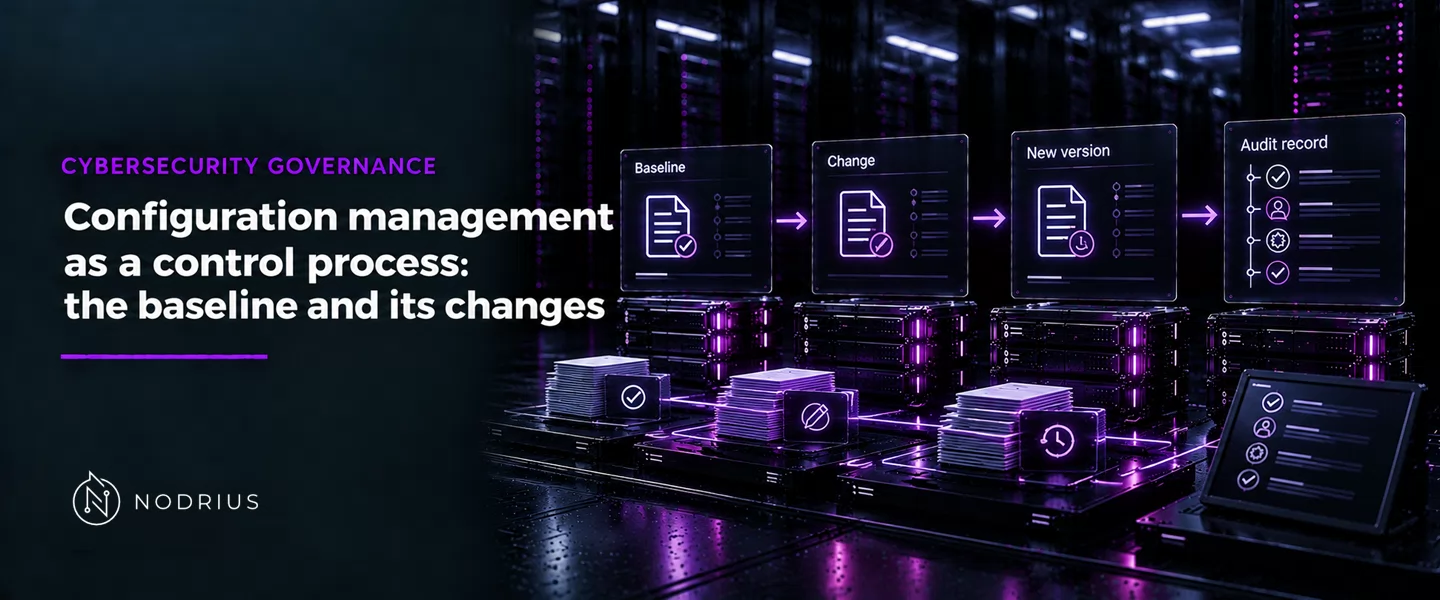
Security-focused configuration management is a process, not a setting. It decides what the organisation manages as one unit (a configuration item), which description of that unit is approved (the baseline configuration), how that description may legally change (configuration change control), and how the organisation notices reality drifting from it (monitoring). NIST’s guide names the phases; the SP 800-53r5 controls carry the duties. This sheet is about how those pieces interlock, and about the object at the centre: an approved baseline.
A process, not a setting
SP 800-128 lists what managing the configuration of a system involves: “development of a configuration management plan, establishment of a configuration control board, … establishment of the baseline configuration, development of a configuration change control process, and development of a process for configuration monitoring and reporting” (lines 902–906). It organises those activities into “four major phases: Planning; Identifying and Implementing Configurations; Controlling Configuration Changes; and Monitoring” (line 1026). Each phase names something that has to exist at the level of the organisation, not a value on a device.
The configuration item is the unit of control
In SecCM a “configuration item (CI) is an aggregation of system components that is designated for configuration management and treated as a single entity throughout the SecCM process”; it “is identified, labeled, and tracked during its life cycle” and is “the target of many of the activities within SecCM, such as configuration change control and monitoring activities” (lines 1206–1210). Its granularity is a governance decision: “The level of granularity varies among organizations and systems and is balanced against the associated management overhead for each CI.” (lines 1218–1220). Chosen too coarsely, the baseline describes nothing usable; too finely, the control costs more than it protects.
The baseline is an approved object
A baseline configuration is “a set of specifications for a system … that has been formally reviewed and agreed on at a given point in time, and which can be changed only through change control procedures” (lines 867–870; the ellipsis omits “or CI within a system”). The load-bearing words are formally reviewed, agreed, and only through change control procedures: approval is what makes the artefact a control. SP 800-128 places it in the sequence: a secure baseline “is developed, reviewed, approved, and implemented” (lines 1068–1069). CM-2 requires the organisation to “develop, document, and maintain under configuration control, a current baseline configuration of the system” and to review it at a defined frequency, when circumstances require, and when components are installed or upgraded (SP 800-53r5 lines 7134–7143). A baseline is not the state the machines happen to be in; it is the state someone accountable has signed for.
 configuration item (CI)                    baseline configuration
 the unit of control                 --->   the approved description of it
 "treated as a single entity"               "formally reviewed and agreed"

        |                                             ^
        | changes arrive                              | rewritten only by
        v                                             | configuration change control
   changes proposed, impact-analysed,  ----------------+
   approved, documented, implemented (CM-3)

        v
   monitoring compares reality with the approved
   description and reports the drift
Change control is what rewrites the baseline
SP 800-128 defines configuration change control as the “process for managing updates to the baseline configurations for the configuration items” (line 884); the baseline follows managed change: “As changes to systems are made, baseline configurations are updated, specific configuration settings confirmed, and configuration items tracked, verified, and reported.” (line 1015). CM-3 sets out those duties and places their oversight with a named change control element (lines 7239–7263). Who signs, and what the record must show, belongs to the sibling sheet on change approval; the point here is narrower — a baseline is only legal if change control is what moved it.
Monitoring is how drift is found
The fourth phase exists because controlled change is not enough: “Planning and implementing secure configurations and then controlling configuration change is usually not sufficient to ensure that a system which was once secure will remain secure.” Monitoring “identifies undiscovered/undocumented system components, misconfigurations, vulnerabilities, and unauthorized changes” and flags “when the system is not consistent with the approved baseline configuration” (SP 800-128 lines 1097–1104). Settings have their own control: CM-6 requires settings that “reflect the most restrictive mode consistent with operational requirements”, with any deviation identified, documented and approved (lines 7528–7537), and states that they “become part of the configuration baseline for the system” (line 7552). CM-8(6) closes the loop: the inventory must include “assessed component configurations and any approved deviations to current deployed configurations” (lines 7932–7935). SP 800-137 names the failure this prevents — a component “unknowingly out of synchronization with the approved secure configurations” leaves officials with “a false sense of security” (lines 3297–3300).
The controls the process binds
SecCM is connective, not a control in itself: SP 800-53r5 carries the duties separately — CM-1 policy, CM-2 the baseline, CM-3 change control, CM-6 settings and deviations, CM-8 the inventory, SI-4 monitoring — and CSF 2.0 states the outcome as a practice: “PR.PS-01: Configuration management practices are established and applied” (line 975). These artefacts are a control only when linked: a tracked item, an approved baseline, changes that passed through the process, and monitoring that notices divergence.
Level and prerequisites
L3 — intermediate: the reader has to assess and coordinate a process, not draft one document. It assumes the L1 vocabulary of control types and the L2 material on the inventory record and on standards and procedures authorship, and does not re-teach them.
Where to go next
- Knowledge — the index.
- Cybersecurity Governance — the area this sheet belongs to.
- Assurance — this sheet’s node.
References
- NIST — Guide for Security-Focused Configuration Management of Information Systems (SP 800-128) — https://doi.org/10.6028/NIST.SP.800-128 — the activities of SecCM and the four phases; the configuration item definition and its granularity; the baseline configuration definition; configuration change control; baselines updated as systems change; the monitoring phase.
- NIST — Security and Privacy Controls for Information Systems and Organizations (SP 800-53 Rev. 5) — https://doi.org/10.6028/NIST.SP.800-53r5 — CM-1, CM-2, CM-3, CM-6 and CM-8 (with CM-8(6) assessed configurations and approved deviations) and SI-4.
- NIST — Information Security Continuous Monitoring (ISCM) for Federal Information Systems and Organizations (SP 800-137) — https://nvlpubs.nist.gov/nistpubs/Legacy/SP/nistspecialpublication800-137.pdf — the ISCM definition and Appendix D.1.5 configuration management (scanning against a defined secure baseline; the false sense of security sentence).
- NIST — The NIST Cybersecurity Framework (CSF) 2.0 (NIST CSWP 29, 26 February 2024) — https://doi.org/10.6028/NIST.CSWP.29 — the PR.PS Platform Security category and PR.PS-01.