
Improvement based on evidence: what turns a finding into change
What turns findings, measures and lessons into a change, and how to tell it happened.
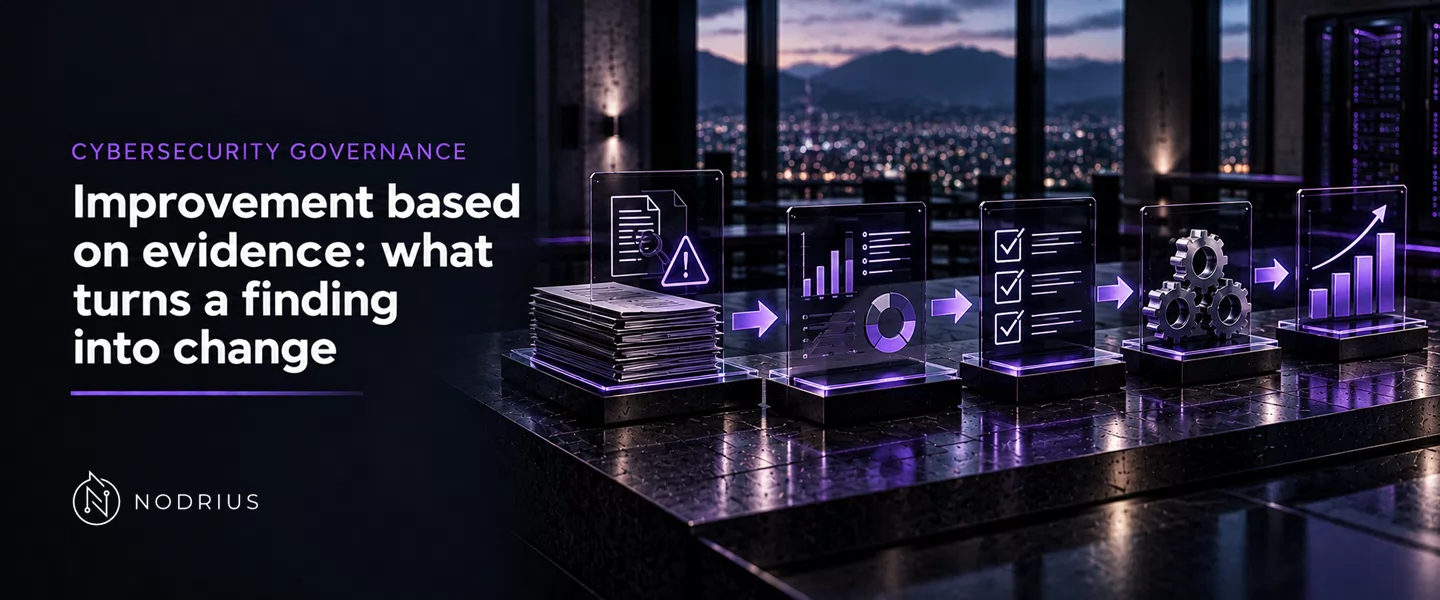
A programme does not improve because it produced findings. It improves when a finding changes an artefact — a policy, a configuration, a plan, an owner — and the change is visible against the state that preceded it. Improvement based on evidence is that loop: evaluations, measures, tests and incidents become a decision, and its proof is the before-and-after difference, not the discovery.
The findings and the evidence come from processes the lower levels define. What is governed here is narrower — what makes a finding become a change, and how you can tell it did.
What has to change, and from what evidence
The NIST Cybersecurity Framework (CSF) 2.0 states the outcome as an Improvement category across “all CSF Functions” (line 917). Its subcategories name four sources: “ID.IM-01: Improvements are identified from evaluations” (line 919); “ID.IM-02: Improvements are identified from security tests and exercises, including those done in coordination with suppliers and relevant third parties” (lines 921–922); the execution of operational processes and procedures (ID.IM-03, lines 924–925); and the plans themselves, which must be “established, communicated, maintained, and improved” (ID.IM-04, lines 927–928).
   evidence source              what turns it into improvement
   --------------               -------------------------------
   evaluations (ID.IM-01) ------.
   tests / exercises (IM-02) ----+--> [ identified ] --> owner of the cause
   operational execution (IM-03)-+                          |
   plans themselves (IM-04) -----'                          v
                                              changed artefact (policy, config,
                                              plan, owner) + before state on record
The framework names sources, not disposition: it says improvements are identified, and names neither who dispositions a finding, nor on what cadence, nor against which acceptance.
The measurement side: continuous feedback and continual improvement
NIST SP 800-55 Vol. 2 states that “Such programs facilitate decision-making and improve performance and accountability by providing a structure for collecting, analyzing, and reporting relevant and related data” (lines 211–213), and that “The continuous feedback provided by a structured measurement program supports regular internal communications that collect data about information security performance and risks for high-level members of the organization” (lines 340–342). The guide warns that measurement stopping at the number corrects nothing (lines 1000–1001); the fix is causation: “corrective actions can be directed at the cause of the problem” (lines 1004–1005). A measure nobody acts on is cost without assurance (interpretation, not a quotation).
The audit side: recommendation, action plan and confirmation
The audit standards build the trace from finding to change. The Institute of Internal Auditors (IIA) Global Internal Audit Standard 14.4 requires that auditors determine “whether to develop recommendations, request action plans from management, or collaborate with management to agree on actions” (lines 2225–2226); the actions include “Address the root cause of the finding” (line 2230). Standard 15.1 fixes accountability into the final engagement communication, which “must specify the individuals responsible for addressing the findings and the planned date by which the actions should be completed” (lines 2295–2296). Standard 15.2 supplies the closing half — the loop is not complete until auditors “confirm that management has implemented internal auditors’ recommendations or management’s action plans following an established methodology” (lines 2323–2324). The standards do not describe improvement so much as make it verifiable — a root cause, an owner, a date, a confirmation. The engagement mechanics are another sheet’s.
The management-system reading, carried by the SC 27 Journal because the clause text is paywalled, agrees: the intention of Clause 9.1 of ISO/IEC 27001:2022 is to “consider the ISMS and its processes and determine the extent to which planned activities are realized and planned results are achieved. Its purpose is to support decision-making related to the respective activities and to drive continual improvement” (lines 730–734). Measurement here is written for improvement, not reporting.
Monitoring and crisis: loops that already feed back
Two programmes treat improvement as a property of the loop. NIST SP 800-137 says the monitoring programme’s information “informs the discrete processes used to manage the organization’s security posture and overall risk” (lines 511–512) — it feeds the posture it measures — and that the monitoring strategy itself is reviewed and changed to keep improving that posture (lines 409–411). The Financial Stability Board (FSB) states that “Lessons learnt are used in the selection and implementation of additional controls and mitigation measures, including changes to CIRR policies, plans and playbooks” (lines 770–773), so lessons learnt must produce changes to plans, not a note.
Where improvement stops being improvement
Four limits separate the loop from its imitation. Improvement without a changed artefact is a lesson learned twice: a lesson ending in a document rather than “the selection and implementation of additional controls” (line 772) improved nothing. An evidence-based claim needs the before state: “identified” improvements are not implemented ones, and only a recorded prior state lets you assert a difference. Measuring more is not improving more: the programme serves decision-making and accountability (lines 211–213), not volume. And most commonly, a finding becomes a ticket with no owner of the underlying cause — the trace points at “the root cause of the finding” (line 2230), and a ticket closed without it is a repeat waiting to be found again.
Level and prerequisites
L5 — specialist: the sheet runs no process and designs no measure; it asks how findings, measures and lessons across functions become a change, and how that change is established. Prerequisites: the L4 framework, audit, maturity and evidence sheets, which own the findings, the maturity vocabulary and the evidence; and the L3 remediation, verification and residual-risk process that owns the change record.
Where to go next
- Knowledge — the register this sheet belongs to.
- Cybersecurity Governance — the macro-area.
- Assurance — the node this sheet sits in.
References
- NIST — CSF 2.0 (NIST CSWP 29) — the four Improvement sources (ID.IM-01…ID.IM-04) and the category statement.
- NIST — SP 800-55 Vol. 2, Measurement Guide for Information Security — the measurement programme as decision-making, continuous feedback and corrective action at the cause.
- The IIA — Global Internal Audit Standards (condensed) — 14.4 recommendations and action plans, 15.1 final engagement communication, 15.2 confirmation of implementation.
- ISO/IEC JTC 1/SC 27 — SC 27 Journal, Volume 3, Issue 4 — the intention of Clause 9.1 to evaluate results and drive continual improvement.
- NIST — SP 800-137, ISCM — the continuous-monitoring programme feeding back into the posture it measures.
- FSB — Effective Practices for Cyber Incident Response and Recovery — lessons learnt turned into controls and changed plans.