
Internal audit, findings and corrective actions: what the function produces
How internal audit produces findings, corrective actions and their confirmation.
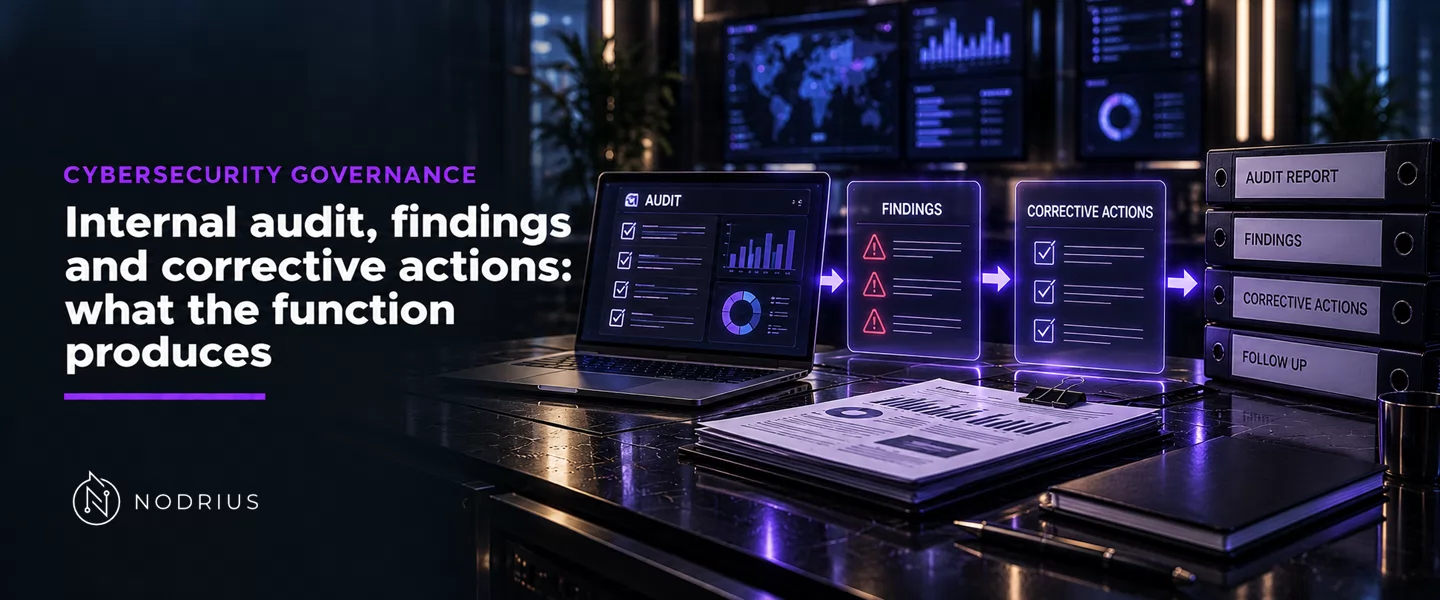
An internal audit is not an assessment. It is a governed function — own mandate, position and board oversight — and what it hands back is a defined set of outputs: a finding where a gap exists between the criteria and the condition observed, a conclusion judging those findings together, recommendations or action plans, and — later — a confirmation that the agreed actions were implemented. Every output depends on one thing: the function sits outside the control it examines.
Three definitions carry that argument. Criteria are the specifications of the desired state; a finding is the determination that a gap exists between them and the condition; the conclusion is the auditor’s professional judgement about the findings viewed together. None of it proves harm, and none of it is a step the team that runs the control can take on itself.
The function and where it sits
The IIA’s Global Internal Audit Standards are the function’s professional frame: the 2024 edition was “Published January 9, 2024” (line 4) and the Standards “are organized into five domains” (line 242), with “15 guiding principles that enable effective internal auditing” (line 152). They are “a mandatory component of the International Professional Practices Framework” (IIA Standards page, line 97). Requirements are “mandatory practices for internal auditing” (line 255), while the closing examples “are neither requirements nor the only ways to demonstrate conformance” (line 265) — a distinction that matters when a checklist is treated as proof.
Two elements fix its position: Domain III has the chief audit executive “position it independently, and oversee its performance” with the board (IIA Standards page, line 113), and Principle 7 holds that “The board establishes and protects the internal audit function’s independence and qualifications” (line 1129). The mandate is carried by a document — the internal audit charter, “A formal document that includes the internal audit function’s mandate, organizational position, reporting relationships, scope of work, types of services, and other specifications” (lines 421–422).
Criteria, finding, conclusion
The glossary fixes three words. Criteria are “specifications of the desired state of the activity under review” (lines 365–366); a finding is “the determination that a gap exists between the evaluation criteria and the condition of the activity under review” (lines 397–398); a conclusion is “Internal auditors’ professional judgment about engagement findings when viewed collectively”, indicating “satisfactory or unsatisfactory performance” (lines 372–373). Standard 14.2 locates the finding in the work: “A difference between the criteria and the condition indicates a potential engagement finding” (line 2185).
criteria          the desired state, written down
condition         the state the auditor actually found
difference        → a potential engagement finding (Standard 14.2)
finding (S/O)     → the engagement conclusion, judging the findings together
                  → recommendations or action plans (Standard 14.4)
                  → final communication (Standard 15.1)
                  → confirmation the actions were implemented (Standard 15.2)
What an engagement must contain
Standard 14.4 requires the auditor to “Resolve the differences between the established criteria and the existing condition” (line 2228) through recommendations, action plans, or agreed actions. Standard 15.1 requires a “final communication that includes the engagement’s objectives, scope, recommendations and/or action plans if applicable, and conclusions” (lines 2284–2285). Standard 15.2 then requires something separate: the auditor must “confirm that management has implemented internal auditors’ recommendations or management’s action plans” (lines 2323–2324), by enquiry, follow-up assessment and status tracking. Verifying that a corrective action was implemented is a distinct act from the finding it closes; an engagement does not end when the report is issued.
The system-audit tradition behind the same words
ISO 19011 supplies the same discipline outside information security: the current edition is ISO 19011:2026, “Edition: 4”, “Publication date: 2026-05” (lines 38–40), replacing “Withdrawn ISO 19011:2018” (line 46). It gives guidance on auditing management systems and “does not itself lead to certification” (line 28). ISO/TC 176 states the purpose: “Effective audits are more than verifying conformity; they help organizations strengthen their management systems, improve performance, and build confidence” (lines 63–64).
Corrective action on the control side
Where a framework names the response, it names a control. SP 800-53 Rev. 5’s RA-7 requires organisations to “Respond to findings from security and privacy assessments, monitoring, and audits in accordance with organizational risk tolerance” (lines 16263–16264). SP 800-53A Rev. 5 gives the assessor’s output two states — each determination produces “satisfied (S); or” “other than satisfied (O)” (lines 2166–2167), the second also covering the assessor who “was unable to obtain sufficient information” (line 2176). SP 800-100 expects the activity: “Perform self-administered or independent security audits or other assessments periodically” (line 1668).
The limits
A finding is evidence of a gap against criteria, not proof of harm: a control can fail the criteria and cause no loss, and can look clean and still be unexamined. The conclusion is worth something only because the function is independent: the same team cannot operate a control and sign it off, and a finding about the audit function’s own work needs an independent route. Confirming an implementation is not removing the finding: the confirmation is itself evidence, recorded against a risk that may still be unacceptable.
Level and prerequisites
L4 — assurance: audit is treated as a governed, output-producing function rather than a technique, and this is the level at which the organisation asks who may conclude anything about its own controls. It assumes the L1 vocabulary (a control designed, implemented and verified; evidence and audit trails), the L2 records (control objectives and verification criteria; the risk and exception register) and the L3 sheets (remediation verification and residual risk; the risk–control–owner–evidence chain).
Where to go next
- Knowledge
- Cybersecurity Governance
- Assurance — the node this sheet sits in.
References
- IIA — Global Internal Audit Standards (2024) — the five domains, the fifteen principles, the charter, the glossary definitions and Standards 14.2, 14.4, 15.1 and 15.2.
- ISO — ISO 19011:2026, Guidelines for auditing management systems — the current edition, its status and its statement on certification.
- NIST — SP 800-53 Rev. 5 — RA-7, the response to findings within risk tolerance.
- NIST — SP 800-53A Rev. 5 — the two finding states and the assessor who cannot obtain sufficient information.
- NIST — SP 800-100 — the periodic self-administered or independent security audit.