
Verifying the fix and the residual risk: closing the remediation loop
Closing a finding takes a new observation and a residual figure, not a status change.
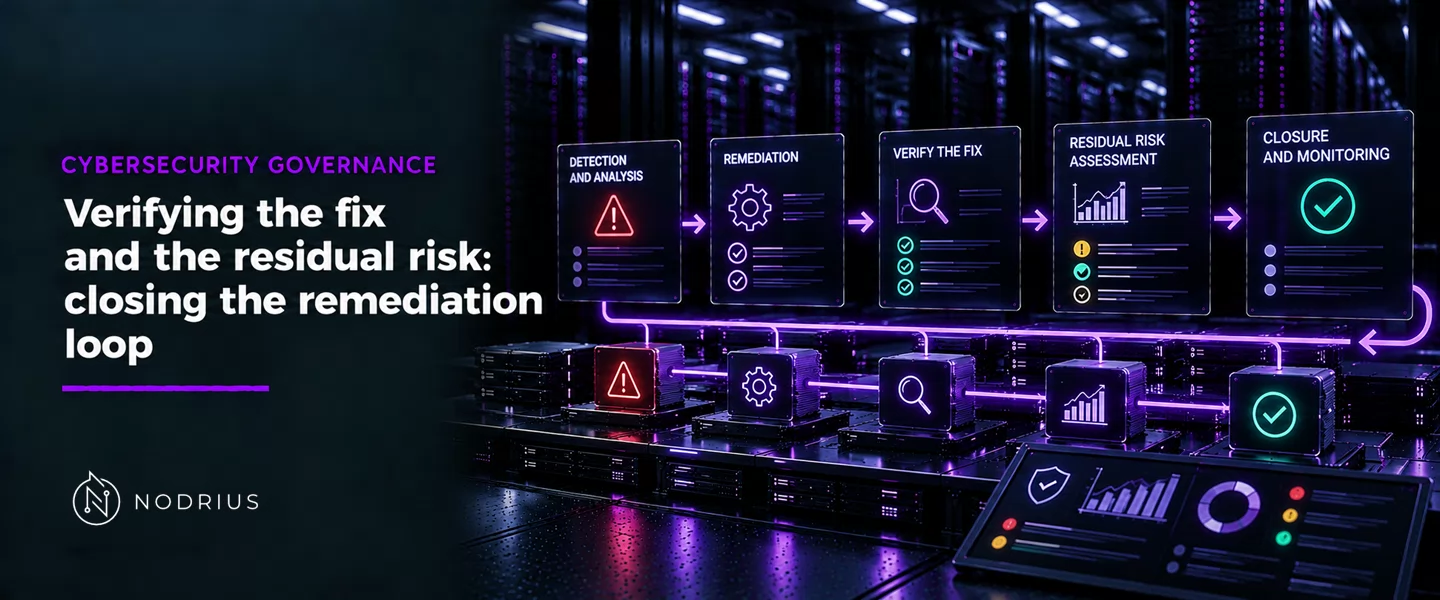
A remediation is verified when someone observes the condition that was wrong and records what the observation returned — not when a ticket changes status. Closing the loop has three joints: a new observation against the original finding, a record of what it returned, and a statement of what is left as residual risk.
A closed ticket is a claim, not an observation
SP 800-53A §3.3 (line 2108) states that each determination statement an assessor executes produces one of two findings: “satisfied (S)” or “other than satisfied (O)” (lines 2166–2167). The second covers “potential anomalies in the operation or implementation of the control” (lines 2174–2175) and the case where “the assessor was unable to obtain sufficient information to make the determination” (lines 2176–2177). A closure claim is answered in the same currency: an observation of the same object.
CA-5 carries the record. The plan of action and milestones documents “planned remediation actions of the organization to correct weaknesses or deficiencies noted during the assessment of the controls” (lines 6636–6638) — the entry exists because an assessment returned something other than satisfied — and must be updated “based on the findings from control assessments, independent audits or reviews, and continuous monitoring activities” (lines 6642–6643). Closure is a later entry in that record, not a status change in a tracker.
The loop the corpus describes
finding                 other than satisfied, about one observable   (SP 800-53A §3.3)
      ↓
plan of action          planned remediation action and milestones     (CA-5)
      ↓
remediation             correct the flaw; test the update first       (SI-2 a, b)
      ↓
new observation         the same object, examined again               (CA-7 c, d)
      ↓
new finding             satisfied, or other than satisfied again
      ↓
residual risk           what remains, in the register's own column    (NISTIR 8286r1)
      ↓
risk response           accept, mitigate further, avoid or transfer   (RA-7)
Every arrow is a place where the loop can be dropped: a finding closed by assertion, an entry without a milestone, a fix installed untested, a second observation against the wrong object, a remainder left unrecorded.
Why a re-scan is not a verification
The reading below is this sheet’s own, not a quotation. A scanner re-testing the vector named in the finding answers one question — is that vector still exploitable — and leaves three: whether the change that closed it was the intended one, whether it introduced something else, and whether the condition existed where the scan did not look.
SI-2 FLAW REMEDIATION requires organisations to “Identify, report, and correct system flaws” (line 21744)
and to “Test software and firmware updates related to flaw remediation for effectiveness and potential side
effects before installation” (lines 21746–21747) — for effectiveness and side effects. Its discussion
names the mechanism: “By incorporating flaw remediation into configuration management processes, required
remediation actions can be tracked and verified” (lines 21759–21761). Verification sits in the record of what
changed, not in the scan output; SI-2(2) adds a periodic check that the updates are installed (line 21784).
CA-7 asks the same at programme level: ongoing control assessments, “Correlation and analysis of information generated by control assessments and monitoring” (line 6777), and CA-7(4) effectiveness monitoring, which “determines the ongoing effectiveness of the implemented risk response measures” (lines 6872–6873).
What remains afterwards is residual risk
A verification that returns satisfied still leaves something, and the corpus gives it a column. NISTIR 8286r1: “The residual risk (i.e., the remaining risk after applying risk responses) should then be recorded in the risk register’s Residual Risk column” (lines 1607–1609), and the register “is updated to reflect that information” once the response is approved and an accountable owner named (lines 1810–1811). 8286r1 quotes both from the COSO ERM Framework: “Target residual risk is the amount of risk that an entity prefers to assume” and “Actual residual risk is the risk remaining after management has taken action to alter its severity. Actual residual risk should be equal to or less than the target residual risk.” (lines 1161–1166).
Where residual risk “is beyond the acceptable level of risk, then the risk owner should evaluate whether the risk can be brought to an acceptable level” (lines 1804–1806). RA-7 places that decision in the catalogue — organisations respond to findings “in accordance with organizational risk tolerance” (lines 16263–16264) — while RA-3 requires the risk assessment itself to be revised on a significant change (line 15900).
Feeding the result back
SP 800-137 ties monitoring frequency to that state: controls recorded in the plan of action and milestones as having weaknesses “are monitored more frequently until remediation of the weakness is complete” (line 1553). The loop closes when the record changes — the CA-5 update, the register’s residual-risk column, the revised risk assessment. CSF 2.0 asks the same at subcategory level: ID.RA-06, “Risk responses are chosen, prioritized, planned, tracked, and communicated” (line 903), and RC.RP-05, where the integrity of restored assets is verified and normal operating status confirmed (line 1100).
What to remember
- A ticket status is a claim; verification is an observation of the same object.
- What remains after a fix is residual risk, recorded by an owner and compared with a target.
- The loop closes when the register, the plan of action or the risk assessment changes.
Level and prerequisites
L3 — intermediate: assessment, control selection and process coordination. It assumes the L2 sheet on control objectives and verification criteria, which owns the criterion, the object and the method, and the L2 sheet on the risk and exception register, which owns the row; this sheet owns the observation that closes a finding and the residual-risk statement that follows it.
Where to go next
- Knowledge — the index.
- Cybersecurity Governance — the area this sheet belongs to.
- Assurance — this sheet’s node.
The sibling L3 sheets on internal SLAs and on vulnerability management as a governance process are not repeated here, and neither is published yet.
References
- NIST — SP 800-53 Rev. 5, Security and Privacy Controls for Information Systems and Organizations — https://doi.org/10.6028/NIST.SP.800-53r5 — CA-5 (the plan of action and milestones and its update), CA-7 and CA-7(4) (ongoing assessment, correlation, response, effectiveness monitoring), SI-2 and SI-2(2) (flaw remediation, testing before installation, configuration management, installed-update check), RA-3(f) (risk assessment revised on significant change) and RA-7 (risk response and the POA&M entry).
- NIST — SP 800-53A Rev. 5, Assessing Security and Privacy Controls in Information Systems and Organizations — https://doi.org/10.6028/NIST.SP.800-53Ar5 — the two finding states satisfied / other than satisfied, the anomaly case and the unable-to-obtain-information case (§3.3).
- NIST — NIST IR 8286r1, Integrating Cybersecurity and Enterprise Risk Management (ERM) — https://doi.org/10.6028/NIST.IR.8286r1 — the residual-risk column of the register, the register update after a risk response, and target versus actual residual risk as quoted there from the COSO ERM Framework.
- NIST — The NIST Cybersecurity Framework (CSF) 2.0, NIST CSWP 29 — https://doi.org/10.6028/NIST.CSWP.29 — ID.RA-06 (risk responses tracked) and RC.RP-05 (verification of the integrity of restored assets).
- NIST — SP 800-137, Information Security Continuous Monitoring (ISCM) for Federal Information Systems and Organizations — https://nvlpubs.nist.gov/nistpubs/Legacy/SP/nistspecialpublication800-137.pdf — POA&M weaknesses monitored more frequently until remediation is complete.