
RPO and RTO: objectives to define and then verify
How to state RPO and RTO as owned objectives, and prove them with test evidence.
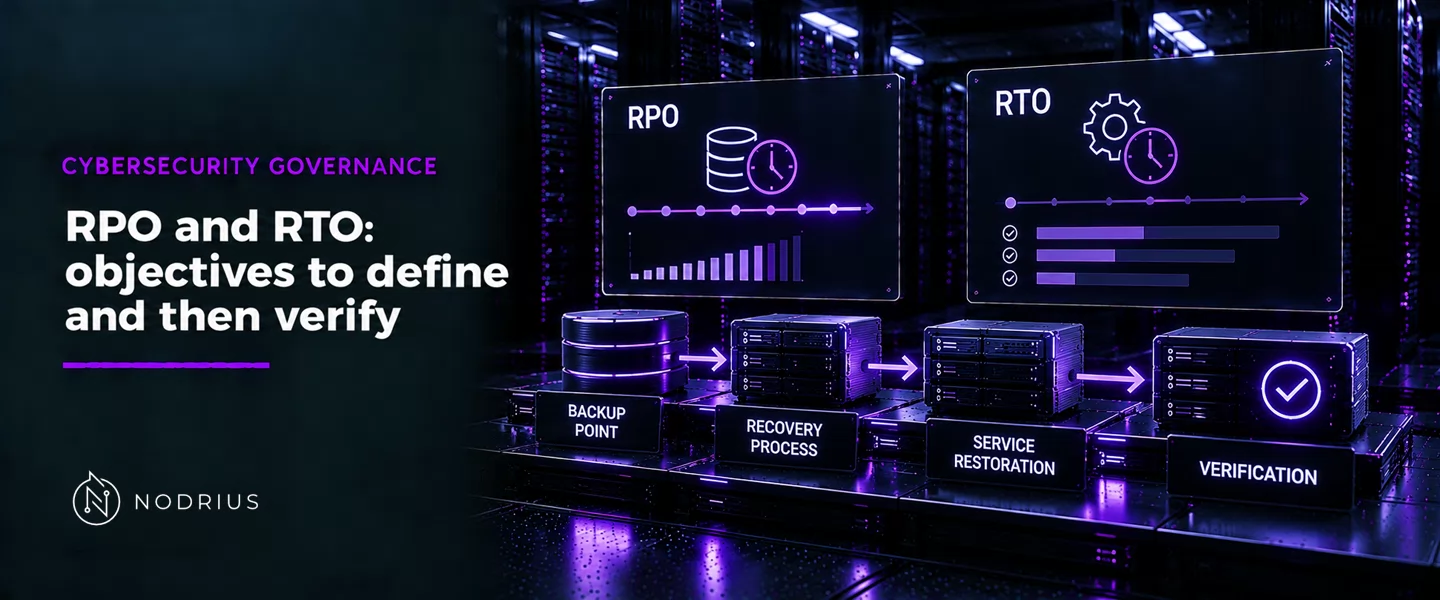
RPO and RTO are decisions before they are numbers. The recovery time objective (RTO) is how long a resource may stay unavailable before the impact becomes unacceptable; the recovery point objective (RPO) is how much data loss the mission can tolerate, expressed as the point in time to which data must be recovered. SP 800-34 Rev. 1 derives both from the business impact analysis rather than from the technology, SP 800-53 Rev. 5 turns them into recovery objectives a plan must state and a test must exercise, and CSF 2.0 puts verification of what is restored inside recovery itself. Neither is worth much without an owner, a cost and a test.
   last backup           disruption             recovered   MTD limit
        |                    |                      |            |
  ------+--------------------+----------------------+------------+-->  time
        |<------ RPO ------->|
        |    data at risk    |
                             |<------- RTO -------->|
                             | resource unavailable |
                             |<-------------- MTD -------------->|
        |           total outage the mission tolerates           |
Two objectives, and two different losses
The two terms answer different questions. RTO is time: it “defines the maximum amount of time that a system resource can remain unavailable before there is an unacceptable impact on other system resources, supported mission/business processes, and the MTD” (SP 800-34 Rev. 1, lines 1323–1326). RPO is data: it “represents the point in time, prior to a disruption or system outage, to which mission/business process data can be recovered (given the most recent backup copy of the data) after an outage” (lines 1331–1334). The guide then states the asymmetry that is easy to miss — “Unlike RTO, RPO is not considered as part of MTD. Rather, it is a factor of how much data loss the mission/business process can tolerate during the recovery process” (lines 1334–1336). RTO sits inside the maximum tolerable downtime (MTD) and must normally be shorter than it (lines 1338–1341). Reading the time line above left to right gives the shape of the problem: the RPO is fixed backwards from the disruption by how often data is copied, the RTO forward from it by how fast the resource can be rebuilt, and the MTD is the ceiling both must respect.
Where the numbers come from
Neither number is a property of the technology stack. SP 800-34 Rev. 1 places them in the business impact analysis: the coordinator and the process owners “determine the acceptable downtime if a given process or specific system data were disrupted or otherwise unavailable” (lines 1310–1312), and the first BIA step requires that “the downtime should reflect the maximum time that an organization can tolerate while still maintaining the mission” (lines 1224–1225). The guide is explicit that “ISCP recovery time objectives are determined by the system-based BIA” (line 1367). SP 800-53 Rev. 5 restates the direction as a control: CP-2 requires the plan to state “recovery objectives, restoration priorities, and metrics” (line 8312), its discussion says the objectives “reflect … organizational risk tolerance, and system impact level” (lines 8353–8355), and it removes the assumption of full recovery — “not all systems need to fully recover to achieve the level of continuity of operations desired” (lines 8352–8353).
The number is also a spending and ownership decision. The coordinator sets the recovery point “while balancing the cost of system inoperability against the cost of resources required for restoring the system” (SP 800-34 Rev. 1, lines 1377–1378), and the plan that carries the objectives must be “reviewed and approved by [Assignment: organization-defined personnel or roles]” (CP-2, line 8325).
No standard value for a class of system
No source in this evidence set prescribes an RPO or an RTO for a class of system. The figures that appear in SP 800-34 Rev. 1 are illustrative: the BIA template’s example row shows a process with a 72-hour MTD, a 48-hour RTO and a 12-hour RPO taken from the last backup (lines 5809–5812), and the surrounding instruction asks only for a form — “Values for MTDs and RPOs are expected to be specific time frames, identified in hourly increments” (lines 5806–5807) — never for a number. (My own reading: that row is a filled-in template, and copying its figures without running the analysis would adopt another organisation’s tolerance.)
What NIST supplies instead is language for turning a general availability wish into a checkable statement. NISTIR 8286r1 defines risk tolerance as “the acceptable level of variance in performance relative to the achievement of objectives” (lines 590–591) and illustrates the reframing: an appetite that “Email service shall be available during the large majority of a 24-hour period”, narrowed to a tolerance that “Email services shall not be interrupted for more than five minutes during core hours” (lines 598–601). An RTO written that way names the resource, the window and the threshold; “high availability” names none of them.
Writing the objective so it can be verified
An objective a test can fail must name the resource, the measure, the threshold and the window. SP 800-53 Rev. 5 makes the objective govern concrete settings rather than sit beside them: CP-9 requires backups at a frequency “consistent with recovery time and recovery point objectives” (lines 8929–8934), and CP-10 requires recovery “to a known state within [Assignment: organization-defined time period consistent with recovery time and recovery point objectives] after a disruption, compromise, or failure” (lines 9071–9073). The objective is not a description of the system; it constrains the backup frequency and the restoration capability that must exist.
A stated objective is a claim, and the evidence that it is met is a test that restores and times the restoration. CP-4 requires the plan to be tested “to determine the effectiveness of the plan and the readiness to execute the plan” (lines 8551–8553). Two CP-9 enhancements narrow the target: CP-9(1) requires backup information to be tested “to verify media reliability and information integrity” (lines 8964–8965), and CP-9(2) requires a sample of backup information to be used “in the restoration of selected system functions as part of contingency plan testing” (lines 8979–8980). CSF 2.0 puts the same expectation at both ends of the restore: RC.RP-03, that “the integrity of backups and other restoration assets is verified before using them for restoration” (lines 1094–1095), and RC.RP-05, that “the integrity of restored assets is verified, systems and services are restored, and normal operating status is confirmed” (lines 1100–1101). (My own reading: a measured restore that meets the RTO is the only thing separating an objective met from an objective assumed.)
Level and prerequisites
L3 — assessment and process coordination: it takes the objectives that continuity planning produces and turns them into verifiable commitments backed by test evidence. Prerequisites are the L2 sheets on service criticality and dependencies and on the inventory record, and the L3 continuity sheet (analysis → strategy → plan → test), which owns the business impact analysis that generates the numbers; this sheet owns the two objectives and their verification.
Where to go next
- Knowledge — the index.
- Cybersecurity Governance — the area this sheet belongs to.
- Assurance — this sheet’s node.
References
- NIST — Contingency Planning Guide for Federal Information Systems (SP 800-34 Rev. 1) — https://nvlpubs.nist.gov/nistpubs/Legacy/SP/nistspecialpublication800-34r1.pdf — the definitions of MTD, RTO and RPO, the business impact analysis as their source, and the cost-versus-availability framing of the recovery decision.
- NIST — Security and Privacy Controls for Information Systems and Organizations (SP 800-53 Rev. 5) — https://doi.org/10.6028/NIST.SP.800-53r5 — CP-2 recovery objectives, metrics and approval; CP-4 plan testing; CP-9 backup frequencies and its reliability and sampling enhancements; CP-10 recovery, reconstitution and restore-within-a-time-period.
- NIST — The NIST Cybersecurity Framework (CSF) 2.0 (NIST CSWP 29) — https://doi.org/10.6028/NIST.CSWP.29 — RC.RP-03 and RC.RP-05, the verification of restoration assets before use and of restored assets afterwards.
- NIST — Integrating Cybersecurity and Enterprise Risk Management (ERM) (NIST IR 8286r1) — https://doi.org/10.6028/NIST.IR.8286r1 — risk tolerance as the acceptable variance in performance relative to objectives, with the appetite-and-tolerance statement example.