
Business impact analysis, continuity and recovery: from impact to plan
Impact first: the BIA turns tolerable downtime into priorities and a plan you can test.
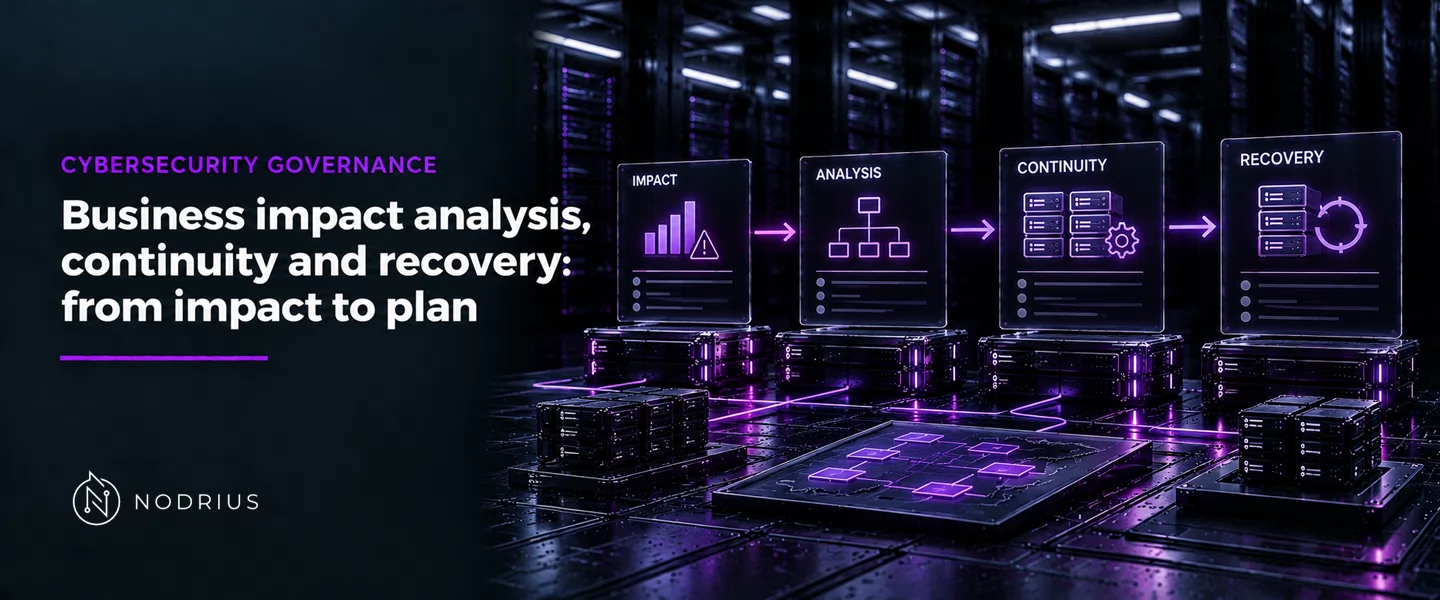
A business impact analysis (BIA) answers two questions the mission, not the technology, has to settle: what stops if this service stops, and how long may that last. NIST’s contingency planning guide makes it the second of seven steps and says the BIA “helps identify and prioritize information systems and components critical to supporting the organization’s mission/business processes” (SP 800-34 Rev. 1, lines 415–416). It is an instrument with an output — recovery priorities and a tolerable downtime — which the same process turns into strategies, a plan and a test. Continuity and disaster recovery differ in scope — business processes in the first case, systems and sites in the second — but both rest on that one analysis.
The BIA is one step in a chain, not a document
The guide defines seven steps and the analysis is the second (lines 408–435). A policy statement gives it authority; preventive controls, contingency strategies and the plan follow; testing and maintenance close the loop.
1  contingency planning policy statement
2  business impact analysis          <-- this sheet's subject
3  preventive controls
4  contingency strategies
5  information system contingency plan
6  plan testing, training and exercises
7  plan maintenance

scope               plan family     analysis it rests on
business processes  BCP / COOP      process-focused BIA
systems and sites   DRP / ISCP      system-focused BIA
The direction is explicit: “The BIA is the first source for determining resiliency and contingency planning strategies” (line 2696). And each choice has a price: “Each of these strategy decisions have cost versus availability or recovery implications” (lines 2700–2701).
What the analysis has to produce
Three steps accomplish the BIA (line 1220). The first determines “mission/business processes and recovery criticality” and “the maximum time that an organization can tolerate while still maintaining the mission” (lines 1222–1225). The second identifies the resources needed to resume those processes — “facilities, personnel, equipment, software, data files, system components, and vital records” (lines 1227–1240). The third establishes “recovery priorities for system resources” and the resulting “information system recovery priority hierarchy” (lines 1241–1245, 1428–1430).
Its purpose is to “correlate the system with the critical mission/business processes and services provided” and, on that basis, “characterize the consequences of a disruption” (lines 1203–1206). The output is a ranking, not a narrative.
Downtime becomes a number, and a number becomes a cost
Tolerable downtime is three figures. Maximum Tolerable Downtime (MTD) is “the total amount of time the system owner/authorizing official is willing to accept for a mission/business process outage” (lines 1315–1318); the Recovery Time Objective (RTO) is “the maximum amount of time that a system resource can remain unavailable before there is an unacceptable impact” (lines 1323–1326); the Recovery Point Objective (RPO) is “the point in time, prior to a disruption or system outage, to which mission/business process data can be recovered” (lines 1331–1333). The RTO “must normally be shorter than the MTD” (lines 1338–1339).
Writing them down as objectives, and later proving them, is the objectives sheet’s subject; here they are the analysis’s output.
Continuity and disaster recovery are different scopes
The plan family is not one document. A Business Continuity Plan (BCP) “focuses on sustaining an organization’s mission/business processes during and after a disruption” (lines 858–859); a Disaster Recovery Plan (DRP) “applies to major, usually physical disruptions to service” and “only addresses information system disruptions that require relocation” (lines 963–970). An Information System Contingency Plan (ISCP) carries procedures “developed for recovery of the system regardless of site or location” (lines 979–980). One evidence base, two scopes: a process-focused BIA behind the business plan, a system-focused BIA behind the system plan (box at lines 1203–1206).
From strategy to a plan that can be tested
SP 800-53 Rev. 5 requires a contingency plan that “Identifies essential mission and business functions and associated contingency requirements” and “Provides recovery objectives, restoration priorities, and metrics” (CP-2, lines 8309, 8312), reviewed at a defined frequency and updated when the system or its environment changes (lines 8332–8337).
An untested plan is a hypothesis. CP-4 requires an organisation to “Test the contingency plan for the system … to determine the effectiveness of the plan and the readiness to execute the plan” (lines 8551–8553), using methods that run from “checklists, walk-through and tabletop exercises” to simulations and comprehensive exercises (lines 8564–8566). Testing buys the plan its corrections: it must incorporate “lessons learned from contingency plan testing, training, or actual contingency activities” (line 8341).
The chain does not end at the plan
Step seven makes maintenance part of the process, and the reason given is that the plan “should be a living document that is updated regularly to remain current with system enhancements and organizational changes” (lines 434–435). The same duty is monitored too: SP 800-137 lists “contingency plan testing dates and results” among the metrics an organisation may collect (lines 1446–1447). Recovery also has an end state: CP-10 requires it “to a known state” within a period consistent with the recovery time and recovery point objectives (lines 9071–9073). An analysis performed once, with a plan never re-run, describes the organisation as it was.
Level and prerequisites
L3 — process coordination: run the analysis-to-plan chain for one service, decide what its recovery objectives need to buy, and say what will prove the plan works. Prerequisites are the L2 sheets on service criticality and the risk and exception register, and the L1 sheet on risk factors. RPO and RTO as objectives, and the governance of an incident, are separate sheets.
Where to go next
- Knowledge — the index.
- Cybersecurity Governance — the area this sheet belongs to.
- Risk management — this sheet’s node.
References
- NIST — Contingency Planning Guide for Federal Information Systems (SP 800-34 Rev. 1, May 2010, updated 11 November 2010) — https://nvlpubs.nist.gov/nistpubs/Legacy/SP/nistspecialpublication800-34r1.pdf — the seven-step contingency planning process with the BIA as step 2; the three BIA steps and the recovery priority hierarchy; MTD, RTO and RPO; the BCP/COOP/DRP/ISCP scopes; the cost-versus-availability sentence; the BIA as the first source for strategies; plan maintenance.
- NIST — Security and Privacy Controls for Information Systems and Organizations (SP 800-53 Rev. 5) — https://doi.org/10.6028/NIST.SP.800-53r5 — CP-2 CONTINGENCY PLAN (essential functions, recovery objectives and restoration priorities, review and update, lessons learned), CP-4 CONTINGENCY PLAN TESTING (test methods and their purpose) and CP-10 SYSTEM RECOVERY AND RECONSTITUTION (recovery to a known state).
- NIST — The NIST Cybersecurity Framework (CSF) 2.0 (NIST CSWP 29, 26 February 2024) — https://doi.org/10.6028/NIST.CSWP.29 — the RECOVER function: RC.RP-01…06 (execution, scoping and prioritisation, verified backups, post-incident norms, restoration, declared end of recovery) and RC.CO-03/-04 (recovery progress communicated, public updates).
- NIST — Information Security Continuous Monitoring (ISCM) for Federal Information Systems and Organizations (SP 800-137, September 2011) — https://nvlpubs.nist.gov/nistpubs/Legacy/SP/nistspecialpublication800-137.pdf — contingency plan testing dates and results as an example of the metrics an organisation may monitor.