
Indicators of residual risk: watching what remains after treatment
Recorded is not the same as watched: what moves a residual figure, and what it hides.
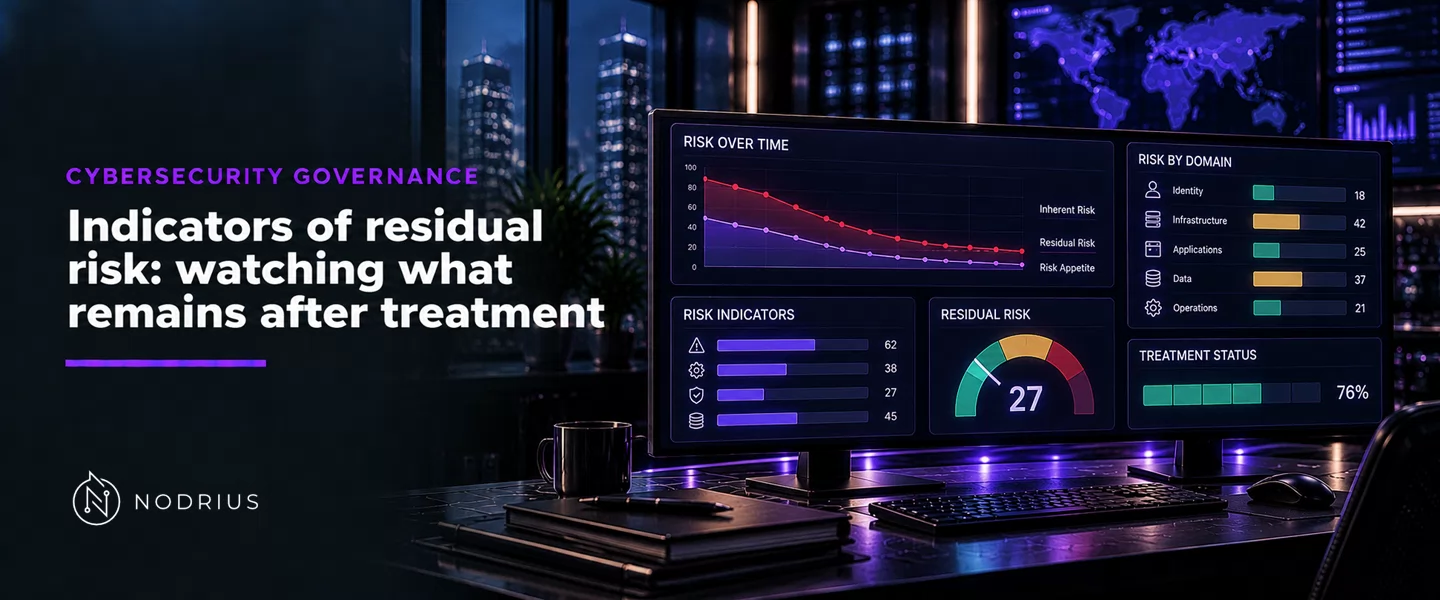
Residual risk is what is still exposed after the organisation applies its security measures: the “Portion of risk remaining after security measures have been applied” (SP 800-30 Rev. 1, glossary, cited there to CNSSI No. 4009). An indicator of residual risk is not the residual figure itself. The figure is recorded once per risk; the indicator watches it over time against what the organisation said it was willing to carry. A value recorded and never read changes nothing.
What is being watched
The register holds the residual after the responses are chosen: “The residual risk (i.e., the remaining risk after applying risk responses) should then be recorded in the risk register’s Residual Risk column” (NISTIR 8286r1). Recording that statement is the register’s own subject and closing a single remediation is the L3 sheet’s; what makes the value watchable is a second number beside it — the state the organisation intends to be in — so that a movement, or a failure to move, becomes visible.
Why a residual figure moves at all
Residual risk is the residue of a decision, not a fixed property. “Based on the course of action selected during the risk response step, some residual risk may remain. Under certain circumstances, the level of residual risk could trigger a reassessment of risk” (SP 800-39) — one that is “typically incremental (assessing only the new information) and differential (assessing how the new information changes the overall risk determination)”. A residual should move when the response changes, when information arrives, or when a control degrades; one identical across all three is a statement about the register, not the risk.
What is accepted is this residual and nothing upstream of it. “The level of residual risk accepted by authorizing officials for information systems or inherited common controls is within the organizational risk tolerance, and not the individual risk tolerances of those authorizing officials.” And the evaluation is not timeless: “the evaluation of residual risk (which changes over time) to determine acceptable risk is dependent on the threshold set by organizational risk tolerance.” Move the threshold and the same figure changes meaning, with no control having moved.
The ERM layer: appetite, tolerance and a target to move toward
The enterprise-risk layer supplies the two reference points. Risk appetite is “the amount and type of risk that an organization is willing to take in meeting its objectives”; risk tolerance is “the organization or stakeholders’ readiness to bear the remaining risk after responding to or considering the risk to achieve its objectives” (NISTIR 8286r1). Tolerance is where measurement bites: statements “should have clear and measurable boundaries where possible to define”, and “Key performance indicators and key risk indicators should be created to warn that these tolerance boundaries are being approached and reported accordingly.”
Beside the recorded value the register can carry an intention rather than a bound: “target residual risk, which is the desired risk state based on risk appetite/tolerance”. The indicator’s work is the gap between the current residual and that target. Continuous monitoring supplies the trigger — “such monitoring could determine when negative cybersecurity risks for a system are approaching the risk tolerance level, triggering a review of the risk that could result in a higher priority for the risk and the implementation of additional risk responses.”
inherent risk   →   risk response   →   residual risk   →   compare with target   →   indicator
                    (accept, avoid,     recorded in the      target = the desired      watched over
                     transfer, mitigate) register's column    state, from appetite      time, read as
                                                               and tolerance            a movement

the same estimate produced the inherent risk and the residual it leaves
a residual that does not move after a remediation marks the register, not the risk
CSF 2.0 states the duty as an outcome: “ID.RA-06: Risk responses are chosen, prioritized, planned, tracked, and communicated”, with GV.RM-02 requiring “Risk appetite and risk tolerance statements … established, communicated, and maintained”. Chosen and planned without tracked is a decision taken and forgotten.
The limits of the indicator
First, the residual is a judgement made with the same estimate that produced the inherent risk. The estimation companion warns that “Some methods, such as this SME estimation, can be subjective”, and treats sensitivity analysis as covering “not just of the model, but of the input assumptions”. An indicator carries those assumptions twice — in the figure and in the threshold it is compared against.
Second, a residual that never moves after a remediation is a sign the register is not being updated, not a sign the risk vanished: the reassessment that would move it is incremental and differential, and the acceptance rests on a threshold that is itself reviewed.
Third, acceptance has a date and an owner, or it is a forgotten tolerance; and a residual aggregated across the estate without a stated aggregation rule is a number nobody can act on. SP 800-39 draws the boundary itself — “the aggregation of different types of risk across the organization is beyond the scope of this publication” — its own measure of how far a single residual-reaching figure travels before it needs a rule.
Level and prerequisites
L4 — metrics and assurance: the sheet does not record a residual or close a finding, it decides what is watched about what remains. Prerequisites: the L2 sheets on the risk register and the exception register and on control objectives and verification criteria; the L3 sheet that verifies a fix and states the residual risk, and the L3 sheet on risk-based prioritisation and exposure.
Where to go next
References
- NIST — SP 800-30 Rev. 1, Guide for Conducting Risk Assessments — the glossary definition of residual risk, cited there to CNSSI No. 4009.
- NIST — SP 800-39, Managing Information Security Risk — why a residual moves and triggers reassessment, what authorizing officials accept, the threshold dependence, and the aggregation limit.
- NIST — IR 8286r1, Integrating Cybersecurity and Enterprise Risk Management (ERM) — risk appetite and tolerance, measurable tolerance boundaries, the target residual risk, and continuous monitoring as the trigger.
- NIST — IR 8286Ar1, Identifying and Estimating Cybersecurity Risk for ERM — the estimation companion: subjectivity of estimation and sensitivity analysis over input assumptions.
- NIST — The NIST Cybersecurity Framework (CSF) 2.0, NIST CSWP 29 — ID.RA-06 and GV.RM-02.