
Supplier evaluation and critical dependencies: where the assessment bites
Assessment depth, evidence and frequency, set by the criticality of the dependency.
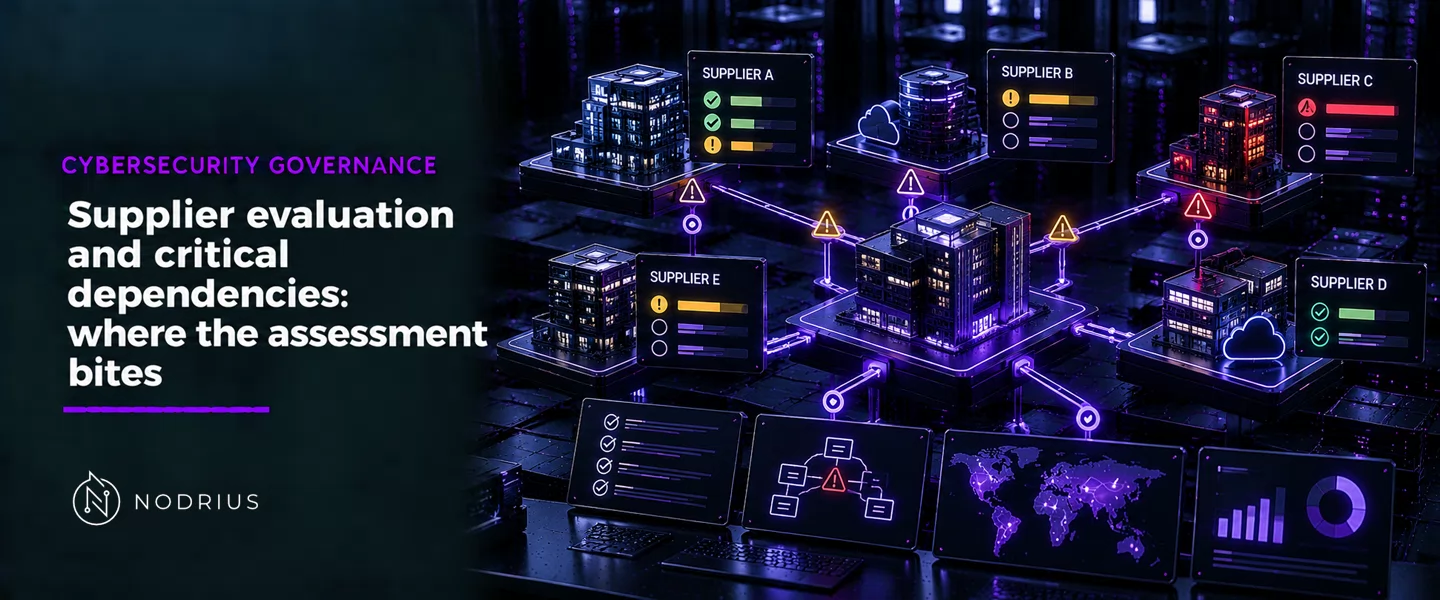
A supplier evaluation is a decision about depth: how much checking a given supplier earns. NIST SP 800-161r1-upd1, the current edition of NIST’s cyber supply chain risk management (C-SCRM) guidance, states the rule the sheet turns on: the required methods are “commensurate with the criticality of the service or product being acquired” (lines 2474–2477). As this sheet reads it, criticality is the input and the evaluation the output; the dependency — what stops working if that supplier stops — is why criticality is worth determining. This sheet chooses the depth and the interval; the contract that states the requirements is the sibling sheet.
The object is the supplier and the service
SR-6 names two things to assess: “the supply chain-related risks associated with suppliers or contractors and the system, system component, or system service they provide” (SP 800-53r5, lines 24088–24090). The supplier is one question; the service is the other.
Choosing which suppliers to evaluate starts from a record. SP 800-161r1-upd1 makes it the first step: “ensure that there is a current and accurate inventory of the enterprise’s supplier relationships, contracts, and any products or services those suppliers provide” (line 2333), so priority can go to “those critical suppliers of the most strategic or operational importance” (line 2340). CSF 2.0 records the duty as GV.SC-04, “Suppliers are known and prioritized by criticality”, and ID.AM-04 (lines 838, 876); SR-13 holds the inventory and fixes its granularity (upd1, lines 9082–9093).
Criticality is a determination you record
Criticality is not read off the supplier; it is decided and written down. The guidance places the determination early in the procurement flow: “the need for and the criticality of the good or service to be procured needs to be identified, along with a description of the factors driving the determination … as this informs how much risk may be tolerated” (lines 2381–2385). One judgement consequently informs how much risk may be tolerated and what the requirements will say.
The example groupings (lines 2336–2338) are categories “as determined by the organization”, not a scale imposed by the standard; SR-13 asks for “the organization’s tier one suppliers” under “[Assignment: organization-defined parameters for determining tier one supply chain]” (upd1, lines 9084–9086). The publication’s three levels — Enterprise, Mission and Business Process, Operational (lines 1520, 1525, 1529) — are the buyer’s own levels of risk management, not a ranking of suppliers.
Depth is chosen, not maximised
The guidance lists the methods an evaluation may use and ties their rigour to the stake: “requisite certifications, site visits, third-party assessments, or self-attestation. The type and rigor of the required methods should be commensurate with the criticality of the service or product being acquired and the corresponding assurance requirements” (lines 2474–2477). The proportionality runs the other way too: “the amount of transparency required from suppliers should be commensurate to the suppliers’ criticality” (lines 3744–3746). A questionnaire built for a critical supplier is as wrong applied to a standard one as the reverse.
the dependency decides the check

  criticality of the service  ->  depth of the method   ->  interval of re-evaluation
  what breaks if it fails         self-attestation,         how often the
  (upd1 2381-2385)                site visit, third-        assumption is retested
  single source of supply         party assessment,         (SR-6 organization-
  (upd1 2342-2343)                certification             defined frequency;
                                  (upd1 2474-2477)          upd1 2461, 2812-2814)
A certificate is an input, never the conclusion
A certificate is one confidence-building mechanism, not the conclusion. The guidance recommends the class — “third-party assessment surveys, on-site visits, and formal certifications (e.g., ISO 27001, IEC 62443-4-1)” to assess critical suppliers (lines 2808–2810) — and allows existing documentation to be reused where it “may provide evidence to support C-SCRM” (lines 1029–1033). What SR-6’s discussion says an assessment covers is wider: security and supply chain risk management processes, foreign ownership, control or influence (FOCI), and “documented processes, documented controls, all-source intelligence, and publicly available information” (lines 24097–24104). A certificate answers one of those.
The supplier’s own suppliers are in scope
Because the service the organisation depends on is rarely built by one firm, the evaluation reaches past the contracting party. SR-6 asks whether the supplier can “effectively assess subordinate second-tier and third-tier suppliers and contractors” (line 24099), and the controls must travel: agreements should include “Flow-down control requirements to subcontractors, if and when applicable” (upd1, line 2457). The second- and third-tier wording names a capability under review, and which controls flow down is the organisation’s own decision.
Scheduling the re-evaluation
The interval is left to the organisation rather than fixed by the standard: SR-6 requires the review at an “[Assignment: organization-defined frequency]” (line 24090). Around it the guidance expects contractual agreements to include “the periodic revalidation of supplier adherence to security requirements” (upd1, line 2461) and a sustaining practice to “Establish formal processes and intervals for continuous monitoring and reassessment” (lines 2812–2814). An evaluation with no interval is a snapshot the organisation cannot rely on.
What the evaluation is not
No source here defines a supplier-tier model or fixes a re-evaluation interval; both are determinations the organisation makes and records, and reading either as given would misstate the guidance. A certificate, a questionnaire or a site visit is an input to that decision, not the decision itself.
Level and prerequisites
L3 — analytical: choose the depth of a supplier evaluation and the interval between evaluations from the criticality of the service and the dependency on it. It assumes the L2 supplier-governance cycle (requirements, due diligence, oversight, evidence, exit) and the L1 vocabulary of risk treatment. The criticality of the service is the L2 sheet’s subject; stating the requirements is the sibling sheet’s.
Where to go next
- Knowledge — the index.
- Cybersecurity Governance — the area this sheet belongs to.
- Risk management — this sheet’s node.
Sibling sheets are unpublished drafts.
References
- NIST — SP 800-53 Revision 5, Security and Privacy Controls for Information Systems and Organizations (September 2020, includes updates as of 10 December 2020) — https://doi.org/10.6028/NIST.SP.800-53r5 — the
SR-6control statement and its discussion (the supplier and the service as the two objects of the assessment, FOCI, the second- and third-tier question, the review methods) and theSR-3(3) SUB-TIER FLOW DOWNenhancement (:23864). - NIST — SP 800-161r1-upd1, Cybersecurity Supply Chain Risk Management Practices for Systems and Organizations, errata update of the May 2022 edition (1 November 2024) — https://doi.org/10.6028/NIST.SP.800-161r1-upd1 — the supplier inventory and the priority given to critical suppliers, the determination of criticality and the risk it informs, the proportionality of validation methods to criticality, the transparency sentence, the confidence-building and certification sentence, the flow-down requirement, the periodic-revalidation clause, and
SR-13. - NIST — The NIST Cybersecurity Framework (CSF) 2.0, NIST CSWP 29 (26 February 2024) — https://doi.org/10.6028/NIST.CSWP.29 — the GV.SC category and its subcategories GV.SC-01 to GV.SC-10, and ID.AM-04.