
Vulnerability management as a governance process: from feed to decision
The scanner is an input: the governance steps from feed to decision, each with an owner.
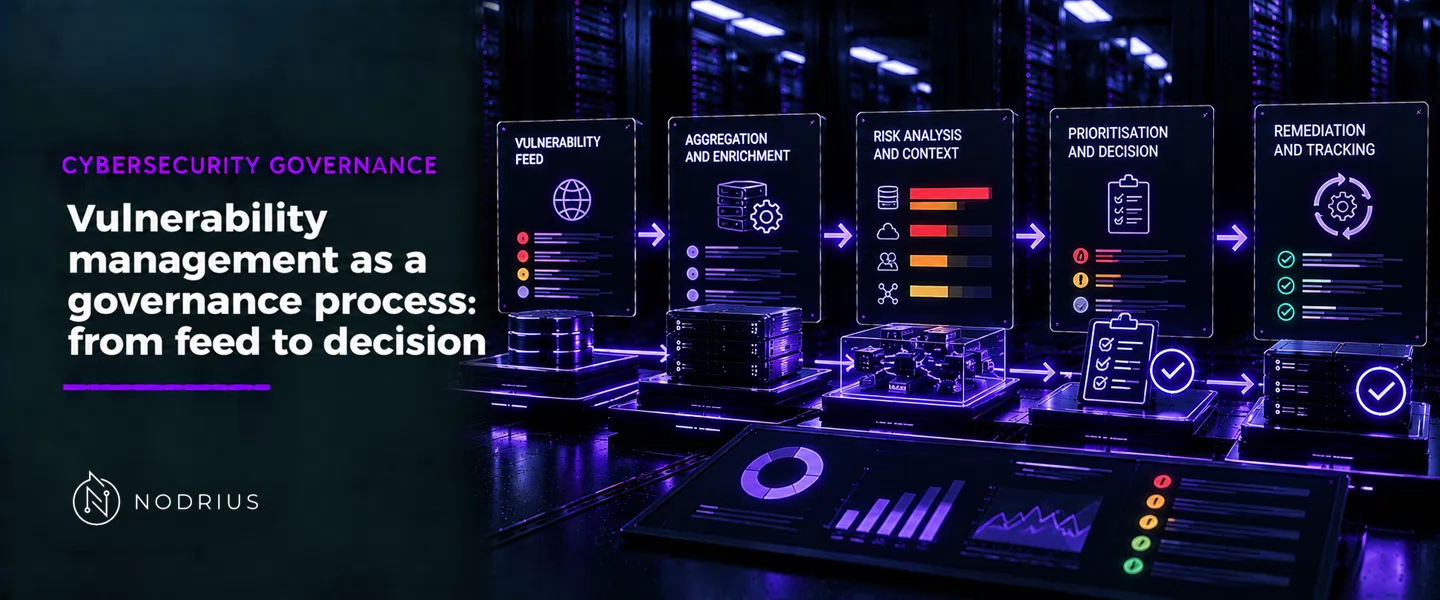
A vulnerability feed is an input; the process that consumes it is a chain of owned steps — identification → validation → recording → prioritisation → remediation → verification — and each step produces a record that a named owner is accountable for. The scanner sits at the first step, and what turns its output into a decision is the machinery after it. The process fails at the step nobody owns, and that step is most often verification.
The feed is an input, not the process
SP 800-40r4 defines the activity by its verbs: “Enterprise patch management is the process of identifying, prioritizing, acquiring, installing, and verifying the installation of patches, updates, and upgrades throughout an organization” (line 110). Read the list as steps rather than as a product: only installing is technical, while identification, prioritisation and verification are organisational acts. CISA makes the same point about the feed — the KEV (Known Exploited Vulnerabilities) catalog is “the authoritative source of vulnerabilities that have been exploited in the wild”, yet organisations “should use the KEV catalog as an input to their vulnerability management prioritization framework” (line 381). An input, explicitly not the framework: a feed describes a vulnerability, and cannot describe what to do about an asset it does not know you have.
   feed (KEV, vendor, NVD, CVSS)            your assets + context
              \                                  /
               v                                v
        +-------------------------------------------------+
        |  identify -> validate -> record -> prioritise    |
        |           -> remediate -> verify                 |
        +-------------------------------------------------+
                 every step: an owner and a record
What a severity score means, and where the priority decision lives, are separate sheets; this one carries the signal to the decision.
The chain, as the guidance describes it
SP 800-40r4 §2.2 gives a software vulnerability management life cycle that applies to every risk response: know when new vulnerabilities affect your assets (line 415), plan the risk response (line 422), execute it (line 430) — and execution is itself four parts, prepare, implement, verify (line 451) and continuously monitor (line 457). CSF 2.0 collapses the front of the chain into one outcome: ID.RA-01, “Vulnerabilities in assets are identified, validated, and recorded” (line 886). The order is the argument — a scan produces candidates, validation decides which of them are real for this asset, and recording is what lets the finding outlive the analyst who made it. ID.RA-08 adds that “Processes for receiving, analyzing, and responding to vulnerability disclosures are established” (line 908): even the intake is a defined process, not an inbox.
Each step carries a record and an owner
RA-5 names the steps and delegates the values. It requires the organisation to “Monitor and scan for vulnerabilities” (line 16016), to “Analyze vulnerability scan reports and results from vulnerability monitoring” (line 16030), to “Remediate legitimate vulnerabilities [Assignment: organization-defined response times] in accordance with an organizational assessment of risk” (line 16032), and to share what the process learns so that “similar vulnerabilities in other systems” are eliminated (line 16035). Two words carry the governance weight: legitimate is the validation gate, because a scanner hit is a candidate rather than a finding; organization-defined leaves the deadline to a decision the organisation must actually make.
| Step | The record that carries it | Anchor |
|---|---|---|
| Identification | the search, against a maintained inventory | RA-5 (16016); SP 800-40r4 §3.2 (690) |
| Validation | the analysis that turns a hit into a finding | RA-5(c) (16030); ID.RA-01 (886) |
| Recording | the owned, dated register row | ID.RA-01 (886); NISTIR 8286r1 (332) |
| Prioritisation | the chosen risk response and its reason | SP 800-40r4 (422); ID.RA-06 (903) |
| Remediation | the change, installed within a stated time | SI-2(c) (21749) |
| Verification | the evidence that the fix took effect | RA-5(d) (16032); SI-2 (21740) |
The inventory is the precondition, not the first step of the chain: a feed can only be matched against assets you know you have, and SP 800-40r4 asks for inventories kept constantly current (§3.2, line 692), warning that the older practice of refreshing them on a quarterly vulnerability scan “should no longer be used” (line 706). Proving that completeness is another sheet’s question.
The step nobody owns
Read the chain as a claim about accountability rather than about tooling: identification needs an inventory owner, validation an analyst, recording a record owner, prioritisation a risk owner, remediation a change owner, and verification someone who is not the person who applied the fix. That reading is mine; the sources supply the steps and the records, not the argument about ownership.
What the guidance does name directly is the exception. “Organizations should closely track and monitor all exceptions to maintenance plans” (SP 800-40r4, line 995): an asset that cannot be patched is not itself a failure of the process, but an exception nobody tracks is, because it leaves the chain with no record at the point where the risk is still live.
Where the feed stops and the decision begins
A feed supplies facts about a vulnerability — that it is exploited in the wild, what its technical impact is, how severe its intrinsic characteristics are. The process adds facts about your assets, and only the two together justify a decision. CISA’s BOD 26-04 is a documented, externally imposed example of the pattern: it fixes its deadlines from four variables — Asset Exposure, KEV Status, Exploit Automation, Technical Impact (lines 98–101) — and its Table 1 “is informed by the SSVC system” (line 170). That combines a feed fact (KEV Status) with an asset fact (Asset Exposure), which is precisely what a feed cannot do alone. BOD 26-04 is a US federal obligation, cited as an example of the mechanism, not as universal advice.
Level and prerequisites
L3 — assessment, control selection and process coordination. The sheet gives the chain a finding travels and the owner and record each step requires. It assumes the L2 records already exist — the asset and service inventory, the risk and exception register, the control classification — and assumes no particular scanner; scanning technique belongs to the technical areas.
Where to go next
References
- NIST — Guide to Enterprise Patch Management Planning: Preventive Maintenance for Technology (SP 800-40 Rev. 4, April 2022) — https://doi.org/10.6028/NIST.SP.800-40r4 — the definition of enterprise patch management and its verbs, the software vulnerability management life cycle, the four risk responses, and the inventory and exception-tracking requirements.
- NIST — Security and Privacy Controls for Information Systems and Organizations (SP 800-53 Revision 5) — https://doi.org/10.6028/NIST.SP.800-53r5 — RA-5 Vulnerability Monitoring and Scanning (statement and discussion), SI-2 Flaw Remediation, RA-3 Risk Assessment and CA-7 Continuous Monitoring.
- NIST — The NIST Cybersecurity Framework (CSF) 2.0 (NIST CSWP 29, 26 February 2024) — https://doi.org/10.6028/NIST.CSWP.29 — ID.RA-01, ID.RA-08, ID.RA-05 and ID.RA-06, the outcomes the process is read against.
- NIST — Information Security Continuous Monitoring (ISCM) for Federal Information Systems and Organizations (SP 800-137, September 2011) — https://nvlpubs.nist.gov/nistpubs/Legacy/SP/nistspecialpublication800-137.pdf — continuous monitoring as the layer that keeps a verified state true, and the recursive relationship between monitoring and the processes it informs.
- NIST — Integrating Cybersecurity and Enterprise Risk Management (ERM) (NISTIR 8286r1, December 2025) — https://doi.org/10.6028/NIST.IR.8286r1 — the risk register as the communication vehicle for tracked risk, its template elements, and residual risk.
- CISA — Binding Operational Directive 26-04: Prioritizing Security Updates Based on Risk (2026) — https://www.cisa.gov/news-events/directives/bod-26-04-prioritizing-security-updates-based-risk — the four decision variables, the SSVC-informed remediation timelines, and the roles and reporting duties they imply.
- CISA — Known Exploited Vulnerabilities (KEV) Catalog — https://www.cisa.gov/known-exploited-vulnerabilities-catalog — what the catalog is, and the statement that it is an input to a prioritisation framework rather than the framework (fetched 8 October 2026).
- CISA — Binding Operational Directive 22-01: Reducing the Significant Risk of Known Exploited Vulnerabilities (2021) — REVOKED, superseded by BOD 26-04 — https://www.cisa.gov/news-events/directives/bod-22-01-reducing-significant-risk-known-exploited-vulnerabilities-revoked — cited only as the historical origin of the catalog’s deadlines, never as current practice.