
Asset owner, risk owner, service owner: who is accountable for what
Asset, process and risk are owned differently; NIST names who is accountable for each.
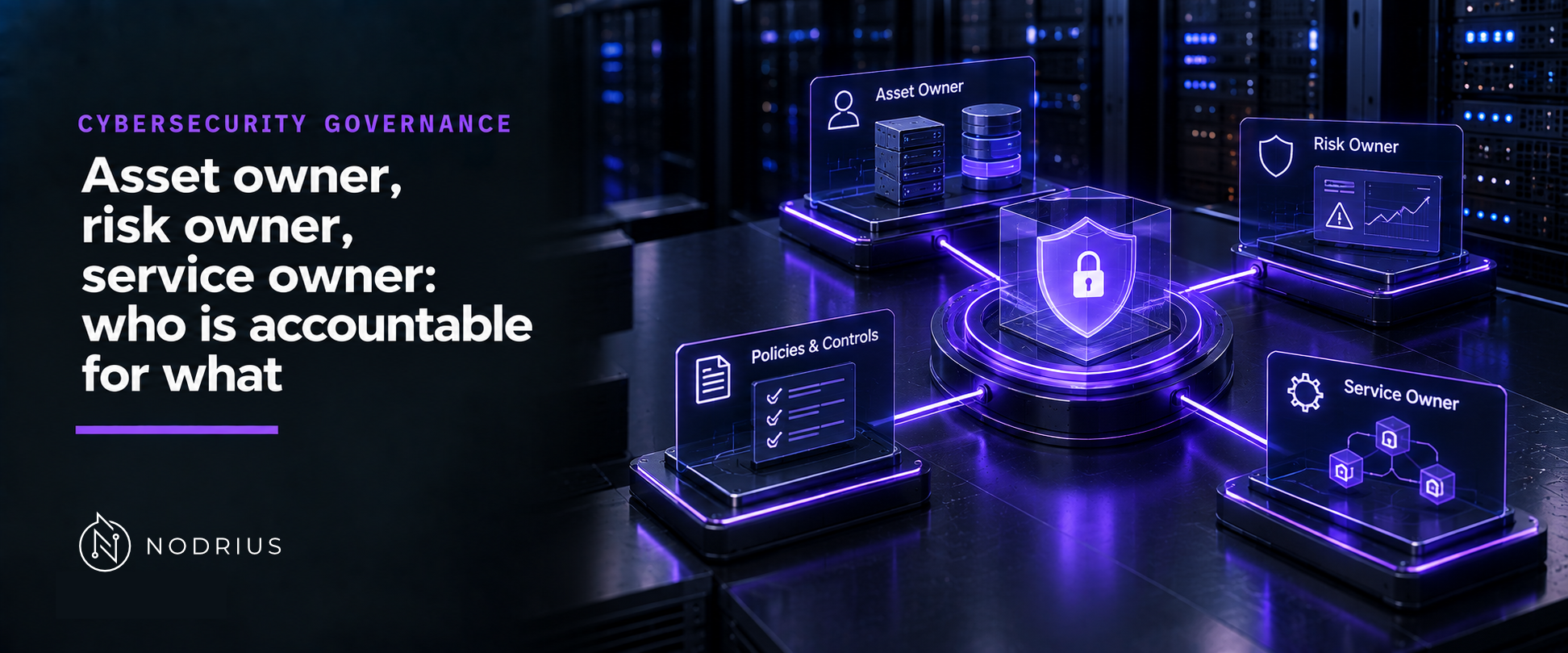
Governance only works if somebody can be asked to answer for each thing and each decision. NIST names the roles: a system owner answers for a system, an information owner or steward for a body of information, and an authorizing official for the decision to let a system operate at an accepted risk; the risk owner answers for a specific risk. None is “the security team” by default.
The model: every thing gets an owner, and each owner answers a different question
asset (system, information)   ↓   asset owner       system owner / information owner
process or service            ↓   service owner     how the capability is delivered and kept running
risk                          ↓   risk owner        the response to one risk
decision to accept risk       ↓   accountable role  authorizing official
Each owner answers a different question: the asset owner whether the system or information is protected and used as agreed; the service owner whether the process keeps working within its security requirements; the risk owner whether the risk was responded to and the response is still right; the accountable role at the top, whether the risk level is acceptable.
The roles NIST actually names
SP 800-53 Revision 5 names the roles: mission or business owners, system owners, information owners or stewards, authorizing officials and senior agency information security officers (§1.2).
System owner. “Official responsible for the overall procurement, development, integration, modification, operation, and maintenance of a system” (SP 800-53r5 glossary); SP 800-100 §8.2.2 adds keeping the system operated to the agreed security requirements.
Information owner or steward. The official with “statutory or operational authority for specified information”, establishing controls for its “generation, collection, processing, dissemination, and disposal” (SP 800-53r5 glossary). It sets the rules for use, gives the system owner the security requirements, and decides who gets access (SP 800-100 §8.2.3).
Authorizing official (AO). The senior official who assumes responsibility for operating a system “at an acceptable level of risk” (SP 800-53r5 glossary). CA-6 states that authorizing officials are “responsible and accountable for security and privacy risks” of the systems they authorize.
Risk owner. NISTIR 8286r1 defines the risk-owner register element as “the designated party responsible and accountable for ensuring that the risk is maintained in accordance with enterprise requirements”, supported by a risk manager. The role attaches to a risk, not a system, so SP 800-53 has no equivalent.
Owning an asset, a process and a risk are three different things
A system owner owns an asset: whether it is operated safely. An information owner owns a class of information that may live on many systems: who may use it and how. A service owner owns a process — how the capability is delivered and kept running — and SP 800-100 notes that some agencies call information system owners “program managers or business/asset/mission owners” (footnote 57). A risk owner owns neither: they own a decision about a risk, and enterprise decision makers “delegate responsibilities to appropriate risk owners” (NISTIR 8286r1).
Accountability is answering for a decision, not doing the work
SP 800-12r1 §2.4 warns that if responsibilities “are not made explicit, management may find it difficult to hold personnel accountable for future outcomes” — the owner must be named, or nobody is accountable. Its glossary defines accountability as the requirement that “actions of an entity … be traced uniquely to that entity”.
NISTIR 8286r1 draws the line: “responsibility for information system risks might be assigned to a System Owner, but accountability might be assigned to an Authorizing Official.”
CSF 2.0 states the same as a governance function: GV.RR requires leadership to be “responsible and accountable for cybersecurity risk” (GV.RR-01) and roles, responsibilities and authorities to be “established, communicated, understood, and enforced” (GV.RR-02); GV.RR-03 and GV.RR-04 cover resource allocation and human-resources practices.
A common misconception: “the security team owns the risk”
The first error is that the security team or the CISO owns the organisation’s risk. NIST puts accountability for security and privacy risk on the authorizing official (SP 800-53 CA-6) and on organisational leadership (CSF 2.0 GV.RR-01); the security function advises and operates controls, but cannot accept risk for the business.
The second is that an owner is whoever administers the system. The administrator operates the system; the owner is accountable for it, and SP 800-53 lists them separately. Naming the operator as owner is how accountability disappears: the person holding the passwords rarely holds the budget or the authority to accept risk. A risk with no owner is the same failure — the reason NISTIR 8286r1 assigns every register entry a risk owner, and SP 800-39 calls “clear assignment and accountability for accepting risk” essential.
What to remember
- A named role is accountable for each asset, each process, each information class and each risk; a risk with no named owner is unmanaged.
- System, information and service owners own things; a risk owner owns a decision about a risk.
- “The security team owns the risk” is wrong: accountability sits with the authorizing official and leadership.
- “The owner is the administrator” is wrong: the administrator operates the system, the owner answers for it.
Level and prerequisites
L1 — fundamentals: the vocabulary of ownership and accountability, not an asset-inventory procedure or a RACI matrix. Prerequisites: none beyond a rough sense of asset, process and risk. Recording owners in a register is operational material (L2–L3).
Where to go next
- Cybersecurity Governance — the area this sheet belongs to.
- The technical work of administering and monitoring systems belongs to Networking, Server & Virtualization and AI & LLM (roadmap §6).
References
- NIST, SP 800-53 Revision 5 — Security and Privacy Controls for Information Systems and Organizations — the §1.2 role list, the glossary definitions of system owner, information owner and authorizing official, and the CA-6 accountability statement.
- NIST, SP 800-100 — Information Security Handbook: A Guide for Managers — the system owner, information owner and authorizing official responsibilities in Chapters 8 and 11, and the title variants for the system owner (footnote 57).
- NIST, SP 800-12 Revision 1 — An Introduction to Information Security — the accountability definition, §2.4 on explicit roles, and the System Owner and Information Owner/Steward responsibilities in Chapter 3.
- NIST, NISTIR 8286r1 — Integrating Cybersecurity and Enterprise Risk Management (ERM) (December 2025, DOI 10.6028/NIST.IR.8286r1; supersedes the withdrawn NISTIR 8286 of October 2020) — the delegation of responsibilities to appropriate risk owners, the risk-owner register element (Table 1), and the responsibility-versus-accountability example.
- NIST, SP 800-39 — Managing Information Security Risk — the statement that clear assignment and accountability for accepting risk is essential.
- NIST, CSF 2.0 (CSWP 29) — the GV.RR subcategories on roles, responsibilities and authorities.