
Choosing a framework and applying it, not collecting checklists
Pick a framework for what it obliges you to demonstrate, then adapt it to your scope.
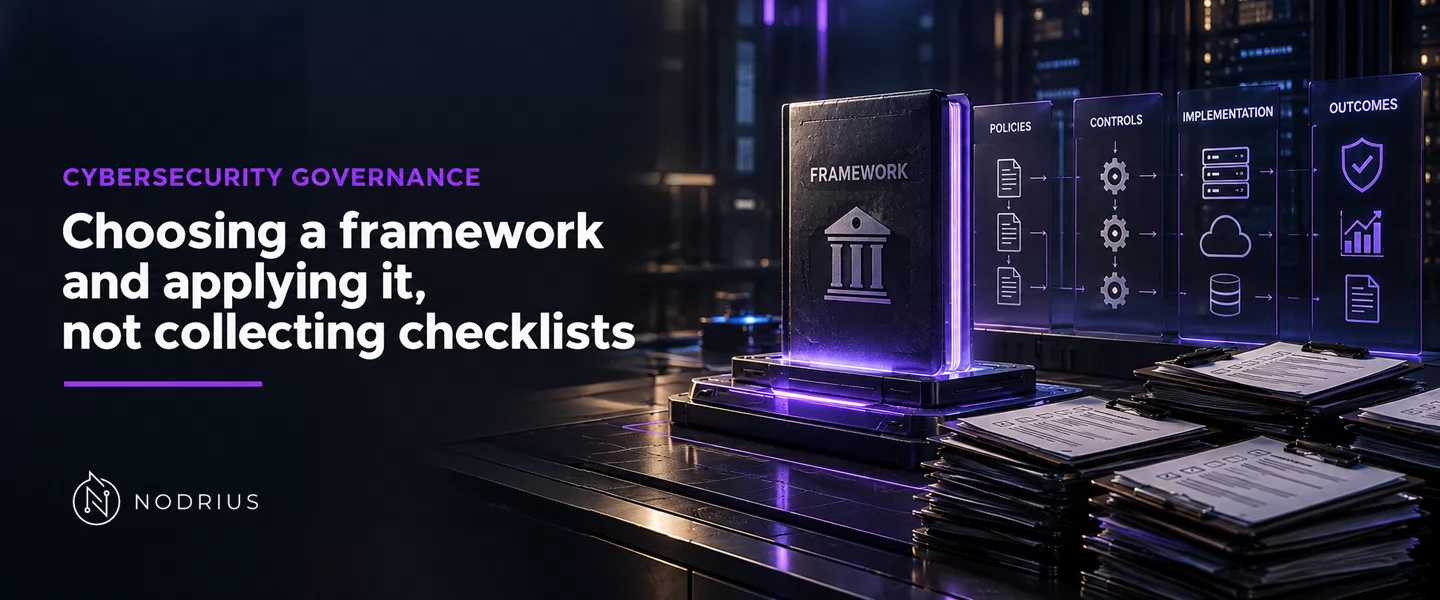
A framework is not a longer checklist. It is a structured set of outcomes or requirements that an organisation adapts to its own scope, and the adaptation — not the adoption — is where the security work happens. CSF 2.0 draws the line itself: its outcomes “are not a checklist of actions to perform; specific actions taken to achieve an outcome will vary by organization and use case” (lines 243–245). Choosing a framework is choosing what you will be obliged to demonstrate; applying it is deciding what each outcome or requirement means here.
A framework is a set of outcomes, not a list
CSF 2.0 says the outcome is fixed and the action is local: “The CSF does not prescribe how outcomes should be achieved. Rather, it links to online resources that provide additional guidance on practices and controls” (lines 17–19). A checklist inverts this: it fixes the actions and leaves the outcome implicit, so “done” means the box is ticked and nobody has to say what the box was for.
Choosing: what the decision rests on
Choosing a framework is a governance decision with a small set of inputs. Scope — which parts of the organisation and which information it covers; CSF outcomes are “sector-, country-, and technology-neutral”, so this stays the organisation’s call (line 153). Obligations — legal, regulatory and contractual requirements that already fix some outcomes; a control’s necessity is determined “via (for example) risk assessment, or via the need to comply with contractual or legal obligations” (SC 27 Journal, lines 294–296). Sector and the management system you already have — “all organizations have a management system, whether or not they have implemented a formal management system standard” (SC 27 Journal, lines 142–144). Certifiability — “ISO 31000 provides good practice guidelines but is not a certifiable risk management standard” (line 34), while ISO/IEC 27001 leaves certification as the company’s own choice (line 63). Cost of assurance — what it takes, every year, to keep demonstrating the claim — is the input most often left out; no source here prices it.
Frameworks complement each other
Programmes rarely run one framework; they run layers. CSF 2.0 supplies the outcome layer — “a taxonomy of high-level cybersecurity outcomes” (lines 14–15). SP 800-37r2 supplies the process layer: the Risk Management Framework is “purposefully designed to be technology neutral” (line 519) and is offered as the execution process under an outcome framework (lines 591–594). It does not hand down a fixed control set — “Organizationally-tailored baselines and overlays complement the NIST control baselines by providing an opportunity to add or eliminate controls to accommodate organizational requirements” (lines 2379–2381). ISO/IEC 27001 supplies the management-system layer, the requirements the system that manages security must meet; ISO 31000 and ISO/IEC 27005 supply the risk guidance beneath it (ISO/IEC 27005, line 15); SP 800-39 sets the stack on one multitier process “across the three tiers” of organisation, mission and system (lines 834–837). The layers also bound one another: “Annex A is not an exhaustive set of controls, so additional control sources (e.g. ISO/IEC 27017, PCI-DSS, COBIT, NIST 800-53) can be applied to complement this” (SC 27 Journal, lines 172–175).
Applying it: scope, tailoring, mapping, ownership
Applying a framework is four acts, all the organisation’s. Scope: state what the framework covers and what it does not. Tailoring turns the reference material into your baseline, chosen so the controls are the set your risks justify and no larger. Mapping connects each outcome or requirement to the evidence that will show it is met, so the framework can be assessed rather than asserted. Ownership puts a named role against each outcome, because a framework no one answers for is a document. The SC 27 Journal gives the model: the requirement is “to make a comparison between the results from the risk assessment and the controls in Annex A” (lines 130–135), run “to discover if any necessary control has been inadvertently omitted” (lines 328–330) — the organisation checking its own reasoning against a common reference.
layer                       what it hands you                 what stays with you
outcomes    (e.g. CSF)    -> what "good" looks like        -> which actions, how far, in what order
process     (e.g. RMF)    -> steps and reference baselines -> the tailoring: add, remove, overlay
management  (ISO/IEC 27001)-> requirements on the system   -> how the organisation meets them
risk guide  (31000 / 27005)-> how to identify, assess, treat -> the risk decision itself

the reference is fixed by the framework; the scope, the fit and the decision stay with you
What applying a framework does not produce
Two results are assumed and neither follows. First, it does not produce conformity: applying a framework is an internal act, and for ISO/IEC 27001 conformity means an organisation “has put in place a system to manage risks” (line 22) — a system, not a set of completed answers. Second, it does not produce the risk decision: the presence of a control in a reference set “does not make it necessary to an organisation”, necessity is “the responsibility of the organisation itself”, and the reference “is intended to support the organisation’s decision-making process, not replace it” (SC 27 Journal, lines 292–297).
Level and prerequisites
L4 — framework and assurance: the reader is not learning a process but judging which structure governs one and where it hands over to the decision. It builds on the L1 vocabulary, the L2 records (the risk register; control objectives and verification criteria) and the L3 processes (the traceability chain from risk to control to owner to evidence). It names ISO/IEC 27001’s requirements and the CSF Core, Profiles and Tiers in one clause each — they belong to companion sheets — and stays with the choice and the application.
Where to go next
- Knowledge — the Knowledge register this sheet belongs to.
- Cybersecurity Governance — the macro-area.
- Security governance foundations — the node this sheet sits in.
References
- NIST — The NIST Cybersecurity Framework (CSF) 2.0 (NIST CSWP 29) — the framework as a set of outcomes rather than a checklist, and the outcomes’ sector-, country- and technology-neutrality.
- NIST — SP 800-37 Rev. 2, Risk Management Framework — the process layer, technology neutrality, tailored baselines and overlays, and the RMF as the execution process under an outcome framework.
- NIST — SP 800-39, Managing Information Security Risk — the multitier risk-management structure the layers sit on.
- ISO/IEC JTC 1/SC 27 — SC 27 Journal, Vol. 3 Issue 4 — how to read Annex A, the 6.1.3 c) comparison, the management-system framing, and the annex as a reference set that supports rather than replaces the decision.
- ISO — ISO 31000:2018, ISO/IEC 27005:2022, ISO/IEC 27000:2026 and ISO/IEC 27001:2022 ISO Store page extracts — certifiability, risk guidance, the overview-versus-requirements distinction, and what conformity means.