
Inventory coverage and completeness: proving what the inventory misses
Coverage is a claim about a population: arguing what the inventory reaches and misses.
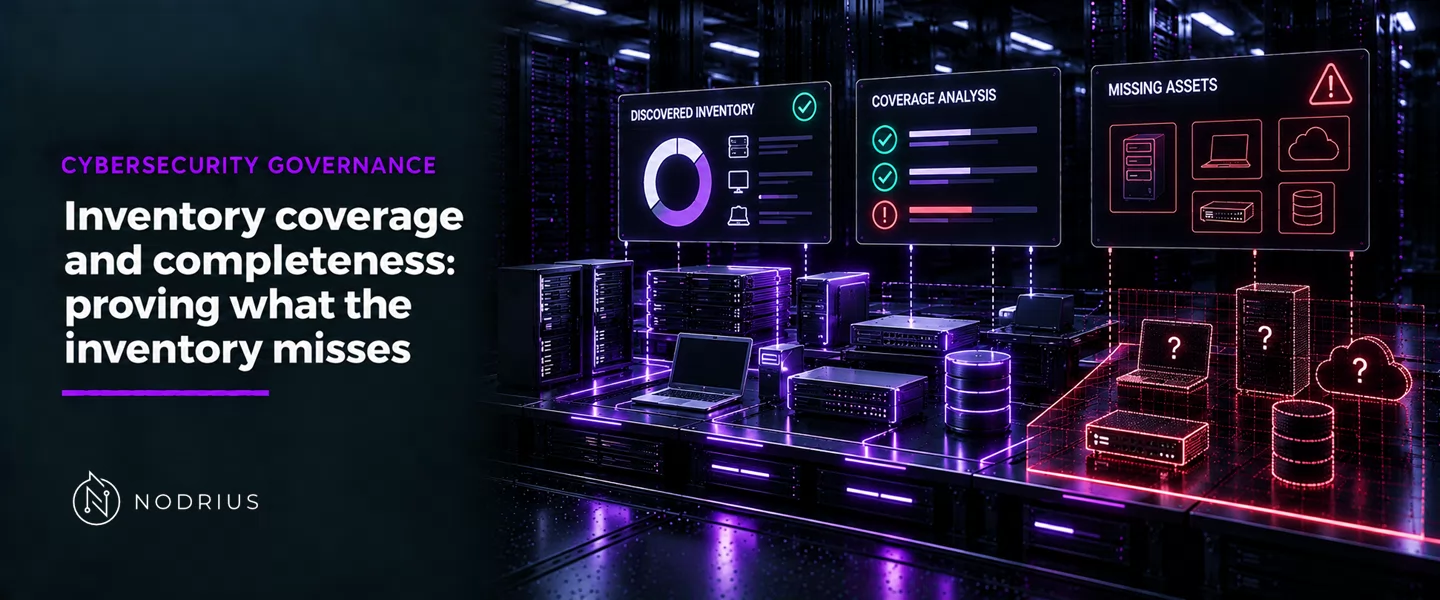
An inventory is a claim about a population, not a list of rows: it says “these are the components we have” and, by omission, “these are the ones we do not”. Coverage is how far that claim reaches; completeness is whether something that should be there is missing. The L2 sheet on asset and service inventory sets out what a record must contain under CM-8 of SP 800-53 Revision 5; this sheet asks what population that coverage is claimed against, and what completeness statement can be defended.
The claim is relative to a boundary and a granularity
CM-8 requires an inventory that “Includes all components within the system” (line 7808) and “Is at the level of granularity deemed necessary for tracking and reporting” (line 7818) — both relative, to a system and to a granularity. SP 800-128 anchors the first: “every item … falls within the authorization boundary of a single system” (lines 1197–1199). Coverage is only meaningful against a stated denominator — the components inside a named boundary, counted at a named granularity.
       the population                      the record
  components inside a named          the rows CM-8 requires
  authorization boundary,      <->   (statement a.1–a.5)
  at a chosen granularity
            ^
            |  declaration   (CM-8(1): installation, removal, system update)
            |  discovery     (SP 800-40r4 §3.2: automation, scans, passive monitoring)
            |
  detection (CM-8(3)) compares the record against what is actually running:
  a component found there is, on our reading, a row the record was missing
Two ways a row arrives: declaration and discovery
Rows arrive by one of two routes. Declaration is a person or process telling the record that something exists; CM-8(1) binds it to those moments — the trigger on installations, removals and system updates (line 7858). Discovery is automation finding what was never declared: SP 800-40r4 §3.2 asks for “up-to-date software inventories” (line 692) maintained constantly, with the goal a “close-to-comprehensive inventory by relying on automation to constantly discover new assets” (line 697). Neither route reaches everything.
Why “complete” cannot be asserted as a fact
SP 800-40r4 is explicit that the ideal is not the plan: “a comprehensive inventory of all assets is ideal, [but] it may be impossible to achieve” (lines 695–696). Its instruction is a close-to-comprehensive record — a statement of how far the record reaches, not a claim that it reaches everything. A defensible coverage statement names the feeding mechanisms and the blind spot each carries; CM-8 concedes one: virtual machines are hard to monitor because they “are not visible to the network when not in use” (lines 7876–7877).
The gap is found by detection, not by review
If the record cannot be trusted to be complete, completeness must be tested. CM-8(3) tests it: detect “the presence of unauthorized hardware, software, and firmware components within the system” (lines 7892–7893), then act — “disable network access by such components; isolate the components; notify [Assignment: organization-defined personnel or roles]” (lines 7896–7898). A component found here is, on our reading, a row the record was missing — the control’s word is unauthorized, not unrecorded. Coverage becomes an observation: discovery output and the record are compared, and the difference is the gap.
Rows in the record but not in the population
Completeness runs in both directions: a record can also overstate, carrying rows for components decommissioned and never removed. The instrument is CM-8(1) again — the same trigger covers “removals” (line 7858) — with CM-8(9), which requires components be assigned to a system (lines 7974–7976) and warns that one “not assigned to a system may be unmanaged, lack the required protection, and become an organizational vulnerability” (lines 7978–7979). An unassigned component is a coverage question before it is a risk question.
Centralised repositories do not settle the count
A centralised repository looks like the answer — CM-8(7): “Provide a centralized repository for the inventory of system components” (line 7946) — but SP 800-53r5 warns it does not settle the count. Centrally managed software “may appear more than once in a centralized component inventory, necessitating a system association for each software instance” (lines 7844–7846), and scanning several protocols “can result in duplicate components being identified in different address spaces” (lines 7846–7848). Duplicate rows inflate the total.
The coverage statement you can defend
The defensible statement is procedural, not numeric. No source here defines a “coverage percentage”; an invented one is only as sound as its named denominator — the boundary, the granularity, the discovery feed, the window. What the sources support is procedural: these mechanisms feed the record — CM-8(1) triggers, CM-8(2) automated maintenance, CM-8(3) detection, CM-8(7) repository — these are their blind spots, and this is the review keeping both current.
Testing the statement against evidence
SP 800-137 makes that accuracy itself observed, assessing inventory information “to determine whether or not the control is effective, (i.e., if the inventory is accurate)”, with a root-cause analysis when it is not (lines 535–542). Reversed, it is the assessor’s checklist: the boundary, the triggers, the discovery feeds and their blind spots, the duplicate reconciliation, and the comparison of the record against detection output.
What the coverage claim serves
CSF 2.0 states the obligation those answers serve — inventories of hardware (ID.AM-01, line 871) and of software, services and systems (ID.AM-02, lines 872–873) “are maintained” — and ID.AM-05’s prioritisation by “classification, criticality, resources, and impact on the mission” (line 877) presupposes coverage rather than establishing it.
Level and prerequisites
L3 — assessment and process coordination: this sheet assumes the L2 record (fields, maintenance triggers and coverage limits, in the L2 sheet on asset and service inventory) and the L2 treatment of the system boundary (the sheet on scope, assumptions and system boundaries). It does not re-teach the record’s fields, a service’s criticality or an asset’s life stages.
Where to go next
- Knowledge — the index.
- Cybersecurity Governance — the area this sheet belongs to.
- Security governance foundations — this sheet’s node.
References
- NIST — SP 800-53 Revision 5, Security and Privacy Controls for Information Systems and Organizations (September 2020) — https://doi.org/10.6028/NIST.SP.800-53r5 — the CM-8 statement (the four properties and the review frequency), the CM-8 discussion on centralised inventories and duplicate accounting, and the enhancements CM-8(1), CM-8(2), CM-8(3), CM-8(7) and CM-8(9).
- NIST — SP 800-128, Guide for Security-Focused Configuration Management of Information Systems (August 2011) — https://doi.org/10.6028/NIST.SP.800-128 — §2.3.4: the component inventory as a descriptive record, granularity as a deliberate organisational choice, and the rule that every item falls within the authorization boundary of a single system.
- NIST — SP 800-40 Revision 4, Guide to Enterprise Patch Management Planning (2022) — https://doi.org/10.6028/NIST.SP.800-40r4 — §3.2: the ideal of a comprehensive inventory, the close-to-comprehensive realistic goal, and reliance on automation to discover new assets.
- NIST — SP 800-137, Information Security Continuous Monitoring (ISCM) for Federal Information Systems and Organizations (September 2011) — https://doi.org/10.6028/NIST.SP.800-137 — the assessment of inventory accuracy with its root-cause follow-up, and the information system owner’s duty to maintain the component inventory.
- NIST — The NIST Cybersecurity Framework (CSF) 2.0, NIST CSWP 29 (26 February 2024) — https://doi.org/10.6028/NIST.CSWP.29 — the ID.AM Asset Management category and the inventory subcategories ID.AM-01, ID.AM-02 and ID.AM-05.