
ISO/IEC 27001 and the ISMS: requirements for a system, not a control list
What ISO/IEC 27001 requires, and what an ISMS is as an object of governance.
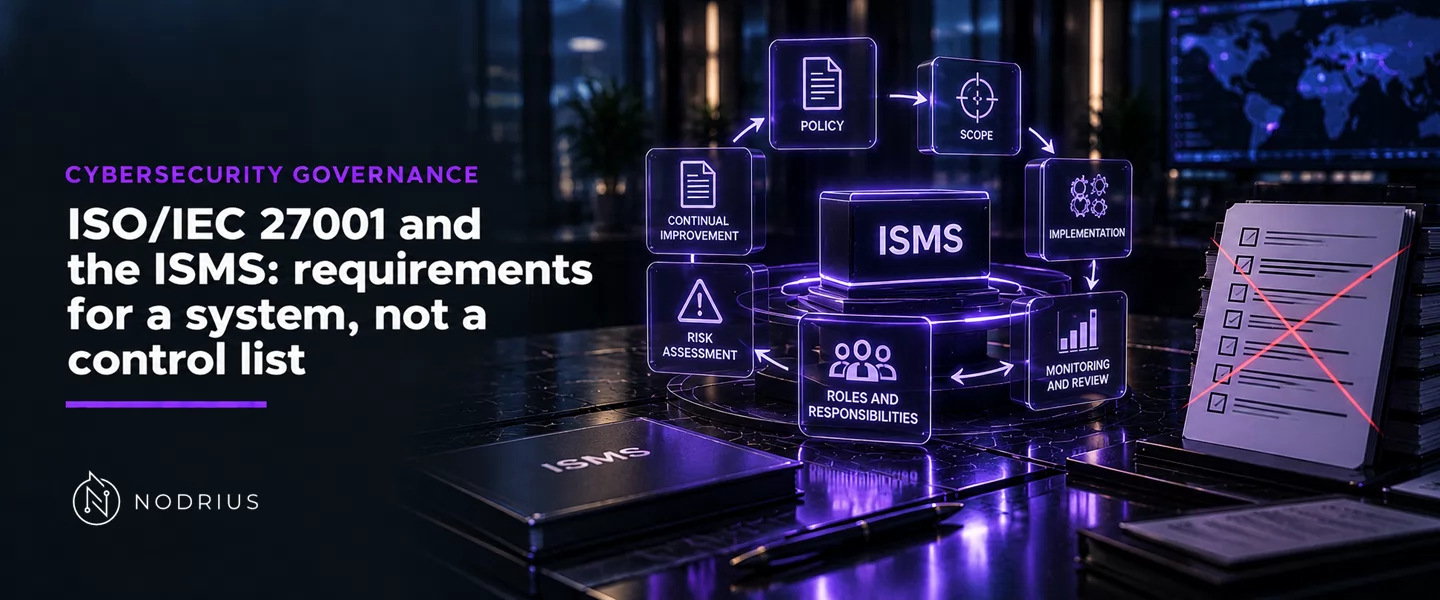
ISO/IEC 27001 is the requirements standard for an information security management system; its companion ISO/IEC 27002 is guidance and cannot be certified to. The two share a vocabulary, yet only one states what an organisation must do.
An information security management system (ISMS) is not a document or a tool. It is a management system in the ISO sense: the interrelated elements an organisation uses to set policies and objectives, and the processes that achieve them. As a governance object it is what a board, a regulator or a customer relies on — a system that plans, operates, checks and improves how information security risk is managed, not any single measure inside it.
The requirements standard and its neighbours
The ISO Store page for ISO/IEC 27001 opens with the framing this sheet unpacks: it “defines requirements an ISMS must meet” (line 20). The current edition is Edition 3, dated 2022-10, with Amendment 1 published in 2024; amendments “provide additional content; available for purchase; not included in the text of the existing standard” (lines 13–14, 71–73, 72). The page asks for the full reference — “certified to ISO/IEC 27001:2022”, not “ISO 27001” (line 62).
Two neighbours are confused with it. ISO/IEC 27000:2026 is the family’s overview, not a requirements standard: it “explains the core concepts and principles behind information security management systems” (line 7), while “ISO/IEC 27001 is the standard that specifies requirements for an information security management system” (line 20); its 2018 predecessor was withdrawn on 3 July 2026 (line 28). ISO/IEC 27002:2022 supplies the controls: “While ISO/IEC 27001 specifies the requirements for establishing an ISMS, ISO/IEC 27002 provides the detailed best practices and controls that can be applied within the ISMS” — so the page answers the certification question directly: it “cannot be certified to” (lines 36, 39).
What an ISMS is
The standard’s framing is a system: guidance for “establishing, implementing, maintaining and continually improving an information security management system” (line 21). Conformity, on the same page, is not a property of a document: it “means that an organization or business has put in place a system to manage risks related to the security of data owned or handled by the company” (line 22). The SC 27 Journal supplies the mechanism behind that shape — ISO/IEC 27001 “is designed around a continual improvement process which means the ISMS can adapt to changing risk situations and circumstances” (lines 485–486).
The shape of a management system
What makes ISO/IEC 27001 a management-system standard rather than a control catalogue is the shape it takes from the ISO Directives. The Journal quotes Annex SL’s definition: a management system is “a set of interrelated or interacting elements of an organization to establish policies and objectives, as well as processes to achieve those objectives” (lines 139–142) — and every organisation already has one, “whether or not they have implemented a formal management system standard” (lines 143–144).
objectives  ->  planning  ->  operation  ->  performance evaluation  ->  improvement
    ^                                                                          |
    +-------------------------  the loop closes  -----------------------------+
The 2022 revision tightened one link in that loop: it “contains a new requirement, Clause 6.2, which is that information security objectives shall be monitored”, and that addition “provides a link between Clause 6.2 (Objectives) and Clause 9.1 (Monitoring, measurement, analysis and evaluation), which was missing in the 2013 edition” (lines 716–717, 725–728). Clause 9.1 “is to consider the ISMS and its processes and determine the extent to which planned activities are realized and planned results are achieved” (lines 730–734).
Certification is a decision, not a consequence
Certification is optional: “companies implementing ISO/IEC 27001 can decide whether they want to go through a certification process” (line 63). The Journal reminds readers that only requirements standards such as 27001 “allow it within the ISO framework” (lines 889–890). Where an organisation does certify, a certificate “from an accredited conformity assessment body may bring an additional layer of confidence, as an accreditation body has provided independent confirmation of the certification body’s competence” (line 61).
What a certificate does not say
The Journal separates the two examinations that keep an ISMS honest: “Performance evaluation is the internal examination of the current security status of the ISMS”, while “conformity assessment is the external/third-party examination of the current security status of the ISMS” (lines 510–512). A certificate is the result of the second — a statement about the management system when it was examined, not proof that the risks behind it are managed well, and not a guarantee that every control is operating as intended. The Journal is blunt about money: “ISO/IEC 27001 can help you save or earn a lot of money; it can equally help you spend and waste a lot of money” (lines 786–787), and “an unexamined ISMS is not worth having” (lines 513–515).
Level and prerequisites
L4 — framework and assurance: the sheet reads one standard as a governance object, above the level at which records and processes are run. It assumes the L1 vocabulary and the L2 records of this area and builds on its L3 process sheets. It does not re-derive framework selection (the first sheet of this batch), the statement of applicability and its excluded controls, or the NIST CSF Core, Profiles and Tiers.
Where to go next
- Knowledge — the register this sheet belongs to.
- Cybersecurity Governance — the macro-area.
- Security governance foundations — the node this sheet sits in.
References
- ISO — ISO/IEC 27001:2022 ISO Store page — the requirements framing, Edition 3 / 2022-10, Amendment 1:2024, conformity, and the certification decision.
- ISO — ISO/IEC 27002:2022 ISO Store page — guidance versus requirements, and the “cannot be certified to” answer.
- ISO — ISO/IEC 27000:2026 ISO Store page — the overview role of the family document and the withdrawn 2018 edition.
- ISO/IEC JTC 1/SC 27 — Journal Vol. 3 Issue 4 — the Annex SL management-system definition and the Clause 6.2 / Clause 9.1 link.
- ISO/IEC JTC 1/SC 27 — Journal Vol. 2 Issue 1 — continual improvement, certification as a decision, and the internal/external examination distinction.