
Management review and reporting: where the governance loop closes
The decision meeting that closes the governance loop, and the reporting line feeding it.
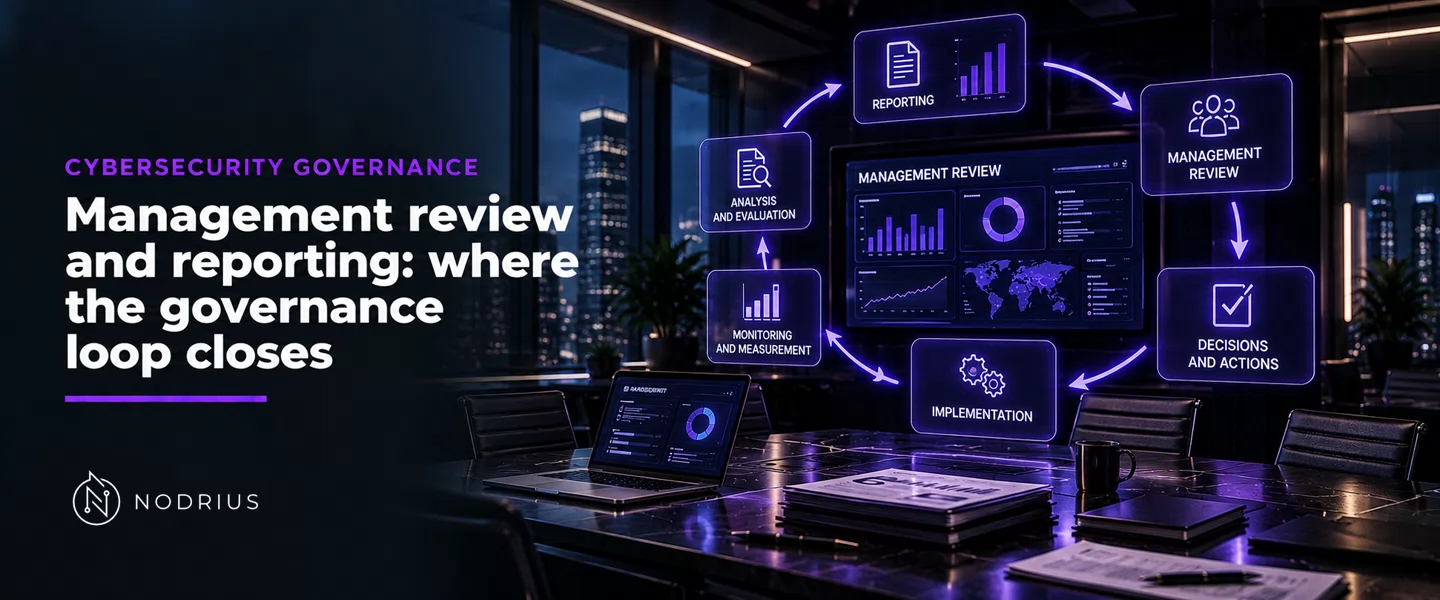
A security programme produces evidence continuously; none of it changes anything until someone with the authority to change the strategy reads it and decides. That is the management review: where top management examines what the management system produced and adjusts it. The reporting lines upward feed that meeting; the loop closes only when the decisions return as a changed strategy, appetite or plan.
The review is an act of governance, not of management: it produces decisions, and a meeting that produces none has not reviewed anything. It is also only as good as what reaches it — a reporting line that loses detail on the way up, or drops a finding the room did not expect, sets the outcome in advance.
What the management-system view requires
The official SC 27 Journal states that “Organizations are required to regularly review their risk management processes to ensure that they remain effective, and to make any necessary adjustments”, adding that this includes “conducting regular internal audits of the ISMS, as well as conducting regular management reviews to evaluate the overall effectiveness of the ISMS” (lines 913–918). Three things are folded together: the review is regular, paired with internal audit as its independent input, and meant to adjust the process rather than observe it. The clause text is paywalled, so the reading follows the Journal and clause 9.3 is not reconstructed; the ISMS itself and internal audit as a function belong to neighbouring sheets, and this sheet owns the review act and the reporting line.
What the review is fed with, and what it produces
The RMF puts the review in its Monitor step: SP 800-37r2 states that “Table 8 provides a summary of tasks and expected outcomes for the RMF Monitor step” (line 5103). The reporting task is M-5 — “Report the security and privacy posture of the system to the authorizing official and other organizational officials” (lines 5384–5385) — whose output is the security and privacy posture report. The reviewing task is M-6: the authorising official must “Review the security and privacy posture of the system on an ongoing basis to determine whether the risk remains acceptable” (lines 5458–5459), a risk determination whose outcomes can include a denial of ongoing authorisation. Reporting also runs to the organisation: task R-5 reports the authorization decision and any significant control deficiencies, and R-5 and M-5 “support OMB reporting and risk management requirements organization-wide” (lines 625–626). The system-level posture report becomes an organisation-level input.
   feeds the review                    the review produces
   ----------------                    --------------------
   posture report (M-5)                a risk determination
   authorisation report (R-5)  ->  REVIEW  ->  risk acceptance or denial
   measures of performance (PM-6)      a changed strategy, appetite,
   open remediation (PM-4)             risk response or plan
        ^                                        |
        +---- decisions return as changed inputs -+
The organisation-level instruments
Two organisation-level controls define those inputs. PM-6 requires the organisation to “Develop, monitor, and report on the results of information security and privacy measures of performance” (lines 13815–13816), discussed as “outcome-based metrics used by an organization to measure the effectiveness or efficiency of the information security and privacy programs”, aligned with the organisational risk tolerance (lines 13818–13822). PM-4 owns the open work: entries must be “reported in accordance with established reporting requirements”, and plans of action and milestones must be reviewed “for consistency with the organizational risk management strategy and organization-wide priorities for risk response actions” (lines 13758, 13760–13761). The review is fed with outcome-based measures and remediation already reconciled against the strategy.
Oversight: who adjusts what, and how it is communicated
NISTIR 8286Cr1 describes “how risk governance elements such as enterprise risk strategy, appetite, tolerance, and capacity direct risk performance”. It adds: “By monitoring the results of CSRM activities at each hierarchical level, senior leaders can adjust various governance components” (lines 335–337). Those leaders “have unique risk management responsibilities, such as fiduciary reporting and establishing risk strategy” (lines 413–414). CSF 2.0 states the same duties as outcomes — “GV.OV-01: Cybersecurity risk management strategy outcomes are reviewed to inform and adjust strategy and direction” and “GV.OV-03: Organizational cybersecurity risk management performance is evaluated and reviewed for adjustments needed” (lines 816–817, 822–823). Communication is a translation: SP 800-55 Vol. 2 names “translating technically measurable performance data into a form that is contextually relevant to the consumer of the report” as the challenge, and notes that “Senior leadership will consider their organization’s reporting requirements to identify the most useful reporting style” (lines 615–616, 620–621).
Where a review stops being a review
The instruments do not make the meeting work. The review is a decision meeting: if its record holds observations but no decision — no change to strategy, appetite, risk response or plan — nothing has been reviewed. It is only as good as its inputs: a body whose papers never record a control failing its own objective is either well run or filtered. And reporting upward loses detail by design — that is what “contextually relevant to the consumer” means — so the decision belongs where the detail is still retrievable.
Level and prerequisites
L4 — advanced: the sheet takes what the lower levels build and asks who reviews it, on what evidence, and what changes as a result. Prerequisites: the L1 vocabulary of governance, the L2 records (risk register, policies, roles) and the L3 processes — the traceability chain, change management, the findings internal audit produces — none re-derived here; it also assumes the ISO/IEC 27001 and ISMS sheet and the CSF and risk-profiles sheet.
Where to go next
- Knowledge — the Knowledge register this sheet belongs to.
- Cybersecurity Governance — the macro-area.
- Security governance foundations — the node this sheet sits in.
References
- ISO/IEC JTC 1/SC 27 — SC 27 Journal, Volume 3, Issue 4 (October 2023) — the required regular review of risk management processes and its pairing with internal audit and management review.
- NIST — SP 800-37 Rev. 2, Risk Management Framework — the Monitor step’s task-and-outcome summary, the posture-reporting task M-5, the reviewing task M-6 and the authorization-reporting task R-5.
- NIST — SP 800-53 Rev. 5 — PM-6 measures of performance and PM-4 plan-of-action-and-milestones reporting.
- NIST — IR 8286Cr1, Staging Cybersecurity Risks for ERM and Governance Oversight — the governance elements that direct risk performance and senior leaders’ fiduciary reporting.
- NIST — CSF 2.0 (NIST CSWP 29) — the GV.OV oversight outcomes.
- NIST — SP 800-55 Vol. 2, Measurement Guide for Information Security — the communication challenge and the reporting consumer.