
The NIST Cybersecurity Framework and risk profiles
The CSF Core, Profiles and Tiers as a device that turns outcomes into risk talk.
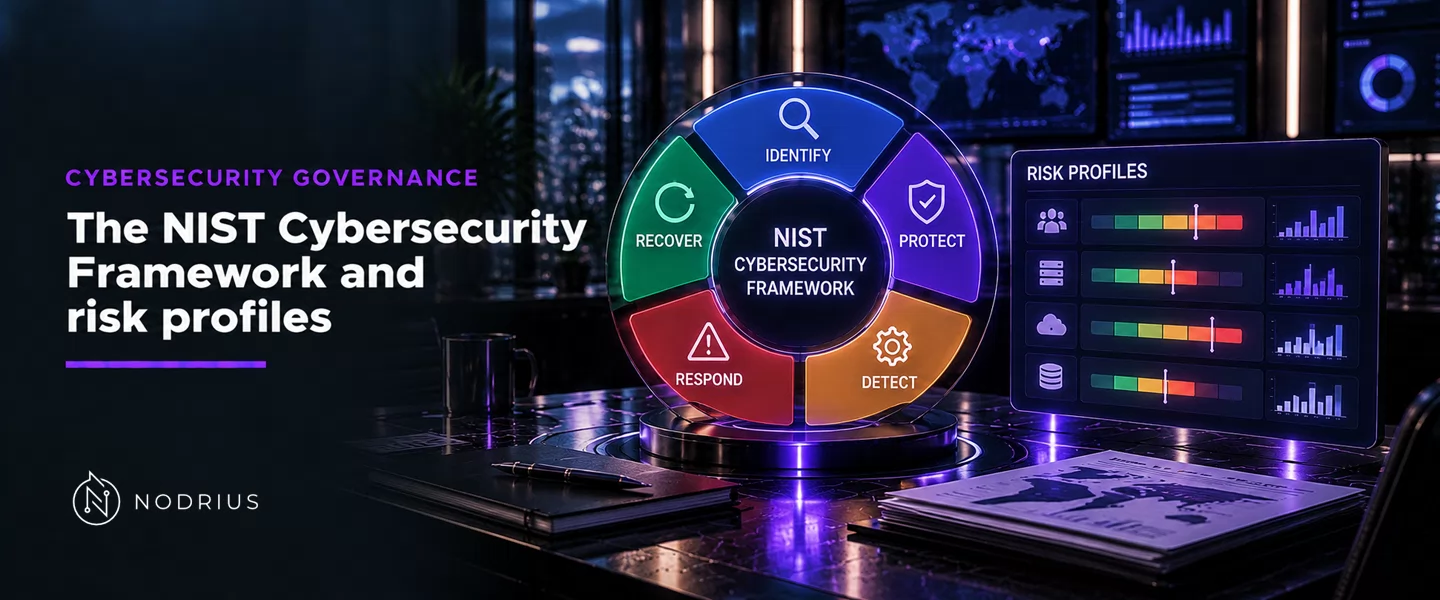
The NIST Cybersecurity Framework (CSF) 2.0 is not a standard you are certified against, and not a checklist you tick. Its own abstract calls it “a taxonomy of high-level cybersecurity outcomes” that any organisation can use “to better understand, assess, prioritize, and communicate its cybersecurity efforts”, and states plainly that it “does not prescribe how outcomes should be achieved” (lines 14–17). The CSF supplies the vocabulary of outcomes; their achievement is left to you.
The device that turns those outcomes into a conversation about your own risk is the Profile — a description of an organisation’s current and/or target posture stated in the Core’s outcomes. A Current Profile and a Target Profile, set side by side, convert a taxonomy into a gap, and a gap into a prioritised action plan. CSF 2.0 is published as NIST CSWP 29 on 26 February 2024 and is free of charge (lines 6–8); its outcome tables are supplemented online by Informative References, Implementation Examples and Quick Start Guides, held outside the document so they “can be updated more frequently than this document” (lines 461–464).
A Core of outcomes, not a checklist
The Core is “a set of cybersecurity outcomes arranged by Function, then Category, and finally Subcategory” (lines 242–243). Six Functions organise the outcomes at the highest level — GOVERN, IDENTIFY, PROTECT, DETECT, RESPOND, RECOVER (line 252) — and each Function is divided into Categories and each Category into Subcategories, which “are not exhaustive, but … describe detailed outcomes that support each Category” (lines 336–337).
These outcomes “are not a checklist of actions to perform” (lines 243–244). Two companion resources carry the guidance the Core withholds: Informative References, mappings that “point to sources of guidance on each outcome” (lines 172–173), and Implementation Examples, notional steps that “illustrate potential ways to achieve each outcome” (line 175). Both are material you consult, not requirements you satisfy.
The Profile: outcomes turned into a posture
An Organizational Profile “describes an organization’s current and/or target cybersecurity posture in terms of the Core’s outcomes” (lines 354–355). A Current Profile specifies the outcomes the organisation is currently achieving, and how fully; a Target Profile specifies the outcomes it “has selected and prioritized for achieving its cybersecurity risk management objectives” (lines 363–368). Both belong to the organisation and are scoped by it — the CSF allows as many Profiles as wanted, over a whole enterprise or a single set of systems (lines 386–391).
A third type crosses organisations. A Community Profile “is a baseline of CSF outcomes that is created and published to address shared interests and goals among a number of organizations”, typically for a sector, a technology or a threat type, and an organisation “can use a Community Profile as the basis for its own Target Profile” (lines 372–375). It is a baseline to build a Target Profile from, not an assessment of anyone.
The document gives five steps for creating and using an Organizational Profile: scope it; gather the information; create it; “Analyze the gaps between the Current and Target Profiles, and create an action plan”; and implement and update (lines 386–412). Step four names the deliverable this sheet may only point at: the comparison is where you “develop a prioritized action plan (e.g., risk register, risk detail report, Plan of Action and Milestones [POA&M]) to address those gaps” (lines 405–408). The mechanics of that plan belong to the gap-assessment sheet of this batch.
the Core            the Organizational Profile          what the comparison produces
outcomes, by        Current Profile (what is)     \
Function, Category  Target Profile (what is to be)  >-- the gap --> prioritized action plan
and Subcategory     (a Community Profile may          (what to do about the gap stays a
                    seed the Target Profile)           risk decision, not a CSF verdict)
Tiers: the rigor behind a Profile
An organisation “can choose to use the Tiers to inform its Current and Target Profiles” (line 426). Tiers “characterize the rigor of an organization’s cybersecurity risk governance and management practices, and … provide context for how an organization views cybersecurity risks” (lines 427–429). There are four — “Partial (Tier 1), Risk Informed (Tier 2), Repeatable (Tier 3), and Adaptive (Tier 4)” (lines 430–431, 1275) — a progression “from informal, ad hoc responses to approaches that are agile, risk-informed, and continuously improving” (lines 432, 438). A Tier is a characterisation chosen alongside a Profile, not a score the framework awards: Tiers “should complement an organization’s cybersecurity risk management methodology rather than replace it” (lines 443–444).
The governance-facing outcomes
CSF 2.0’s addition is a GOVERN Function at the centre of the wheel that “informs how an organization will implement the other five Functions” (lines 317–318). Its outcomes are the governance ones: Organizational Context (GV.OC), Risk Management Strategy (GV.RM), Roles, Responsibilities, and Authorities (GV.RR), Policy (GV.PO), Oversight (GV.OV) and Cybersecurity Supply Chain Risk Management (GV.SC) (lines 705–710). Improvement sits in IDENTIFY rather than GOVERN, but serves the same arrangement: ID.IM requires that “Improvements to organizational cybersecurity risk management processes, procedures and activities are identified across all CSF Functions” (lines 916–917). The framework’s governance content is therefore not an appendix to the technical Functions; it is what tells them what to prioritise.
What a Profile is not
A Profile is a description of outcomes. It is not an audit, and completing one is not a claim of conformity: the outcomes “are not a checklist”, the Subcategories “are not exhaustive”, and the CSF is “a foundational resource that may be adopted voluntarily” (lines 243, 336, 203). Nor does the CSF make the risk decision. It lists the ways an organisation “may choose to handle risk” — “mitigating, transferring, avoiding, or accepting negative risks” — as choices it informs but does not make (lines 504–506), and describes itself as guidance to be used “in conjunction with other resources” (line 209). NISTIR 8286r1 states the same boundary from the enterprise-risk side: the CSF 2.0 and SP 800-221A together provide “methods for performing CSRM and integrating the results”, while the detail of implementing those outcomes sits in the IR 8286 series (lines 374, 1065–1066).
Level and prerequisites
L4 — framework, assurance and improvement: this sheet works at the framework layer — its Core, the Profile device, the Tiers and the governance outcomes they carry — rather than at the controls or register entries the levels below describe. Prerequisites: the L1 sheets on risk-treatment-options, risk-appetite-and-acceptance-criteria and policy-standard-procedure-and-guideline; the L2 sheets on risk-and-exception-register and control-objectives-and-verification-criteria; and the L3 sheets on risk-control-owner-and-evidence-traceability and risk-based-prioritisation-and-exposure, whose risk-to-control trace and prioritisation this sheet expresses as framework outcomes.
Where to go next
- Knowledge — the Knowledge register this sheet belongs to.
- Cybersecurity Governance — the macro-area.
- Security governance foundations — the node this sheet sits in.
References
- NIST — The NIST Cybersecurity Framework (CSF) 2.0, NIST CSWP 29 — https://doi.org/10.6028/NIST.CSWP.29 — the Core’s structure, the Profile types and uses, the five steps, the Tiers, the governance outcomes (GV and ID.IM), and the framework’s own stated limits.
- NIST — IR 8286r1, Integrating Cybersecurity and Enterprise Risk Management (ERM) — https://doi.org/10.6028/NIST.IR.8286r1 — the enterprise-risk framing: the CSF as a method for CSRM, and the boundary between framework outcomes and the risk detail.