
Statement of applicability: the decision record, not the conformance table
What the SOA records, why a control is excluded, and who owns the decision.
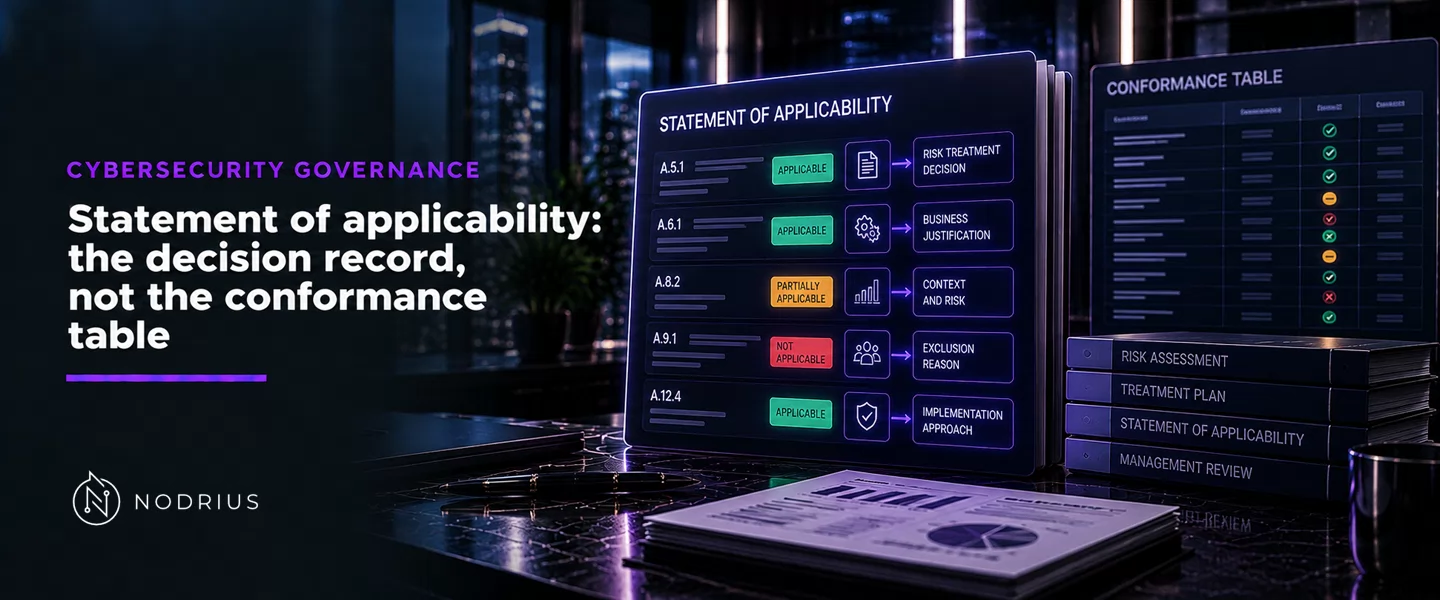
A statement of applicability (SOA) is the document in which an organisation records the information security controls it has decided it needs, why each is there, whether it is implemented yet, and why any Annex A control was left out. It is a decision taken against risk, written down — not a copy of Annex A with “applicable” beside every line.
The requirement behind it is a comparison. ISO/IEC 27001 clause 6.1.3 c) asks the organisation to compare the controls its risk treatment determined with those in Annex A and to verify that none it needs has been omitted. This sheet covers that record: the comparison, its contents, what Annex A is in it, when exclusion is legitimate, and who owns the decision.
The comparison the requirement asks for
The SC 27 practice note on the SOA quotes the clause: ISO/IEC 27001 6.1.3 c) states “…compare the controls determined in 6.1.3 b) above with those in Annex A and verify that no necessary controls have been omitted;” (lines 130–132). Those are the “necessary controls” the organisation determined it needs “to reduce their exposure to information security risk to an acceptable level” (lines 258–261). The step guards against the omission that leaves an organisation exposed: it “will think itself safe when it is not” (lines 263–266).
risk treatment (6.1.3 b)                 Annex A (reference set)
  determine necessary controls  ->  compare (6.1.3 c)  ->  any reference control left over?
                                                             -> justify its exclusion

the SOA records: the necessary controls, why each is included,
whether it is implemented, and the justification for each exclusion
What the record has to contain
The term has a settled meaning: the SOA is “the documented information that contains an organization’s necessary information security controls; justification for why they are included in the SOA; whether they are implemented or not; and the justification for any Annex A. controls that are excluded” (lines 250–255). Four things, then: the controls, the reason each is included, its implementation status, and the justification for each exclusion. Status is explicit — a control chosen but not yet built belongs in the record — so an SOA never claims that everything in it is running. The journal’s own summary sentence puts it this way: the SOA is “a means to document all the organization’s necessary controls in one place” (lines 333, 335).
The standard fixes the content, not the form: “ISO/IEC 27001 specifies what the SOA must contain. It does not specify how it should be structured.” (lines 353–354). The record may also hold controls absent from Annex A: “necessary controls that are not in Annex A … are referred to in ISO/IEC 27003 as custom controls” (lines 312–314). The full chain from risk to control, owner and evidence is a separate subject, treated in the L3 sheet on traceability.
Annex A is a reference set, not a requirements list
The 2022 edition says so in the annex’s own name: “(Note: Annex A is renamed as Information security controls reference in the 2022 edition of ISO/IEC 27001.)” (lines 272–273) — and that edition is the current one: ISO/IEC 27001:2022 is Edition 3, published at stage 60.60, with Amendment 1:2024 published separately (ISO Store page, lines 13, 71, 73). The improper uses include treating it “As a requirement list; the ‘shalls’ in Annex A apply only if the organization determines that the specific control is relevant” (lines 124–125). Nor is it complete: “Annex A is not an exhaustive set of controls, so additional control sources (e.g. ISO/IEC 27017, PCI-DSS, COBIT, NIST 800-53) can be applied to complement this.” (lines 172–175). Choosing among frameworks is a separate decision; Annex A is the common reference the comparison runs against, not the whole set of controls an organisation may need. Presence in the annex proves nothing: necessity “is the responsibility of the organisation itself”, and the annex is “an aide memoire” meant to support the decision, “not replace it” (lines 292–297).
Exclusions, and the ISO 9001 confusion
Excluding an Annex A control is legitimate when justified. The journal gives three grounds and says the list is not closed: “If there is no related risk; If the risk is acceptable when considering the related controls and the impact to interested parties; If there is(are) another control(s) that replaces the Annex A control.” (lines 180–181, 183–185).
The word “applicability” invites a false analogy with ISO 9001, whose main-body requirements may be excluded. For ISO/IEC 27001 it fails: “all the requirements in Clauses 4 – 10 are applicable and cannot be excluded. The controls in Annex A … are not requirements and therefore the term SOA, in the context of ISO/IEC 27001 is not the same as it is in ISO 9001.” (lines 347–351). What the SOA excludes is a control, not a requirement; the journal notes the term has been repurposed since its origin while the name stayed the same (lines 241–248).
Who decides, and what the record does not prove
The SOA is the organisation’s: “The organization has the final authority and responsibility for how to implement its ISMS, including the SOA.” (lines 429–430). The auditor does not decide — “auditors are looking for evidence of conformity against Clause 6.1.3 d), and auditors can rule the SOA nonconformant if it does not meet those requirements.” (lines 431–434) — only whether the record matches the decision.
The journal raises the common failure as a real question: “Is not the SOA just a conformance table, which explains how the organization implements the Annex A controls?” (lines 222–223). An SOA marking every Annex A control applicable and implemented, with no risk link, is exactly that: agreement with a list instead of a decision about risk. The journal’s test is the justification, which “must reflect the context and risk management arrangements of the organization, not simply because it is in Annex A” (lines 304–308).
Two limits follow. The SOA states whether a control is implemented, not whether it works, so by itself it does not show operating effectiveness; that distinction is the companion sheet’s subject. And producing an SOA is not demonstrating compliance with a regulator: “Demonstrating compliance with regulatory requirements is not the same as producing an SOA.” (lines 426–427).
Level and prerequisites
L4 — framework and assurance: the sheet reads one governance record against the requirement that produces it, and its content is the decision behind the record, not the drafting of the document. Prerequisites: the L1 sheets on risk treatment options and on a control designed, implemented and verified, and the L2 sheets on the risk and exception register and on control objectives and verification criteria.
Where to go next
- Knowledge — the Knowledge register this sheet belongs to.
- Cybersecurity Governance — the macro-area.
- Security governance foundations — the node this sheet sits in.
References
- ISO/IEC JTC 1/SC 27 — SC 27 Journal, Volume 3, Issue 4 (October 2023) — the “What is Annex A?” and “Statement of Applicability (SOA)” practice notes: the 6.1.3 c) comparison, the contents of the SOA, the exclusion grounds, the Annex A renaming, and the ISO 9001 distinction.
- ISO — ISO/IEC 27001:2022 store page — the edition, publication date and stage of the current standard.
- ISO — ISO/IEC 27002:2022 store page — the edition and status of the controls guidance that supports the ISMS.