
Gateway availability: first-hop redundancy and what it does not cover
One gateway address held by two routers: what redundancy covers, and what it does not.
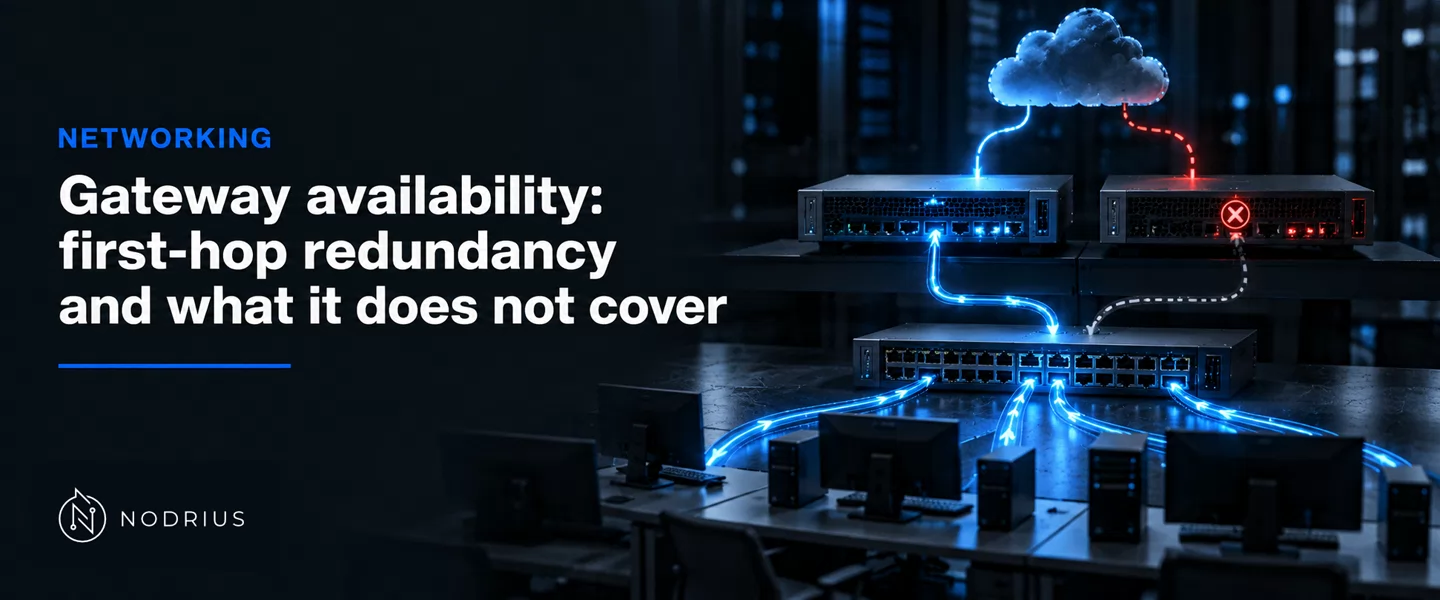
An end host that does not route keeps one next hop for everything off its own link, and nothing tells it quickly when that hop stops forwarding: router discovery is deliberately slow, which “can result in a significant delay in the detection of an unreachable router” (rfc9568.txt lines 248–251). Losing such a router “results in a catastrophic event, isolating all end-hosts that are unable to detect an available alternate path” (lines 253–259). First-hop redundancy answers with one identity held by several routers.
One identity, several routers
A Virtual Router is an abstract object that “acts as a default router for hosts on a shared LAN”, defined by a Virtual Router Identifier (VRID, 1–255) and a set of IPv4 or IPv6 addresses (rfc9568.txt lines 336–346); its scope is one LAN (line 513). Two or more routers carry that identity; the host is configured with the virtual address.
        host: default gateway = the virtual address
                        |
        +---------------+---------------+
        |                               |
   Router A                        Router B
   ACTIVE                          BACKUP
   answers ARP/ND                  answers nothing
   forwards everything             watches the Active
        |                               |
        +----- Router A fails ----------+
                        |
                        v
        Router B becomes Active: same address, same MAC,
        and no change of any kind on the host
The link-layer address matters as much: the Active router answers ARP for the virtual address with the virtual MAC, never with its own. “This allows the host to always use the same MAC address, regardless of the current Active Router” (lines 1448–1449). VRRP derives that MAC from the VRID — 00-00-5E-00-01-{VRID} for IPv4, 00-00-5E-00-02-{VRID} for IPv6 (lines 1389, 1397).
The standard in force: VRRP version 3
RFC 9568 is the current specification, Standards Track, April 2024. It obsoletes RFC 5798, “which previously specified VRRP (version 3)”, and RFC 5798 “obsoleted RFC 3768, which specified VRRP (version 2) for IPv4” (rfc9568.txt lines 16–19); RFC 3768 had obsoleted RFC 2338 (rfc3768.txt line 9). Version 2 called it the Master (rfc3768.txt lines 32–34); version 3 calls it the Active Router, with Backup Routers “available to assume forwarding responsibility” if it fails (lines 381–392).
Only the Active Router “sends periodic VRRP Advertisement messages” (lines 524–525). Priority decides the election — 255 for the router that owns the address, 1–254 for backups, 100 by default (lines 829–835) — the interval defaults to one second (lines 857–859), and a Backup declares the Active down after three missed intervals plus a priority-based skew (lines 967–972). A returning higher-priority router does not seize the address unless preemption is enabled (lines 525–527).
The vendor implementation that came first
Cisco’s HSRP came before the standard, and RFC 9568 still describes its own function as “similar to the proprietary protocols Hot Standby Router Protocol (HSRP) … and IP Standby Protocol” (rfc9568.txt lines 169–171). Cisco documents the same picture: routers that “share an IP address and a MAC (Layer 2) address” (cisco-hsrp.md line 151), one Active forwarding while a Standby waits (line 177), a preempt delay so a returning router settles first (line 230), and the MAC block 0000.0c07.ac** (line 190). HSRP is proprietary: everything beyond that shape is the platform’s business, not the standard’s.
Redundancy is not load balancing
A pair of routers gives one Active forwarder and one idle Backup: while nothing is broken, half the hardware does nothing. Availability is a design requirement, not a bonus: NIST’s enterprise-network guide lists “availability, security, and operational visibility/control” among the capabilities a network architecture has to add (nist-sp800-215.txt line 1434). The design goals allow “multiple Virtual Routers on a network for load-balancing” (rfc9568.txt line 418), while “the details of load-balancing are out of scope of this document” (lines 698–699).
What first-hop redundancy does not cover
- Session state. Nothing carries a flow across the change: “HSRP provides stateless redundancy for IP routing. HSRP by itself can maintain only its own state” (
cisco-hsrp.mdline 376). - The path beyond the first hop. The Active router forwards “based on the local Routing Information Base (RIB) / Forwarding Information Base (FIB)” (
rfc9568.txtlines 374–376), and routers on one subnet may “not have identical connectivity to the rest of the network” (cisco-hsrp.mdline 463). - A failure the election cannot see. Advertisements arrive over the LAN, so a router whose uplink is dead but whose advertisements still arrive stays Active. Making priority follow another interface is a platform feature, not a protocol rule: it “allows you to specify another interface on the router for the HSRP process to monitor in order to alter the HSRP priority” (
cisco-hsrp.mdline 238). - Two forwards at once. Equal priorities can produce simultaneous Active Routers, so they must differ by enough (
rfc9568.txtlines 1587–1591); version 3 adds no authentication (line 1663), because the earlier schemes did not stop a misconfigured or hostile router from creating them (lines 1666–1672).
Where it meets routing, and what IPv6 changes
VRRP is not a routing protocol: it chooses which device owns a virtual address and MAC, and everything after that is ordinary forwarding against that device’s own table (rfc9568.txt lines 374–376). For IPv6, Neighbor Discovery is too slow to be the failover mechanism — “it can take a host more than 10 seconds to learn that a router is unreachable before it will switch to another default router” (lines 293–295) — whereas a Backup Router takes over “in around three seconds (using VRRP default parameters)” (lines 308–310).
Level and prerequisites
L4 — architecture. It assumes the L1 and L2 sheets that own the on-link decision, the gateway hand-off and the default gateway; none of that is restated here. Failure detection, and whether two failures are independent, belong to the sibling sheet on resilience, convergence and failure domains.
Where to go next
References
- RFC 9568 — A. Lindem, A. Dogra, Virtual Router Redundancy Protocol (VRRP) Version 3 for IPv4 and IPv6, IETF, Standards Track, April 2024. Obsoletes RFC 5798. https://www.rfc-editor.org/rfc/rfc9568.txt (local copy
rfc9568.txt). - RFC 3768 — R. Hinden, Ed., Virtual Router Redundancy Protocol (VRRP), IETF, Standards Track, April 2004. Superseded: obsoleted by RFC 5798, itself obsoleted by RFC 9568; read here only as the version 2 text it once was. https://www.rfc-editor.org/rfc/rfc3768.txt (local copy
rfc3768.txt). - RFC 5798 — S. Nadas, Ed., Virtual Router Redundancy Protocol (VRRP) Version 3 for IPv4 and IPv6, IETF, March 2010. Listed for the obsolescence chain only, not read in this session. https://www.rfc-editor.org/info/rfc5798 (address taken from the reference list of RFC 9568).
- RFC 2281 — T. Li, B. Cole, P. Morton, D. Li, Cisco Hot Standby Router Protocol (HSRP), March 1998. Listed by RFC 9568 as the HSRP reference, not read in this session. https://www.rfc-editor.org/info/rfc2281 (address taken from the reference list of RFC 9568).
- Cisco Systems, Understand the Hot Standby Router Protocol Features and Functionality, Document ID 9234, updated 13 September 2023. Vendor documentation. https://www.cisco.com/c/en/us/support/docs/ip/hot-standby-router-protocol-hsrp/9234-hsrpguidetoc.html (local copy
cisco-hsrp.md). - NIST SP 800-215 — R. Chandramouli, Guide to a Secure Enterprise Network Landscape, November 2022. https://doi.org/10.6028/NIST.SP.800-215 (local copy
nist-sp800-215.txt).