
Multicast and QoS: the two places they earn their complexity
Group delivery and traffic treatment pay off only where a link or a fan-out is saturated.
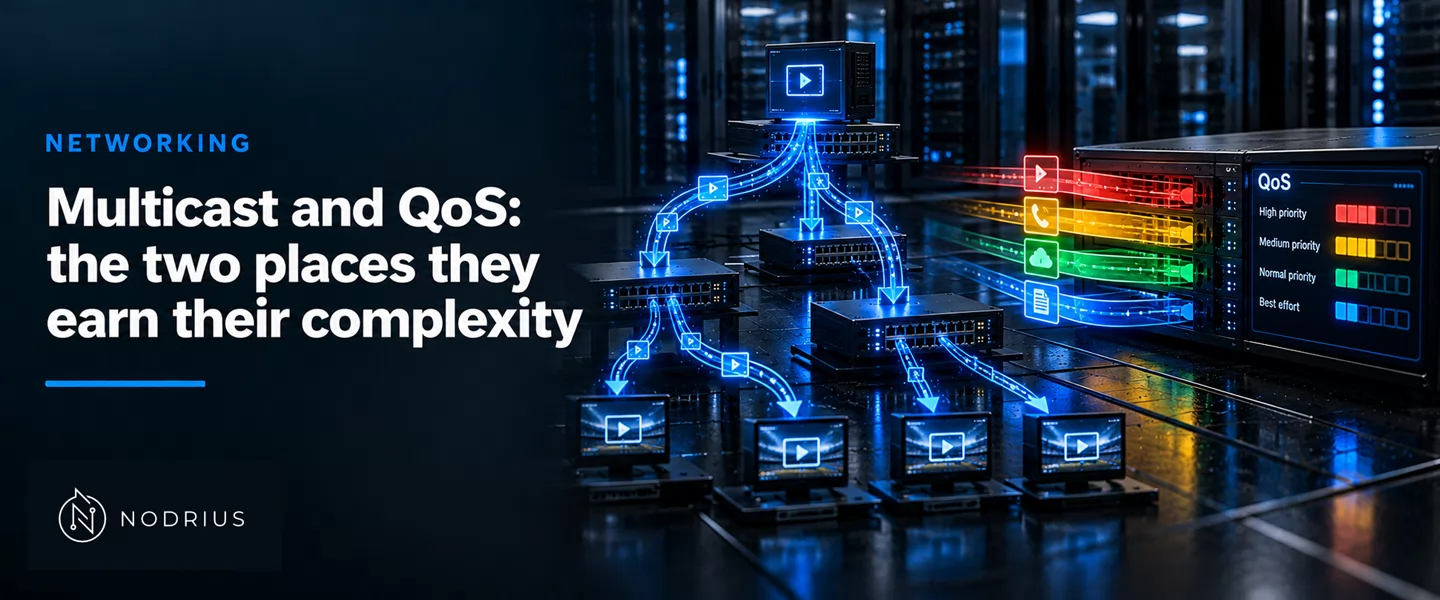
Two mechanisms do more work than most networks ask of them. Multicast replaces many copies of one stream with a single copy the network itself replicates; quality of service (QoS) decides which packets a congested link serves first and which it drops last. Both are optional, and each earns its complexity only where a resource is under pressure.
The question both mechanisms answer
one resource is asked for more than it can deliver
        |
        +-- the same content to many receivers -----> multicast
        |       one copy, replicated inside the network
        |
        +-- different traffic on one congested link -> quality of service
                a queue, a mark, a per-hop decision
Without either tool, a network forwards every packet on its destination address alone: multicast turns that address into a group, and QoS decides how a packet is treated once a queue forms.
Multicast: one address, a group of receivers
Multicast starts with the address. IP multicasting addresses a datagram to a host group, “a set of zero or more hosts identified by a single IP destination address”, and host groups “are identified by class D IP addresses” (RFC 1112, rfc1112.txt lines 23–26, 121–123). Membership is dynamic: “hosts may join and leave groups at any time”, and “A host need not be a member of a group to send datagrams to it.” (lines 31–35).
On a link, membership is carried by the Internet Group Management Protocol (IGMP), “the protocol used by IPv4 systems to report their IP multicast group memberships to neighboring multicast routers”; a router learns only that a group has a listener, not which host (RFC 3376, lines 36–38). Version 3 of IGMP adds support for “source filtering” (lines 38–40).
Forwarding is where multicast first costs. A switch that does not read those reports floods the group: packets “will be flooded into network segments where no node has any interest in receiving the packet”, and “significant bandwidth can be wasted by flooding” (RFC 4541, lines 63–69). A snooping switch forwards only where a listener asked, “conserving bandwidth on those segments of the network where no node has expressed interest”, instead of forwarding “on all interfaces” (lines 81–85).
Multicast routing: the shared tree, and the way off it
PIM Sparse Mode (PIM-SM) “builds unidirectional shared trees rooted at a Rendezvous Point (RP) per group, and it optionally creates shortest-path trees per source” (RFC 7761, lines 31–33). A receiver’s join walks to the RP and forms “the shared tree because it is shared by all sources sending to that group” (lines 421–424); because that path can detour, a router may transfer to a source-specific shortest-path tree (SPT) joining the source directly (lines 519–524). Source-specific multicast (SSM) drops the rendezvous machinery: with a known source (S,G) is a “channel” (RFC 4607, line 175), and shared trees and Rendezvous Points “are not necessary to support the source-specific model” (lines 190–193).
Where multicast earns its cost, and where it does not
Multicast pays when one stream must reach many receivers: live video, telemetry to many sites, signalling that fans out. It does not pay when receivers are few and unknown, or when the content is already cached near each viewer by an application-level delivery network — then group state and a routing protocol are cost without benefit.
QoS: a queue, a mark, and a per-hop decision
QoS starts with a queue: when offered load exceeds a link’s rate, packets wait and the router must choose what to serve first and what to drop. Marking makes that choice systematic through one field. The DS field “is intended to supersede the existing definitions of the IPv4 TOS octet [RFC791] and the IPv6 Traffic Class octet [IPv6]”, and “Six bits of the DS field are used as a codepoint (DSCP) to select the PHB a packet experiences at each node” (RFC 2474, lines 367–372). A per-hop behaviour (PHB) is “the externally observable forwarding behavior applied at a DS-compliant node to a DS behavior aggregate” — the treatment given to packets sharing a codepoint (RFC 2475, lines 311–313).
Two PHB families carry most deployments. Assured Forwarding (AF) delivers packets “in four independently forwarded AF classes”, each with three drop precedences, so under congestion “the drop precedence of a packet determines the relative importance of the packet within the AF class” (RFC 2597, lines 36–39, 80–81). Expedited Forwarding (EF) is “a building block for low delay, low jitter and low loss services by ensuring that the EF aggregate is served at a certain configured rate” (RFC 3246, lines 45–48), with codepoint 101110 recommended (line 502). RFC 4594 defines “twelve different service classes”; administrators implement a subset, with “no intrinsic requirement that particular DSCPs, traffic conditioners, PHBs, and AQM be used for a certain service class” (lines 150–166).
Where QoS earns its cost, and what it honestly cannot do
Marking and conditioning belong at the edge: “Sophisticated classification, marking, policing, and shaping operations need only be implemented at network boundaries or hosts” (RFC 2475, lines 41–43); interior nodes only read the codepoint. A service level agreement is a contract for a stated forwarding service, and differentiated services cross a domain boundary only by such an agreement: where none exists, the next domain may reset the marking to the default (RFC 2475, lines 354–357, 737–739, 1560–1562). QoS also does not create bandwidth: it apportions a node’s existing buffer and bandwidth between aggregates (RFC 2475, lines 1038–1039), reordering a queue and picking what to drop once a link is full; on a lightly loaded link the same effort buys more capacity instead (RFC 4594, lines 197–201). Explicit Congestion Notification (ECN) marks a packet instead of dropping it, and helps only if the transport reacts (RFC 3168, lines 312–313, 325–329). QoS pays on a genuinely constrained link carrying traffic with different needs — voice beside bulk data, or across domains bound by a contract.
Level and prerequisites
L4 — advanced. Prerequisites: the IP address model and prefixes, routing as a next-hop decision, and what a switch does with an unlearned frame. No configuration experience is required.
Where to go next
- Knowledge
- Networking
- Network routing
- Related published sheets: unicast, broadcast and multicast (L1) owns the group concept; VLANs and 802.1Q tagging (L2) owns the link priority tag.
References
- RFC 1112 — Host Extensions for IP Multicasting (Standards Track; host group, class D addresses, IGMP router state).
- RFC 3376 — Internet Group Management Protocol, Version 3 (Standards Track; membership reports, source filtering).
- RFC 4541 — Considerations for IGMP and MLD Snooping Switches (Informational; flooding and snooping).
- RFC 4607 — Source-Specific Multicast for IP (Standards Track; channel, no shared tree or rendezvous point).
- RFC 7761 — Protocol Independent Multicast — Sparse Mode (PIM-SM) (Standards Track; RP, shared tree, shortest-path tree).
- RFC 2474 — Definition of the Differentiated Services Field (DS Field) (Standards Track; DS field and DSCP).
- RFC 2475 — An Architecture for Differentiated Services (Informational; per-hop behaviour, conditioning, boundary policy).
- RFC 2597 — Assured Forwarding PHB Group (Standards Track; four classes, three drop precedences).
- RFC 3246 — An Expedited Forwarding PHB (Standards Track; EF, codepoint 101110).
- RFC 4594 — Configuration Guidelines for DiffServ Service Classes (Informational; service classes as policy).
- RFC 3168 — The Addition of Explicit Congestion Notification (ECN) to IP (Standards Track; two-bit ECN field, CE marking).