
SDN: what actually moves when control is centralised
Centralising control moves the decision, not the packet, and buys reach as well as risk.
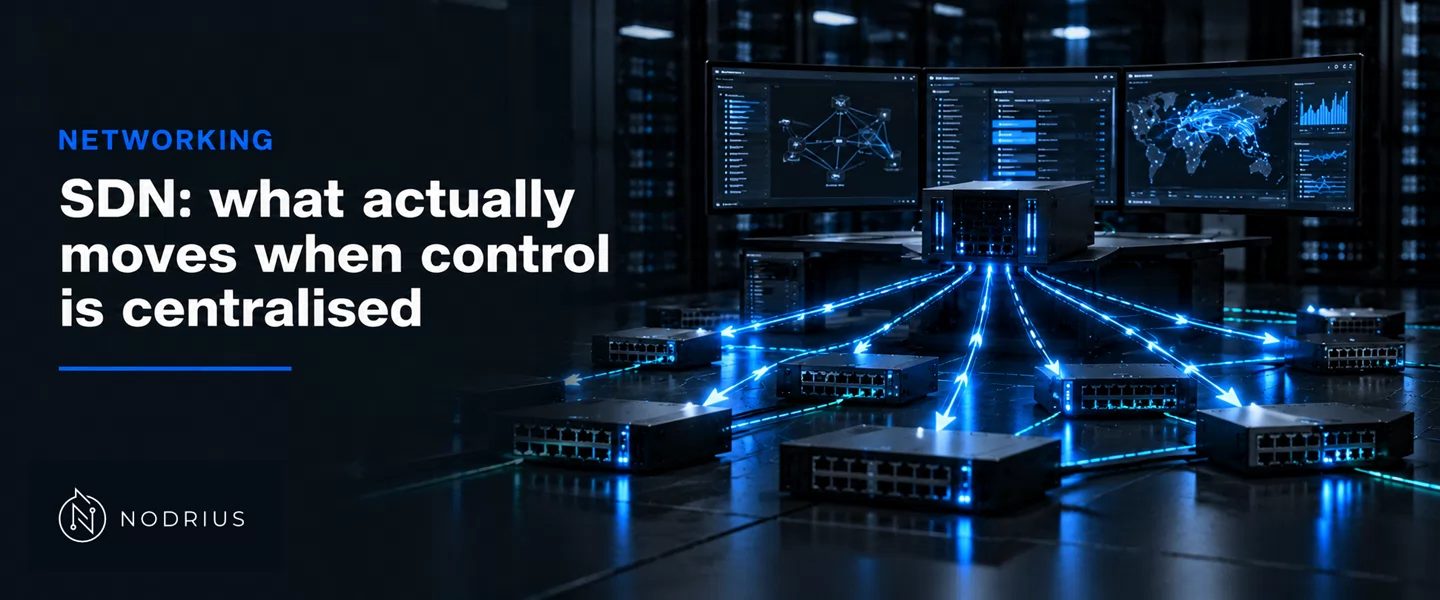
Software-defined networking (SDN) is usually described as a movement of control, but the honest version is narrower. When the control and forwarding planes are separated — a separation the IETF notes most routers have assumed for decades — what moves is the decision: where the path, the policy and the forwarding rule are worked out, not where the packet is forwarded. “Centralised” then names a claim about how many views and policy sources exist, not about one box. This sheet asks what a controller is, which interfaces carry its work, what centralising the decision buys, and what it costs when it is down.
What the separation actually separates
The architecture the IETF publishes for SDN defines it as “A programmable networks approach that supports the separation of control and forwarding planes via standardized interfaces” (rfc7426.txt lines 271–273). Three parts follow: an application plane, a control plane and a forwarding plane. The forwarding plane does what the next packet needs now; the control plane exists to “fine-tune the forwarding tables that reside in the forwarding plane” (lines 524–526). The split itself is old; the novelty is a control plane whose instructions arrive over a standardised interface from outside the device.
        +---------------------------------------+
        |            application plane          |  orchestration, policy, apps
        +---------------------------------------+
                          |  northbound interface (APIs)
        +---------------------------------------+
        |              control plane            |  decides: path, policy, rules
        +---------------------------------------+
                          |  southbound interface
                          |  (OpenFlow, NETCONF, RESTCONF, gNMI)
        +---------------------------------------+
        |             forwarding plane          |  forwards the packet
        +---------------------------------------+
What “centralised” is a claim about
Centralised control is often read as one controller box; the useful reading is one view and one policy source. SDN “is based on the concept of separation between a controlled entity and a controller entity”, and “The controller manipulates the controlled entity via an interface” (rfc7426.txt lines 368–370). In policy terms the controller decides and the devices apply — a Policy Decision Point (PDP) with one or more Policy Enforcement Points (PEPs) (rfc7149.txt lines 369, 376). A “centralized SDN controller acts as a consistent global database” (rfc7426.txt lines 944–945) of topology, reachability and policy; that shared view is what “one” means.
The interfaces carry the work
Two directions matter. Southbound is the controller-to-device interface. OpenFlow — an industry specification from the Open Networking Foundation, not an IETF standard — sits on that path, where the controller adds, updates and deletes flow entries “both reactively (in response to packets) and proactively” (openflow-spec-1.3.0.txt lines 362–363); the IETF architecture names it as “a protocol through which a logically centralized controller can control an OpenFlow switch” (rfc7426.txt lines 1146–1148). The model-driven alternative carries intent, not flow entries: the Network Configuration Protocol (NETCONF) “provides mechanisms to install, manipulate, and delete the configuration of network devices” (rfc6241.txt lines 23–24) with a candidate datastore that “can be manipulated without impacting the device’s current configuration” (lines 349–352); RESTCONF is an HTTP interface to the same data modelled in YANG (rfc8040.txt lines 20–23); and gNMI, OpenConfig’s project specification, is a gRPC protocol “for the modification and retrieval of configuration from a target device” (gnmi-specification.md lines 86–89). Northbound is the application programming interface (API) that orchestration tools call (lines 1035–1036 of the same architecture).
What centralising the decision buys
Coherence, speed and visibility. One view means a policy is computed once against the whole topology rather than negotiated device by device; one interface means a change is applied consistently instead of re-derived per platform; the same view feeds assurance. The framing is modest: exposing programmable interfaces “is not a goal per se” but “a means to facilitate configuration procedures for improved flexibility” (rfc7149.txt lines 257–259).
What it costs
The costs are concrete. A controller is a failure domain: “SDN designs that assume a central decision-making entity must avoid single points of failure” (rfc7149.txt lines 415–416). Connectivity is the sharp edge: the basic model does not answer what a device does when it cannot reach its controller, and until the connection returns the affected flows are unavailable (rfc7426.txt lines 946–950). Spreading control across instances buys partition tolerance only “at the cost of loss of absolute consistency” (lines 960–961), and the interface becomes a security perimeter that must be authenticated and encrypted. The controller also speaks the vendor’s models: where a model is incomplete, a platform-specific extension reappears, so implementations still “accommodate vendor-specific components” (rfc7149.txt lines 483–484).
Why the real thing is rarely one controller
OpenFlow is one candidate, not the definition: there is “no 1:1 relationship between OpenFlow and SDN”, and OpenFlow is “one possible component of the global SDN toolkit” (rfc7149.txt lines 520, 522–523). A single network-wide deployment is “very unlikely”; multiple instantiations are adapted to individual segments (line 492). Centralised policy therefore rides on model-driven configuration, and where a protocol already exists it can carry the controller’s intent: large data-centre designs use the Border Gateway Protocol (BGP) “as the only routing protocol” (rfc7938.txt lines 25–26) while a controller injects routes over the same protocol. What stays local is what must survive alone — the underlay “should remain operational even if connection with the PDP has been lost” (rfc7149.txt lines 743–744). That is the real price: the risk of “depending on a controller technology rather than a device technology” (lines 917–918).
Level and prerequisites
L5 — specialist design and trade-off. It assumes the L2 and L3 routing vocabulary (routing table, next hop, dynamic routing) and the L4 sheet on traffic engineering, which owns the Path Computation Element and centralised path computation and is only named here. It stays above configuration: no vendor syntax or platform default is given.
Where to go next
References
- RFC 7426 — Software-Defined Networking (SDN): Layers and Architecture Terminology (Haleplidis, Pentikousis, Denazis, Salim, Meyer, Koufopavlou; Informational; January 2015) — the SDN definition (lines 271–273); the control plane’s role (lines 320–322, 524–526); the controlled/controller separation (lines 368–370); the northbound service abstraction layer (lines 1035–1036); consistency and partition tolerance (lines 944–945, 946–950, 960–961); the control-versus-management interface distinction (lines 737–738, 815–816); OpenFlow and NETCONF as SDN interfaces (lines 216–217, 1135–1136, 1146–1148).
- RFC 7149 — Software-Defined Networking: A Perspective from within a Service Provider Environment (Boucadair, Jacquenet; Informational; March 2014) — the “gimmick” observation (lines 194–196); the tentative SDN definition (lines 263–265); policy-based management and PDP/PEP (lines 369, 376, 383–384); single points of failure (lines 415–416); fully centralised control as a non-goal (lines 544–545, 545–547, 547–549); no 1:1 relationship with OpenFlow (lines 520, 522–523); one network-wide deployment unlikely (line 492); survival of the underlay (lines 743–744); the risk of a controller technology (lines 917–918); vendor-specific components (lines 483–484); programmable interfaces not a goal in themselves (lines 257–259).
- RFC 6241 — Network Configuration Protocol (NETCONF) (Enns, Bjorklund, Schoenwaelder, Bierman; Standards Track; June 2011) — the protocol’s purpose (lines 23–24); the candidate configuration datastore (lines 349–352); capability discovery (lines 311–312).
- RFC 8040 — RESTCONF Protocol (Bierman, Bjorklund, Watsen; Standards Track; January 2017) — an HTTP interface to YANG data (lines 20–23); the schema-driven API (lines 625–626).
- RFC 7938 — Use of BGP for Routing in Large-Scale Data Centers (Lapukhov, Premji, Mitchell; Informational; August 2016) — BGP as the only routing protocol (lines 25–26); distributed control-plane failures (lines 252–253).
- OpenFlow Switch Specification, Version 1.3.0 (ONF TS-006; 25 June 2012) — industry specification, not an IETF standard — the switch/controller split and the OpenFlow channel (lines 358–359, 1282, 1287–1288); reactive and proactive flow entries (lines 362–363); connection interruption and the fail modes (lines 1489–1490, 1493–1494, 1497).
- gNMI Specification (gRPC Network Management Interface), Version 0.10.0 (OpenConfig; 25 May 2023) — project documentation, not a standard — gRPC configuration and telemetry (
gnmi-specification.mdlines 86–89).