
Drift: the distance between what you declared and what is running
Three states, not two: measuring how far a network drifted from what you declared.
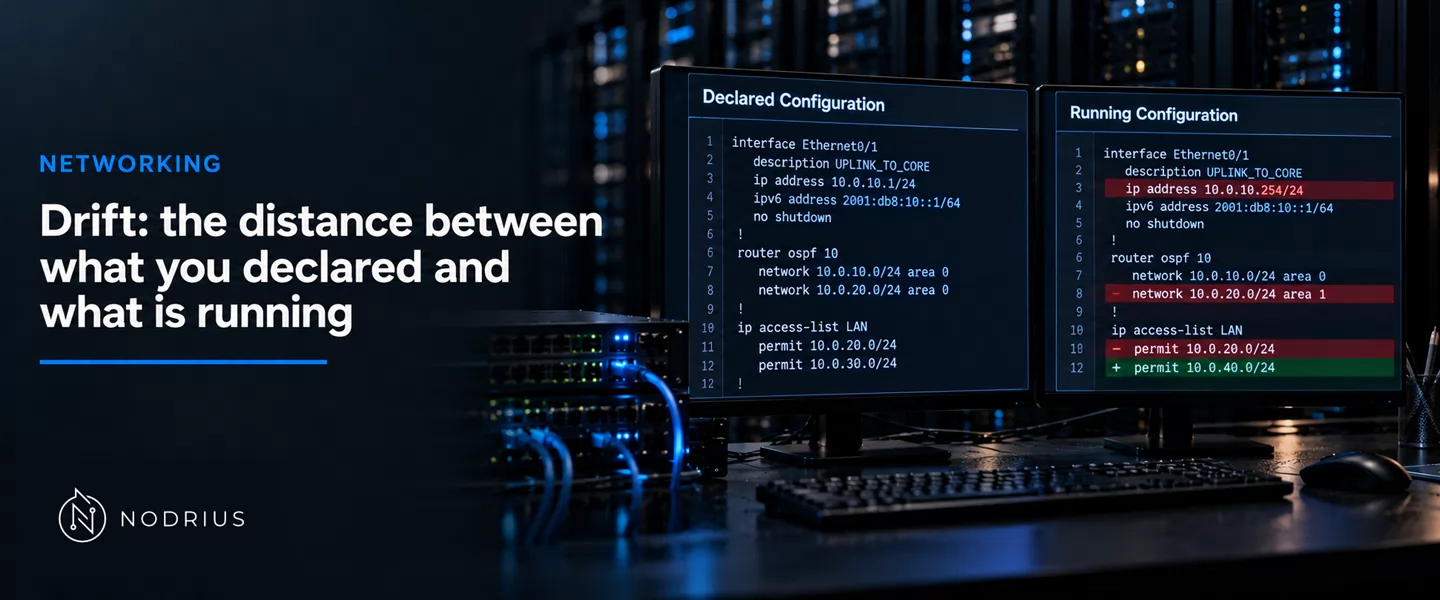
Configuration drift is the distance between the configuration the organisation declared it would run and the configuration the devices are actually running. Nothing has to break for drift to exist: a device can be reachable, passing traffic and running a configuration nobody intended. Detecting drift is not a question of whether the network is up but an evidence question of whether it is still what you said it was. This sheet separates the three states and shows how to measure the distance with what the network already runs.
Three states, not two
Declared intent is what the source of truth declares: the template and variables saying this interface carries these addresses and this VLAN. Rendered configuration is what automation produces, which can differ from intent when a template has a bug or a variable resolves unexpectedly. Device state is what the device holds, unless someone edited it. Drift is any divergence among the three, including a legitimate change never recorded. Its unit is the configuration item, “an identifiable part of a system” that is “a discrete target of configuration control processes” (NIST SP 800-128 lines 863–865).
  declared intent          rendered configuration      device state
 (source of truth:       (what the automation       (what the device
  template +              produced from it)          is running now)
  variables)                    \                        /
                                 \                      /
                            compare on a schedule
                                     │
                       the difference is the drift — any
                       divergence, including a legitimate
                       change that was never recorded
Where the distance comes from
Drift is ordinary: a device repaired by hand under pressure whose fix never reaches the source; a second tool or console writing a setting the automation does not manage; an emergency change applied before it is recorded; a software update that changes a default the configuration relied on. NIST SP 800-128: monitoring finds “undiscovered/undocumented system components, misconfigurations, vulnerabilities, and unauthorized changes” (lines 1099–1100). The vocabulary is exact: undocumented and unauthorized are different failures, and recording “of deviations from the baseline configuration” is what tooling should help produce (lines 1103–1104). Who may authorise a deviation belongs to Cybersecurity Governance.
Finding it with what the network already has
The comparison needs three ingredients the network usually has. The first says how the configuration should look: the versioned source — in an inventory-driven tool, the inventory that “defines the managed nodes you automate and the variables associated with those hosts” plus its templates (Ansible inventory documentation, line 21). The second is a way to read the device: periodic polling, a model-driven read of a named subtree, or the command-line session a collector uses. The third is a schedule that reports the difference against the source — a diff, “the exact lines added and removed”, as the Git book puts it for a working tree against its snapshot (line 583).
On-change is a capability, not a given
Polling costs what the standard names: it “incurs significant latency”, cycles “may be missed”, and places “unwanted and ultimately wasteful load on the network” (RFC 8641 lines 178–195). The documented alternative pushes updates instead: a receiver asks for “automatic and continuous updates from a targeted subset of a datastore” (lines 200–202), and an on-change subscription is one “with updates that are triggered when changes in subscribed datastore nodes are detected” (lines 249–251). RFC 8639 defines the model, RFC 8650 the transport. It is a capability, not universal: on-change “may not be supported by all implementations or for every object” (lines 408–409), and a dampening period exists because a rapid series of changes “has the potential to exhaust resources” (lines 328–330).
The device keeps its own record
Detection also has a source on the device: its accounting log — the telemetry mechanisms the sibling L3 sheets fix (the syslog event log, the SNMP metric, the flow record, the packet capture), whose limits carry over: a record shows what was reported, never what happened if nothing reported it. The device that drifted may be the one whose log would explain it, so the record belongs somewhere it cannot rewrite.
Detecting is not reconciling
An alert is not a correction. A comparison produces a difference; deciding it is wrong and putting the device back is a change in its own right, needing a decision and a record. Who may reconcile, and under whose authority, is the process the Cybersecurity Governance sheet on change management and change approval holds: the change record and the approval that authorises it. Detection answers “what is different”; reconciliation answers “and now what” — different owners.
What a comparison is worth
Two decisions decide if a comparison is a control. The first is what enters it: the fields worth defending, with the deliberately exempted ones — a counter, an uptime, a timestamp — named as exemptions rather than left to noise. The second is signal-to-noise: a differential that always shows two hundred lines is not a control but a report nobody reads. The honest limit is coverage, not the tool: no comparison sees a device the collection never reaches or a subtree the read never asks for, and coverage is a claim about a population — the subject of the Cybersecurity Governance sheet on inventory coverage and completeness.
Level and prerequisites
L5 — specialised automation and operations. It assumes the L3 telemetry sheets that fix the mechanisms of an event log, a metric, a flow record and a capture; the sheets owning the versioned source, the template and the inventory; and the vocabulary of the configuration item and baseline. This sheet owns the detection, not the reconciliation.
Where to go next
References
- NIST — Guide for Security-Focused Configuration Management of Information Systems, SP 800-128 (August 2011) — https://doi.org/10.6028/NIST.SP.800-128 — the configuration item and baseline definitions, and the monitoring that identifies undocumented and unauthorized change.
- RFC 8641 — Subscription to YANG Notifications for Datastore Updates (September 2019, Standards Track) — the cost of polling, the datastore subscription model, the on-change and periodic triggers, dampening, sync-on-start and the update record.
- RFC 8639 — Subscription to YANG Notifications (September 2019, Standards Track) — the YANG data model and the “subscribe, then publish” subscription mechanism.
- RFC 8650 — Dynamic Subscription to YANG Events and Datastores over RESTCONF (November 2019, Standards Track) — the RESTCONF transport binding for dynamic subscriptions.
- Git — Recording Changes to the Repository, in Pro Git, 2nd Edition (project documentation, git-scm.com) — the tracked/untracked file states and the diff as “the exact lines added and removed”.
- Ansible — How to build your inventory (project documentation, docs.ansible.com) — the inventory as the declaration of the managed nodes and their variables.