
Validate, then roll back: what a change needs before and after
A change needs proof it can apply, proof it is in use, and a prepared way back.
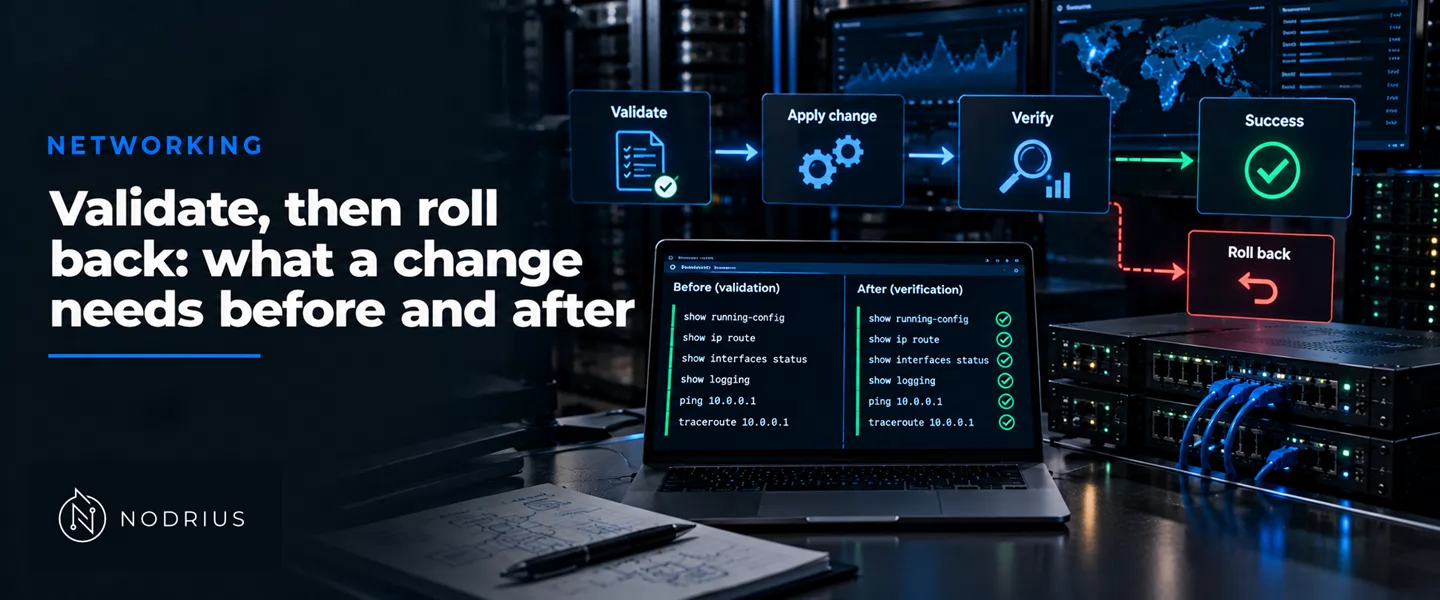
A configuration change is a transaction with three states: what a device runs now, what you intend, and the ability to return to the first. A device can accept every command you send and still not do what you meant: the reply reports whether the request was applied, not whether the outcome exists. Validation before proves the change can apply; validation after proves it is in use; a route back, prepared first, makes the attempt survivable. Approval and the record are Cybersecurity Governance.
A change has three states, and success is not one of them
Platforms model those states as datastores. In NETCONF the running datastore holds the complete configuration currently active on the device (rfc6241.txt lines 385–387), while a candidate datastore can be manipulated without impacting the device’s current configuration and that can be committed to the running configuration datastore (rfc6241.txt lines 349–353). The datastore architecture adds the state the older model hid: the intended configuration represents the configuration after all configuration transformations to <running> are performed, and is what the system attempts to apply (rfc8342.txt lines 713–717). Three names for three things: what you wrote, what the system set out to apply, and what is actually in use.
   state before              the change                state after
   ------------              ----------                -----------
   the configuration    -->  validate: can it    -->   validate: is it
   the device runs           apply here?               actually in use?
        |                          |                         |
        |                          v                         v
        |                    apply / commit            read what the device
        |                          |                   reports as in use
        v                          v                         |
   a copy kept       <----  roll back if not  <----  confirm or revert
   and a way back           confirmed in time
Validation before: prove the change can be applied
Validation before answers one question: given the device as it is, can this change be applied? Record the state you are about to leave, because the baseline has been formally reviewed and agreed on at a given point in time (nist-sp800-128.txt lines 1253–1256). Then test against the device, not your intention: where a model exists, checking a complete configuration for syntactical and semantic errors before applying is a protocol operation, failing on syntax errors, missing parameters, references to undefined configuration data (rfc6241.txt lines 3483–3485, 3545–3548). The configuration tooling adds a rehearsal — check mode reports the changes it would have made without applying them — but a rehearsal shows what the tool would send, not how the device behaves once live (Ansible playbooks documentation, lines 100–110).
Prepare the way back before you need it
Design the rollback first; after a failure it is a second change under pressure. Where a candidate datastore exists, the cheapest route back is not to commit: discarding changes reverts the contents of the candidate configuration to the contents of the running configuration (rfc6241.txt lines 2998–3000), and commit is all-or-nothing. If the device is unable to commit all of the changes in the candidate configuration datastore, then the running configuration MUST remain unchanged (rfc6241.txt lines 3036–3038). A confirmed commit is reverted if a confirming commit is not issued within the timeout period, and if the session is lost the server MUST restore the configuration to its state before the confirmed commit was issued (rfc6241.txt lines 3168–3170, 3199–3203). Without such a datastore, the route back is the previous approved baseline, retained for rollback (nist-sp800-128.txt lines 1267–1268) — which is why the sibling sheet’s versioned configuration is the material of a rollback, not archiving.
One device, one segment, in a defined order
Scope the attempt: change one device or one segment, verify it, then widen. A change that touches a whole dependent set at once removes the untouched part you would compare against, and the order of operations decides whether the intermediate state is survivable. The change-control sequence is the same one the technical steps come from: identified, proposed, reviewed, analyzed for security impact, tested, and approved prior to implementation (nist-sp800-128.txt lines 1086–1088). This sheet keeps the technical half — tested before, verified after.
Validation after: the outcome must exist
Validation after is the spine. Run the same checks you ran before, then observe the new behaviour rather than trust the report of it. The datastore architecture supplies the standard’s own test: a client can determine to what extent the intended configuration is currently in use by checking to see whether the contents of <intended> also appear in <operational> (rfc8342.txt lines 737–740). The read is available over the same interface — <get-data> retrieves data from a specific NMDA datastore (rfc8526.txt lines 219–220) — and change control asks the same question after the fact, that the changes have been implemented as approved (nist-sp800-128.txt lines 1306–1309).
What cannot be rewound
Rollback restores a configuration; it does not restore everything the change touched. A removed item remains part of the applied configuration for a period of time after it has been removed from the intended configuration — the standard’s remnant configuration (rfc8342.txt lines 359–361). State the configuration never owned is not in the copy either: an adjacency that dropped and reconverged, a session that closed, a value overwritten with no earlier copy taken. And time is not recoverable — a change applied and reverted is not a change never made, because traffic was affected while it stood. Whether a rollback really restores service is the resilience sheet’s subject, not this one.
Level and prerequisites
L5 — operational automation. It assumes the model-driven interface and its capabilities (the device-API sheet), the rehearsal and idempotency model of the configuration tooling (the Ansible sheet), and the versioned configuration that supplies the route back (the versioning sheet). Approval and the change record are Cybersecurity Governance.
Where to go next
References
- RFC 6241 — NETCONF Configuration Protocol (R. Enns, M. Bjorklund, J. Schoenwaelder, A. Bierman, Eds., June 2011, Standards Track; obsoletes RFC 4741) — the running and candidate datastores (lines 349–353, 385–387), the validate capability (lines 3479–3498, 3545–3548), commit and discard-changes (lines 2997–3040), the confirmed commit and its timeout (lines 3158–3229), and rollback-on-error (lines 3397–3443).
- RFC 8342 — Network Management Datastore Architecture (NMDA) (M. Bjorklund, J. Schoenwaelder, P. Shafer, K. Watsen, R. Wilton, March 2018, Standards Track; updates RFC 7950) — the datastore definitions (lines 260–294), the running, candidate, intended and operational datastores (lines 650–807), the intended-versus-operational test (lines 737–740) and remnant configuration (lines 359–365).
- RFC 8526 — NETCONF Extensions to Support the Network Management Datastore Architecture (M. Bjorklund, J. Schoenwaelder, P. Shafer, March 2019, Standards Track; updates RFC 6241, RFC 7950) — the
<get-data>operation reading any NMDA datastore (lines 210–260). - NIST — Guide for Security-Focused Configuration Management of Information Systems (SP 800-128, August 2011), https://doi.org/10.6028/NIST.SP.800-128 — the baseline configuration definition (lines 1253–1256); the retention of older baselines for rollback (lines 1267–1268); the change sequence tested and approved before implementation (lines 1086–1088); the after-the-fact security impact analysis (lines 1306–1309).
- Ansible — Ansible playbooks, Ansible Community Documentation (project documentation, extract read 8 October 2026) — check mode without applying alterations and the report it returns (lines 100–110); idempotency (line 90); the validation flags
--check,--diff,--list-hosts,--list-tasks,--syntax-check(line 124). - Netmiko — README (project documentation, extract read 8 October 2026) — the two purposes of network automation, gathering output from show commands and making configuration changes (line 23).