
Link aggregation and LACP: making several links look like one
How link aggregation bundles parallel links into one logical interface, what LACP negotiates before the bundle is used, and why one flow still moves at one link speed.
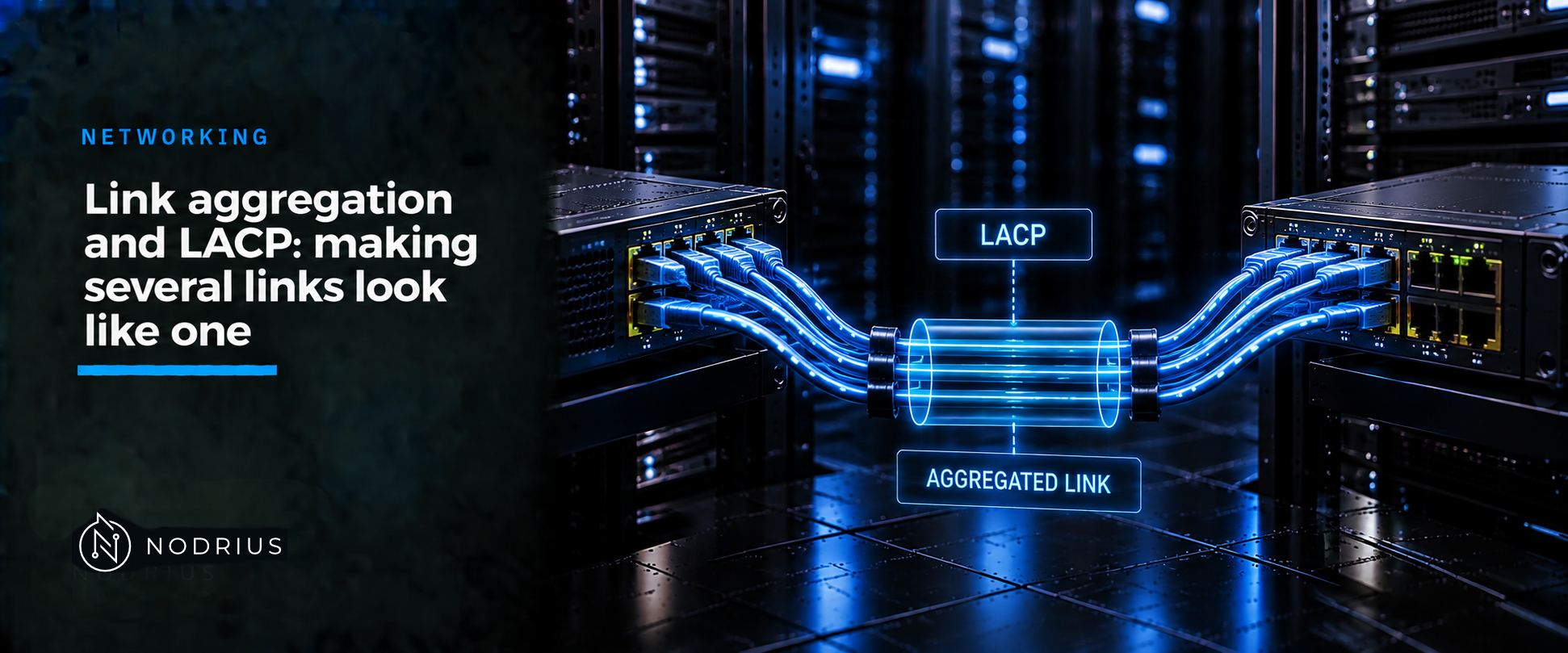
Link aggregation bundles several physical Ethernet links into one logical link, so the rest of the network sees a single interface instead of parallel cables. It recovers capacity and adds resilience, but it does not make one conversation faster. LACP (Link Aggregation Control Protocol) is the protocol that lets both ends confirm the bundle is valid before they put traffic on it.
The mental model: one logical link, many wires
Treat the bundle as one pipe with several strands. The aggregate has its own identity — generically a Link Aggregation Group (LAG), on Cisco a port-channel interface — and addressing, VLAN membership and spanning tree apply to the aggregate, not to the individual members. Spanning tree therefore sees one logical port, so it does not block the second member as a loop. Every member is a full-duplex point-to-point link running at the same data rate as its peers.
        SW1                                     SW2
  ┌──────────────┐                        ┌──────────────┐
  │ port-channel │  Gi1/0/1 ════════════  │ port-channel │
  │      1       │  Gi1/0/2 ════════════  │      1       │
  │  one logical │  Gi1/0/3 ════════════  │  one logical │
  │   interface  │  Gi1/0/4 ════════════  │   interface  │
  └──────────────┘                        └──────────────┘

  4 physical links          ──►          1 logical link
  one MAC address · one spanning-tree port · one routing endpoint
  LACP control frames are exchanged on every member
Terminology: how practitioners name it
Link aggregation is the standards term; the aggregate is a Link Aggregation Group (LAG). Cisco calls the feature EtherChannel and the logical interface port-channel. LACP is the negotiation protocol of IEEE link aggregation, introduced by Cisco documentation as “defined under the IEEE 802.3ad standard”; the current standard is titled Link Aggregation (IEEE 802.1AX-2020). PAgP (Port Aggregation Protocol) is the Cisco-proprietary alternative and interoperates only with Cisco. A bundle configured with no negotiation at all runs in on mode.
How a bundle forms, step by step
- Create the logical port-channel interface and put addressing, trunking and VLAN membership on it.
- Assign each physical interface to the channel group with a mode. In LACP active mode the port starts the negotiation; in passive mode it only answers.
- The two ends exchange LACP frames carrying each system’s identity and port priorities. A port joins the bundle only when the peer’s parameters are compatible.
- Compatibility is strict: members must share speed and duplex, the same access VLAN or trunking, and the same allowed-VLAN list and native VLAN; a matching MTU is commonly required too [FACT TO VERIFY]. A port that does not match is suspended rather than bundled.
- The aggregate is then presented to the rest of the network as one interface — one MAC address, one spanning-tree port, one routing endpoint. Spanning-tree cost and VLAN pruning are configured on the port-channel.
- For each frame the switch hashes the selected address or port fields and forwards it over one member. The hash is deterministic, so every frame of the same flow follows the same member, which keeps frames in order.
A worked example (Cisco IOS-XE)
The reference platform for the syntax below is Cisco IOS-XE; the concepts are portable, the syntax is not. Configure the logical interface first, then the members:
!
interface Port-channel1
 description Uplink to access switch
 switchport mode trunk
!
interface range GigabitEthernet1/0/1 - 4
 switchport mode trunk
 channel-group 1 mode active
!
LACP parameters worth knowing before you change them: lacp system-priority sets the end’s system priority, which with the system ID decides which device controls the bundle; lacp port-priority makes a member more or less likely to be bundled (lower value wins); lacp max-bundle caps the active members; and port-channel min-links keeps the bundle down until enough members are up. channel-protocol lacp restricts a channel group to LACP. Verification is read-only: show etherchannel summary lists the channel groups and each member’s state — bundled, suspended or hot-standby — while show etherchannel load-balance reports the active hashing method, and show lacp neighbor and show lacp internal expose the negotiated peer and local parameters. Confirm the exact legend and field names on the target platform and release. [TECHNICAL TEST NEEDED]
Limiting factors and the common error
The most common misconception is that four gigabit links give a single transfer four gigabits. They do not. The hash pins one flow — one source/destination pair, and depending on the method one port pair — to one member, so a single large transfer still moves at one link’s speed. Aggregation adds capacity across many flows and adds redundancy; it does not add per-flow speed.
The second trap is treating missing negotiation as convenience. On mode skips LACP: it comes up quickly but cannot detect a member that is misconfigured or that reached the wrong device, and Cisco documentation warns that a misconfigured on group can cause packet loss or spanning-tree loops. Prefer active on both ends — passive on both ends never forms a bundle, because neither end starts negotiation.
Two operational facts follow. If a member fails, the surviving members carry the load, so the bundle keeps running at reduced bandwidth. And the load-balancing method is a global setting: changing it recomputes the hash and, on the platforms Cisco documents, can interrupt traffic for seconds to minutes, so schedule it outside production hours. Removing a member or shutting the port-channel interface disturbs the whole bundle — treat member changes as planned work.
Level and prerequisites
L2 — operational. The concept and LACP mechanism are explained here; the Cisco IOS-XE configuration is the practical part. Prerequisite: the L1 sheets on Ethernet frames and MAC tables and on the TCP/IP packet journey, so the “one logical interface” idea is clear before configuration. No prior configuration experience is assumed.
Where to go next
- Networking — the area this sheet belongs to.
References
- IEEE 802.1AX-2020 — Standard for Local and Metropolitan Area Networks — Link Aggregation (abstract; full text paywalled).
- Cisco — Etherchannels, Catalyst 9000 Layer 2 Forwarding configuration guide (Cisco IOS-XE).
- Cisco — Layer 2/3 command reference, Catalyst 9500, Cisco IOS-XE 16.6 (
channel-group,channel-protocol,interface port-channel,lacp max-bundle,lacp port-priority). - Cisco — Understand EtherChannel Load Balance and Redundancy on Catalyst Switches (Document ID 12023).